10-K: Annual report [Section 13 and 15(d), not S-K Item 405]
Published on March 12, 2026
UNITED STATES
SECURITIES AND EXCHANGE COMMISSION
Washington, D.C. 20549
FORM
(Mark One)
ANNUAL REPORT PURSUANT TO SECTION 13 OR 15(d) OF THE SECURITIES EXCHANGE ACT OF 1934 |
For the fiscal year ended
OR
TRANSITION REPORT PURSUANT TO SECTION 13 OR 15(d) OF THE SECURITIES EXCHANGE ACT OF 1934 |
for the transition period from ___ to ___.
Commission file number:

(Exact name of registrant as specified in its charter)
|
||
(State or other jurisdiction of incorporation or organization) |
|
(I.R.S. Employer Identification No.) |
(Address of principal executive offices, including zip code)
Registrant’s telephone number, including area code: (
Securities registered pursuant to Section 12(b) of the Act:
Title of Each Class |
|
Trading Symbol |
|
Name of Each Exchange on Which Registered |
|
|
Securities registered pursuant to Section 12(g) of the Act:
None
(Title of class)
Indicate by check mark if the registrant is a well-known seasoned issuer, as defined in Rule 405 of the Securities Act.
Indicate by check mark if the registrant is not required to file reports pursuant to Section 13 or Section 15(d) of the Exchange Act. Yes ☐
Indicate by check mark whether the registrant (1) has filed all reports required to be filed by Section 13 or 15(d) of the Securities Exchange Act of 1934 during the preceding 12 months (or for such shorter period that the registrant was required to file such reports), and (2) has been subject to such filing requirements for the past 90 days.
Indicate by check mark whether the registrant has submitted electronically every Interactive Data File required to be submitted pursuant to Rule 405 of Regulation S-T (§232.405 of this chapter) during the preceding 12 months (or for such shorter period that the registrant was required to submit such files).
Indicate by check mark whether the registrant is a large accelerated filer, an accelerated filer, a non-accelerated filer, a smaller reporting company, or an emerging growth company. See the definitions of “large accelerated filer,” “accelerated filer,” “smaller reporting company,” and “emerging growth company” in Rule 12b-2 of the Exchange Act.
☒ |
Accelerated filer |
☐ |
|
Non-accelerated filer |
☐ |
Smaller reporting company |
|
|
|
Emerging growth company |
If an emerging growth company, indicate by check mark if the registrant has elected not to use the extended transition period for complying with any new or revised financial accounting standards provided pursuant to Section 13(a) of the Exchange Act. ☐
Indicate by check mark whether the registrant has filed a report on and attestation to its management’s assessment of the effectiveness of its internal control over financial reporting under Section 404(b) of the Sarbanes-Oxley Act (15 U.S.C. 7262(b)) by the registered public accounting firm that prepared or issued its audit report.
If securities are registered pursuant to Section 12(b) of the Act, indicate by check mark whether the financial statements of the registrant included in the filing reflect the correction of an error to previously issued financial statements.
Indicate by check mark whether any of those error corrections are restatements that required a recovery analysis of incentive-based compensation received by any of the registrant’s executive officers during the relevant recovery period pursuant to §240.10D-1(b).☐
Indicate by check mark whether the registrant is a shell company (as defined in Rule 12b-2 of the Act). ☐ Yes
The aggregate market value of common stock held by non-affiliates of the registrant, as of June 30, 2025, the last day of the registrant’s most recently completed second fiscal quarter, was approximately $
As of March 5, 2026, there were
DOCUMENTS INCORPORATED BY REFERENCE
Portions of the registrant’s definitive Proxy Statement for the 2026 annual meeting of the stockholders of the registrant are incorporated herein by reference in Part III of this Annual Report on Form 10-K to the extent stated herein. Such Proxy Statement will be filed with the Securities and Exchange Commission (the “SEC”) within 120 days of the registrant’s fiscal year ended December 31, 2025.
Astrana Health, Inc.
Form 10-K
Fiscal Year Ended December 31, 2025
Table of Contents
2
Glossary
The following abbreviations or acronyms that may be used in this document shall have the adjacent meanings set forth below:
AAMG |
All-American Medical Group |
ACO REACH |
ACO Realizing Equity, Access, and Community Health |
ADSC |
Advanced Diagnostic and Surgical Center, Inc. |
AHMC |
AHMC Healthcare Inc. |
AHMS |
Advanced Health Management Systems, L.P. |
AHM |
Astrana Health Management, Inc. (f/k/a Network Medical Management Inc.) |
APC |
Allied Physicians of California, a Professional Medical Corporation |
APC-LSMA |
APC-LSMA Designated Shareholder Medical Corporation |
Astrana |
Astrana Health Inc. (f/k/a Apollo Medical Holdings, Inc.) |
Astrana Medical |
Astrana Health Medical Corporation (f/k/a AP-AMH Medical Corporation) |
Astrana Care Partners Medical |
Astrana Care Partners Medical Corporation (f/k/a AP-AMH 2 Medical Corporation) |
CAIPA MSO |
CAIPA MSO, LLC |
CFC |
Community Family Care Medical Group IPA, Inc. |
CHS |
Collaborative Health Systems, LLC, Golden Triangle Physician Alliance, and Heritage Physician Networks |
CMS |
Centers for Medicare & Medicaid Services |
DMHC |
California Department of Managed Health Care |
HSMSO |
Health Source MSO Inc., a California corporation |
IPA |
Independent Practice Association |
LMA |
LaSalle Medical Associates |
MSSP |
Medicare Shared Savings Program |
PCCCV |
Primary Community Care of Central Valley, Inc. |
Prospect |
Certain businesses and assets of Prospect Medical Holdings, Inc. acquired by the Company |
PMIOC |
Pacific Medical Imaging and Oncology Center, Inc. |
Sun Labs |
Sun Clinical Laboratories, a California corporation |
VIE |
Variable Interest Entity |
3
INTRODUCTORY NOTE
Unless the context dictates otherwise, references in this Annual Report on Form 10-K to the “Company,” “we,” “us,” “our,” and similar words are references to Astrana Health, Inc., a Delaware corporation (“Astrana” or “Astrana Health”), and its consolidated subsidiaries and affiliated entities, as appropriate, including its consolidated variable interest entities (“VIEs”).
The following discussion and analysis provide information that management believes is relevant to an assessment and understanding of our results of operations and financial performance. This discussion should be read in conjunction with the consolidated financial statements and notes thereto appearing elsewhere herein, and with our prior filings with the Securities and Exchange Commission (the “SEC”).
This Form 10-K includes market data and certain other statistical information and estimates based on reports and other publications from industry analysts, market research firms, and other independent sources, as well as management’s own good faith estimates and analyses. Astrana believes these third-party reports to be reputable, but has not independently verified the underlying data sources, methodologies, or assumptions. The reports and other publications referenced are generally available to the public and were not commissioned by Astrana. Information based on estimates, forecasts, projections, market research, or similar methodologies is inherently subject to uncertainties, and actual events or circumstances may differ materially from events and circumstances reflected in this information.
The Centers for Medicare & Medicaid Services (“CMS”) has not reviewed any statements contained in this Report, including statements describing the Company’s participation in the ACO Realizing Equity, Access, and Community Health Model (“ACO REACH Model”), in the Medicare Shared Savings Program (“MSSP”), and in the ACO Long-term Enhanced ACO Design Model (“ACO LEAD Model”).
Trade names and trademarks of Astrana and its subsidiaries referred to herein, and their respective logos, are our property. This Annual Report on Form 10-K may contain additional trade names and/or trademarks of other companies, which are the property of their respective owners. We do not intend our use or display of other companies’ trade names and/or trademarks, if any, to imply an endorsement or sponsorship of us by such companies, or any relationship with any of these companies.
4
NOTE ABOUT FORWARD-LOOKING STATEMENTS
This Annual Report on Form 10-K contains “forward-looking statements” within the meaning of the Private Securities Litigation Reform Act of 1995, Section 27A of the Securities Act of 1933, as amended (the “Securities Act”), and Section 21E of the Securities Exchange Act of 1934, as amended (the “Exchange Act”). All statements other than statements of historical fact are “forward-looking statements” for purposes of federal and state securities laws, including, but not limited to, any statements about our business, financial condition, operating results, plans, objectives, expectations, and intentions; any projections of earnings, revenue, earnings before interest, taxes, depreciation, and amortization (“EBITDA”), Adjusted EBITDA, adjusted EPS - diluted, free cash flow, or other financial items, such as our projected capitation from CMS, any forward-looking guidance and our future liquidity; any statements of any plans, strategies, and objectives of management for future operations, such as the material opportunities that we believe exist for our Company; any statements concerning proposed services, developments, mergers, acquisitions, or dispositions; any statements relating to our completed Prospect acquisition; any statements with respect to dividends or stock repurchases and timing, methods, and payment of same; any statements regarding the outlook of the ACO LEAD Model, ACO REACH Model, the MSSP or strategic transactions; any statements relating to delayed payments under, or potential cuts to, Medicaid and/or Medicaid programs and/or changes in federal or state funding policies; any statements regarding management’s view of future expectations and prospects for us; any statements about prospective adoption of new accounting standards or effects of changes in accounting standards; any statements regarding our ability to remediate the material weakness in our internal control over financial reporting and maintain effective internal control over financial reporting and disclosure controls and procedures; any statements regarding potential changes to our tax structure; any statements regarding future economic conditions or performance; any statements relating to the potential impact of cybersecurity breaches or disruptions to our management information systems or widespread outages, interruptions, or other failures of operational, communication, and other systems; any statements of belief; any statements of assumptions underlying any of the foregoing; and other statements that are not historical facts. Forward-looking statements may be identified by the use of forward-looking terms, such as “anticipate,” “could,” “can,” “may,” “might,” “potential,” “predict,” “should,” “estimate,” “expect,” “project,” “believe,” “think,” “plan,” “envision,” “intend,” “continue,” “target,” “seek,” “contemplate,” “budgeted,” “will,” or “would,” and the negative of such terms, other variations on such terms or other similar or comparable words, phrases, or terminology.
Forward-looking statements involve risks and uncertainties, many of which are difficult to predict and are outside of our control, and are based on the current beliefs, expectations, and certain assumptions of management. Some or all of such beliefs, expectations, and assumptions may not materialize or may vary significantly from actual results. Such statements are qualified by important economic, competitive, governmental, and technological factors that could cause our business, strategy, or actual results or events to differ materially from those in our forward-looking statements. Factors that might cause or contribute to such differences include, but are not limited to, those discussed in this Annual Report on Form 10-K, including the risk factors discussed under the heading “Risk Factors” in Part I, Item 1A below. Although we believe the expectations reflected in our forward-looking statements are reasonable, actual results could differ materially from those projected or assumed in any of our forward-looking statements. Our future financial condition and results of operations, as well as any forward-looking statements, are subject to change. Significant risks and uncertainties could cause actual conditions, outcomes, and results to differ materially from those indicated by such statements. Any forward-looking statement made by the Company in this Form 10-K speaks only as of the date it is made. The Company undertakes no obligation to publicly update any forward-looking statement, whether as a result of new information, future developments or otherwise, except as may be required by any applicable securities laws.
5
PART I
Item 1. Business
Overview
Astrana is a leading physician-centric, technology-powered, risk-bearing healthcare company. Leveraging its proprietary end-to-end technology solutions, Astrana operates an integrated healthcare delivery platform that enables providers to successfully participate in value-based care arrangements, thus empowering them to deliver accessible, high-quality care to patients in a cost-effective manner. We, together with our affiliated physician groups and consolidated subsidiaries and VIEs, provide coordinated outcome-based care, serving patients covered by private or public insurance provided through Medicare, Medicaid, and health maintenance organizations (“HMOs”), with a small portion of our revenue coming from non-insured patients. We provide care coordination services to each major constituent of the healthcare delivery system, including patients, families, primary care physicians, specialists, acute care hospitals, alternative sites of inpatient care, physician groups, and health plans. Our physician network consists of primary care physicians, specialist physicians, physician and specialist extenders, and hospitalists. Astrana’s common stock is listed on The Nasdaq Stock Market LLC (“Nasdaq”) and trades under the symbol “ASTH.”
Led by a leadership team with several decades of experience, we have built a company and culture focused on physicians providing high-quality medical care, population health management, and patient care coordination. Through our integrated health network of more than 20,000 contracted physicians, we were responsible for coordinating value-based care for approximately 1.6 million patients as of December 31, 2025. As a result, we believe we are well-positioned to capitalize on the shift in the U.S. healthcare industry toward value-based and results-oriented healthcare, with a focus on patient satisfaction, high-quality care, and cost efficiency. We implement and operate different innovative healthcare models, primarily including the following three reportable segments:
Care Partners
Our Care Partners segment is focused on building and managing high-quality and high-performance provider networks by partnering with, empowering, and investing in strong provider partners aligned on a shared vision for coordinated care delivery. Astrana meets providers where they are and enables independent providers to remain independent while succeeding in value-based care. Astrana acts as a “single payer” for our network of providers, enabling value-based care arrangements, including hospital shared-risk contracts. By leveraging our unique Care Enablement platform and ability to recruit, empower, and incentivize physicians to manage total cost of care effectively, we are able to organize partnered providers into successful multi-payer risk-bearing organizations that take on varying levels of risk, based on total cost of care across membership in all lines of business, including Medicare fee for service (“FFS”), Medicare Advantage, Medicaid, Commercial, and Exchange. These organizations make up our Care Partners segment, which consists of a network of risk-bearing organizations (“RBOs”) that encompass independent practice associations (“IPAs”), accountable care organizations (“ACOs”), and state-specific entities such as Restricted Knox-Keene licensed health plans (sometimes referred to as “RKKs”) in California. Through this network, our healthcare delivery entities are tasked with coordinating and providing high-quality care to patients within Astrana’s ecosystem. This helps ensure seamless continuity of care among patients in different age groups, stages of life, and life circumstances.
6
An IPA is an association of independent physicians, or other organization that contracts with independent physicians. IPAs contract with HMOs, which are medical insurance groups that generally offer health care coverage to enrollees for a fixed annual fee, on a negotiated per capita rate, flat retainer fee, or negotiated FFS basis. Our affiliated IPAs comprise a network of independent providers, including primary care physicians, specialists, and other providers, who collectively care for patients. Our IPAs contract with various HMOs and other licensed healthcare service plans—such as Restricted Knox-Keene licensed health plans, as defined in the California Knox-Keene Health Care Service Plan Act of 1975, as amended (the “Knox-Keene Act”), to provide physician services to their enrollees, typically under capitated arrangements. Each HMO negotiates a fixed amount per member per month (“PMPM”) that is to be paid to our IPAs. In return, the IPAs arrange for the delivery of healthcare services by contracting with physicians or professional medical corporations for primary care, specialty care, and other ancillary services. Our IPAs assume the financial risk of the cost of delivering certain healthcare services in excess of the fixed amounts received from health plans. Some of the risk is transferred to the contracted physicians or professional corporations and some is subject to stop-loss provisions in the contracts with the HMOs. With our owned RKKs in California, we can assume full financial responsibility, including both professional and institutional risk, for the medical costs of our members under the plans, which allows our Care Partners to manage a full spectrum of care.
An ACO is an organization that participates in one or more payment and delivery models sponsored by the Centers for Medicare & Medicaid Services (“CMS”) that provide high-quality and affordable care to Medicare FFS patients. The CMS programs allow provider groups to assume financial risk and potentially achieve a higher reward from participation in the respective program’s attribution-based risk-sharing model. For the year ended December 31, 2025, the Company’s ACOs participated in the ACO REACH Model and the Medicare Shared Savings Program (“MSSP”).
Care Delivery
Our Care Delivery segment is a patient-centric, data-driven organization focused on delivering high-quality and accessible care, serving approximately 1.6 million patients annually. As medical care has been increasingly delivered in clinic settings, many integrated health networks also operate healthcare facilities primarily focused on the diagnosis and/or care of outpatients, including those with chronic conditions such as heart disease and diabetes, to meet the primary healthcare needs of local communities. Our Care Delivery organization spans over 60 locations and includes:
We evaluate our Care Partners network based on specialty and geographic location, and then strategically engage in efforts to build or acquire practices and provider groups to address any gaps. This ensures that patients have access to high-quality care. Our ability to establish Care Delivery organizations tailored to specific markets enables us to scale effectively as we enter into new markets.
Care Enablement
Our Care Enablement segment represents a comprehensive platform that integrates clinical, operational, financial, and administrative information, all powered by our proprietary technology suite. Our Care Enablement tools are leveraged across our Care Partners and Care Delivery lines of business as well as third-party providers outside of our Astrana ecosystem. Our Care Enablement segment provides solutions to payers and providers, including independent physicians, providers, and medical groups, as well as ACOs. The Company’s platform meets providers and payers wherever they are on the spectrum of total cost of care, offering solutions for FFS entities and to providers open to taking upside and downside risks on professional and institutional spending, and across all patient types, including Medicare, Medicaid, Commercial, and Exchange-insured patients. This segment includes the Company’s wholly owned subsidiaries that operate as management services organizations (“MSOs”),
7
to provide non-medical services under long-term management and/or administrative services agreements (“MSAs”) with RBOs and other providers. By leveraging our Care Enablement platform, providers and payers can improve their ability to deliver high-quality care to their patients and achieve better patient, clinical, and financial outcomes.
Population health management (“PHM”) seeks to improve health outcomes by monitoring and identifying individual patients, aggregating data, and providing a comprehensive clinical picture of each patient. PHM is a central trend within healthcare delivery, which includes the aggregation of patient data across multiple health information technology resources, the analysis of that data into a single, actionable patient record, and the actions through which care providers can improve both clinical and financial outcomes. When combined with effective care coordination, data-driven approaches can better connect patients to providers and resources, resulting in streamlined care delivery, improved clinical outcomes, and lower costs. A successful PHM platform requires a robust care and risk management infrastructure, a cohesive delivery system, and a well-managed partnership network.
Under established MSAs, our MSOs have authority over various non-medical decisions related to ongoing business operations and provide services that include, but are not limited to:
Integrated Health Network
An integrated health network that is able to pool a large number of patients, such as the Company and its affiliated physician groups, is positioned to take advantage of industry trends, meet patient and government demands, and benefit from cost advantages resulting from its scale of operation and integrated approach of care delivery. In addition, an integrated health network with years of managed care experience can leverage its expertise and sizeable medical data to identify specific treatment strategies and interventions, improve the quality of medical care, and lower costs. Many integrated health networks, including the Company and its affiliated physician groups, have also established physician performance metrics that allow them to monitor quality and service outcomes achieved by participating providers, to reward efficient, high-quality care delivered to members, and to initiate improvement efforts for providers whose performance can be enhanced.
Our RBOs, with more than 20,000 contracted healthcare providers, have agreements with various health plans, hospitals, and other HMOs, pursuant to which we were responsible for coordinating the care of approximately 1.6 million patients, as of December 31, 2025. These covered patients are comprised of managed care members whose health coverage is provided either through their employers, acquired directly from a health plan, or as a result of their eligibility for Medicaid or Medicare benefits. Our managed patients benefit from an integrated approach that places physicians at the center of patient care and utilizes sophisticated risk management techniques and clinical protocols to provide high-quality, cost-effective care. To implement a patient-centered, physician-centric experience, we also have other integrated and synergistic operations, including (i) MSOs that
8
provide management and other administrative services to our Care Partners segment, (ii) primary care clinics, (iii) multi-specialty care clinics and medical groups, and (iv) ancillary service providers.
Human Capital
As of December 31, 2025, Astrana, its subsidiaries, and consolidated VIEs had approximately 3,000 employees. None of our employees are members of a labor union, and we have not experienced any work stoppage.
We are committed to supporting the professional development of our employees, providing competitive compensation and benefits and a safe and inclusive workplace that enables employees to achieve their full potential. We measure employee engagement on an ongoing basis to create a more innovative, productive, and profitable company. Results from engagement surveys are used to implement programs and processes designed to support employee retention and satisfaction. The Company believes a workplace that promotes fairness and opportunity fosters innovation and cultivates an environment filled with unique perspectives and growth. Respect for human rights is fundamental to the Company’s business and its commitment to ethical business conduct.
Our dedication to employee growth is reflected in the various learning and development programs offered at Astrana. We have internal learning and development programs as well as a professional development reimbursement program, to empower employees to enhance their skill sets and provide opportunities for advancement within the Company. Our learning and development programs include a comprehensive portfolio of enterprise programs designed to strengthen leadership capabilities, improve operational performance, and support organizational integration across the Company. We further expanded employee development by creating educational newsletters and enhancing compliance and system-training pathways. These efforts advanced workforce readiness, supported smoother transitions during organizational changes, and reinforced our commitment to developing talent that drives long-term growth.
We actively promote and support employees who seek to donate their time, talents, and resources to make a positive impact on their communities and charitable causes. In 2025, Astrana contributed to several charitable organizations, including Susan G. Komen and Eisner Health, and Astrana employees participated in volunteer efforts with the Los Angeles Dream Center and Los Angeles Mission.
Organization
We operate through our wholly owned subsidiaries and their consolidated entities, including consolidated VIEs. Our wholly owned subsidiaries include MSOs, ACOs, RKKs, and a hospital. Our MSOs operate within our Care Enablement segment and are in the business of providing management services. Our ACOs operate within our Care Partners segment and participate in CMS programs. Our RKKs operate within our Care Partners segment and allow us to assume both institutional and professional risk in providing medical services to members. Our hospital, operating within the Care Delivery segment, is consolidated and wholly owned by us. Our other consolidated VIEs include IPAs operating within our Care Partners segment, and the clinics and ancillary service providers operating within our Care Delivery segment. We consolidate a VIE if we have both power and benefits—that is, (i) we have the power to direct the activities of a VIE that most significantly influence the VIE’s economic performance, and (ii) we have the obligation to absorb losses of, or the right to receive benefits from, the VIE that could potentially be significant to the VIE.
Some states have laws that prohibit the corporate practice of medicine. In such states, the IPA must be owned by a licensed physician or physicians. Business entities with non-physician owners, such as Astrana and its subsidiaries, are prevented from practicing medicine, employing physicians to practice medicine, or exercising control over medical decisions by physicians. These laws are generally referred to as the corporate practice of medicine laws. States with corporate practice of medicine laws permit only physicians to practice medicine, exercise control over medical decisions, or engage in certain arrangements with physicians, such as fee-splitting.
9
Due to these laws, the Company maintains long-term MSAs with our affiliated IPAs and medical groups, each of which is owned and operated by physicians only and employs or contracts with additional physicians to provide medical services to the patients. Astrana Health Management, Inc. (“AHM”), a wholly owned subsidiary of the Company, has entered into MSAs with several affiliated IPAs, including Allied Physicians of California, a Professional Medical Corporation, d.b.a. Allied Pacific of California IPA (“APC”). APC arranges for the delivery of healthcare services by contracting with physicians or professional medical corporations for primary care and specialty care services and assumes the financial risk of the cost of delivery of these healthcare services. The physicians in the IPA are exclusively in control of, and responsible for, all aspects of the practice of medicine for enrolled patients. In accordance with relevant accounting guidance, APC has been determined to be a VIE of AHM, as AHM is its primary beneficiary with the ability, through majority representation on the APC Joint Planning Board and otherwise, to direct the activities (excluding clinical decisions) that most significantly affect APC’s economic performance. Therefore, APC and its wholly owned subsidiaries and VIEs are consolidated in the accompanying financial statements.
Certain state laws prohibit a professional corporation that has more than one shareholder from serving as a shareholder in another professional corporation. As a result, the Company cannot directly own shares in another professional corporation. However, an exception to such regulations permits a professional corporation that has only one shareholder to own shares in another professional corporation. In reliance on this exception, the Company has designated certain key personnel as the nominee shareholder of professional corporations that hold controlling and non-controlling ownership interests in several medical corporations. Via a Physician Shareholder Agreement with the nominee shareholder, the Company has the ability to designate another person as the equity holder of the professional corporation. In addition, these entities are managed by our wholly owned MSOs via MSAs. In accordance with relevant accounting guidance, the Company consolidates the professional corporations and their consolidated medical corporations in the accompanying financial statements.
See Note 18 — “Variable Interest Entities (VIEs)” to our consolidated financial statements under Item 8 in this Annual Report on Form 10-K for information on our entities that qualify as consolidated VIEs.
Investments
We have invested in several entities in the healthcare industry. Our equity method investments range from 25.0% to 51.0% equity interest in entities that operate similarly to our Care Partners, Care Delivery and Care Enablement segments. These investments are accounted for under the equity method as the Company has the ability to exercise significant influence, but not control, over operations. Our investments in privately held entities consist of investments ranging from 2.8% to 10.0% and include a Simple Agreement for Future Equity (“SAFE”) that, upon certain triggering events, grants the Company has rights to equity.
Certain businesses and assets of Prospect Medical Holdings, Inc. (collectively, “Prospect”) (such acquisition, the “Prospect Acquisition”)
On July 1, 2025, we completed the previously announced Prospect acquisition for a purchase price of $674.9 million. Prospect is a physician-centric risk-bearing healthcare company that operates an integrated healthcare delivery platform enabling a network of over 11,000 providers to successfully participate in value-based care arrangements and empowering them to deliver accessible, high-quality care to patients in a cost-effective manner. Prospect enables providers to deliver payer-agnostic, patient-centered care across different lines of business. Prospect also operates a California Restricted Knox-Keene-licensed health plan, an MSO, a specialty pharmacy, and a fully-accredited acute care hospital. The acquisition significantly expanded our provider network and enhanced our ability to offer increased access, quality, and value to our members.
10
Our Industry
Industry Overview
U.S. healthcare spending has increased steadily over the past two decades. CMS estimates that total U.S. healthcare expenditures are expected to grow at an average annual rate of 5.8% from 2024 to 2033, and will reach $8.6 trillion by 2033. Health spending is projected to grow 1.5% faster than the U.S. gross domestic product per year on average over 2024–2033, and as a result, the healthcare share of gross domestic product is expected to grow from 17.6% in 2023 to 20.3% in 2033. Medicare spending increased by 7.8% to $1.1 trillion, and Medicaid spending increased by 6.6% to $931.7 billion in 2024, which accounted for 21% and 18% of total health expenditures, respectively. Private health insurance spending increased by 8.8% to $1.6 trillion in 2024, accounting for 31% of total health expenditures. Medicare spending is expected to have the fastest growth (7.9% per year for 2024–2033), primarily due to projected enrollment growth.
Managed care health plans were developed in the U.S., primarily during the 1980s to mitigate the rising cost of providing healthcare to populations covered by health insurance. These managed care health plans enroll members through their employers in connection with federal Medicare benefits or state Medicaid programs. As a result of the prevalence of these health plans, many seniors now becoming eligible for Medicare have been interacting with managed care companies through their employers for more than 30 years. Individuals now turning 65 are likely more familiar with the managed care setting than previous Medicare populations. The healthcare industry, however, is highly regulated by various government agencies and heavily relies on reimbursement and payments from government-sponsored programs such as Medicare and Medicaid. Companies in the healthcare industry, therefore, have to organize, operate around, and face challenges from idiosyncratic laws and regulations.
Many health plans recognize both the opportunity for growth from adding members, as well as the potential risks and costs associated with managing additional members. Many health plans subcontract a significant portion of the responsibility for managing patient care to an integrated health network such as Astrana and our affiliated physician groups. These integrated healthcare systems offer a comprehensive medical delivery system, sophisticated care management expertise, and infrastructure to more efficiently provide for the healthcare needs of the population enrolled with that health plan. While reimbursement models for these arrangements vary around the U.S., health plans often prospectively pay the integrated healthcare system a fixed capitation payment, which is frequently based on a percentage of the amount received by the health plan. In the aggregate, capitation payments to integrated healthcare systems represent a prospective budget from which the system manages the care-related expenses on behalf of the population enrolled with that system. To the extent that these systems manage such expenses under the capitated levels, the system realizes an operating profit. On the other hand, if the expenses exceed projected levels, the system will realize an operating deficit. Since premiums paid represent a substantial amount per person, there is a significant revenue opportunity for an integrated health network that can effectively manage healthcare costs for the capitated arrangements entered into by its affiliated physician groups.
Industry Trends and Demand Drivers
We believe that the healthcare industry is undergoing a significant transformation, and the demand for our offerings is driven by the confluence of a number of fundamental healthcare industry trends, including:
Shift to Value-Based and Results-Oriented Models. According to the 2024 National Health Expenditure Historical Data prepared by CMS, healthcare spending in the U.S. increased by 7.2% to $5.3 trillion in 2024, representing 18.0% of the U.S. Gross Domestic Product. CMS projects healthcare spending in the U.S. to increase at an average rate of 5.8% for 2024-2033 and to reach approximately $8.6 trillion by 2033. To address this expected significant rise in healthcare costs, the U.S. healthcare market is seeking more efficient and effective methods of delivering care. The FFS reimbursement model has arguably played a major role in increasing the level and growth rate of healthcare spending. In response, the public and private sectors are shifting away from the FFS reimbursement model toward value-based, capitated payment models designed to incentivize value and quality at an individual patient level.
11
Increasingly Patient-Centered. More patients are becoming actively involved and are taking an informed role in how their healthcare is delivered, resulting in the healthcare marketplace becoming increasingly patient-centered, and thus requiring providers to deliver team-based, coordinated, and accessible care to stay competitive.
Added Complexity. In the healthcare space, more sophisticated technology has been employed, new diagnostics and treatments have been introduced, research and development have expanded, and regulations have multiplied. This expanding complexity drives a growing and continuous need for integrated care delivery systems.
Integration of Healthcare Information and Emphasis on Health Services & Technology Growth. Across the healthcare landscape, a significant amount of data is generated daily, driven by patient care, payment systems, regulatory compliance, and record keeping. As the amount of healthcare data continues to grow, it becomes increasingly important to connect disparate data and apply insights in a targeted manner in order to better achieve the goals of higher quality and more efficient care.
Our Revenue Streams
Our revenue reflected in the accompanying consolidated financial statements includes revenue generated by our subsidiaries and consolidated entities. Our revenue streams are diversified among our various operations, and multi-year renewable contractual arrangements are as follows:
Capitation Revenue
Our capitation revenue consists primarily of capitated fees for medical services we provide under capitated arrangements made directly with various managed care providers, including HMOs. Under the capitated model, an HMO pays the IPA a capitation payment and assigns the IPA the responsibility for providing physician services required by patients. The IPA physicians are exclusively in control of, and responsible for, all aspects of the practice of medicine for enrolled patients. Capitation revenue for our Restricted Knox-Keene licensed health plan consists of “global” capitation arrangements, whereby the Restricted Knox-Keene licensed health plan accepts financial risk for hospital and other institutional services in addition to professional medical services (whereas IPA capitation contracts are typically limited to accepting financial risk for professional medical services). Most HMO agreements have an initial term of two years, renewing automatically for successive one-year terms. The HMO agreements generally allow either party to terminate the HMO agreements without cause, typically with a four to six-month advance notice and provide for a termination for cause by the HMO at any time.
Capitation revenue is typically prepaid to us monthly based on the number of enrollees who select us as their healthcare provider. Capitation is a fixed payment amount per patient per unit of time paid in advance for the delivery of healthcare services, whereby the service providers are generally liable for excess medical costs. The actual amount paid is determined by the range of services provided, the number of patients enrolled, and the period of time during which the services are provided. Capitation rates are generally based on local costs and average service utilization. Additionally, Medicare pays capitation using a “Risk Adjustment” model, which compensates managed care organizations and providers based on the health status (acuity) of each individual enrollee. Health plans and providers with higher acuity enrollees will receive more, and those with lower acuity enrollees will receive less. Under the Risk Adjustment model, capitation is determined based on health severity, which is measured using patient encounter data, and is thus paid on an interim basis based on data submitted for the enrollee for the preceding year and is adjusted in subsequent periods after the final data is compiled.
12
PMPM-managed care contracts generally have a term of one year or longer. All managed care contracts have a single performance obligation that constitutes a series of services for the provision of managed healthcare services for a population of enrolled members for the duration of the contract. The transaction price for PMPM contracts is variable, as it primarily includes PMPM fees associated with unspecified membership that fluctuates throughout the contract term. In certain contracts, PMPM fees also include adjustments for items such as performance incentives, performance guarantees, and risk sharing.
Through our ACOs, we participate in the Global Risk track with Total Care Capitation (“TCC”) in the ACO REACH Model sponsored by CMS. Under the ACO REACH Model, we recruit a group of Participant and Preferred (in-network) Providers. Based on the Participant Providers that join our ACO, CMS grants us a pool of Traditional Medicare patients (beneficiaries) to manage (the “Aligned Beneficiaries”). Our Aligned Beneficiaries will receive services from physicians and other medical service providers that are both in-network and out-of-network. Under TCC, CMS estimates average in-network monthly expenditures for our ACOs’ Aligned Beneficiaries and pays that projected amount to us in monthly installments. We are then responsible for paying our in-network providers for all Medicare-covered services they provided to our Aligned Beneficiaries. In addition, we bear risk on all Medicare expenditures (both in-network and out-of-network), excluding drug expenditures covered by Medicare Part D, based on a budgetary benchmark established with CMS. Claims from out-of-network providers are processed and paid by CMS. Our shared savings or losses in managing our beneficiaries are generally determined annually after reconciliation with CMS. Pursuant to our risk-share agreement with CMS, we are eligible to receive the surplus (shared savings) or are liable for the deficit (shared losses) according to the budgetary benchmark established by CMS based on our efficiency, or lack thereof, in managing the expenditures associated with our Aligned Beneficiaries. Using the most recent CMS data, the Company estimates the potential savings or deficit for the performance year. We also recognize the budgetary benchmark established by CMS, net of any ACO REACH program discounts and adjustments, as revenue. The risk track we elect with CMS determines our maximum shared savings or losses. Under the Global Risk track, we are responsible for 100% of shared savings or losses up to 25% of the total budgetary benchmark established by CMS, with adjusted risk corridors taking effect for any proportion of shared savings/losses exceeding 25% of the benchmark—for savings/losses of 25–35% of the benchmark, we assume 50% risk responsibility, for savings/losses 35%–50% of the benchmark we assume 25% of the risk responsibility, and for savings/losses exceeding 50% of the benchmark, we assume only 10% of the risk responsibility. We recognize revenue related to the ACO Reach Model within capitation revenue in our consolidated statements of income because of the similar shared characteristics to our other capitation revenue. Revenue is recorded on a gross basis and is comprised of capitated fees for medical services provided, for which the Company is assigned the responsibility and management.
Risk Pool Settlements and Incentives
Our affiliated IPAs may enter into hospital shared-risk capitation arrangements with certain health plans and local hospitals, where the hospital is responsible for providing, arranging, and paying for institutional risk, and the IPA is responsible for providing, arranging, and paying for professional risk. Under a hospital shared-risk pool-sharing agreement, the IPA generally receives a percentage of the net surplus from the affiliated hospital’s risk pools with health plans after deductions for the affiliated hospital’s costs. In contrast, deficits, if any, are not payable until and unless (and only to the extent) risk-sharing surpluses are generated. At the termination of the hospital shared-risk pool-sharing agreement, any accumulated deficit will be extinguished. Advance settlement payments are typically made quarterly in arrears if there is a surplus. Risk pool settlements under arrangements with health plans and hospitals are recognized using the most likely amount methodology, and amounts are included in revenue only to the extent that it is probable that a significant reversal of cumulative revenue will not occur once any uncertainty is resolved. The receivables related to these risk pool arrangements incorporate estimates of the affiliated hospitals’ claims costs, including incurred but not reported (“IBNR”) claims, which include actuarial methods based on utilization of healthcare services, historical payment patterns, cost trends, seasonality, changes in membership, and other factors.
13
Under capitated arrangements with certain HMOs, our affiliated IPAs may participate in one or more health plan shared-risk arrangements relating to the provision of institutional services to enrollees. They can earn additional revenue or incur losses based on enrollee utilization of institutional services. Health plan shared-risk capitation arrangements are entered into with certain health plans, that are administered by the health plan, in which the IPA is responsible for rendering professional services but the health plan does not enter into a capitation arrangement with a hospital; therefore, the health plan retains the institutional risk. Health plan shared-risk deficits, if any, are not payable until and unless (and only to the extent) risk-sharing surpluses are generated. At the termination of the HMO contract, any accumulated deficit will be extinguished. Final settlement of health plan shared-risk pools for prior contract years generally occurs in the third or fourth quarter of the following year. The Company has limited insight into the amount and timing of the health plans’ shared-risk payments. These amounts are considered to be fully constrained and only recorded when such payments can be reasonably estimated and to the extent that it is probable that a significant reversal will not occur once such settlement occurs.
In addition to risk-sharing revenues, we also receive incentives under “pay-for-performance” programs for quality medical care, based on various criteria. As an incentive to promote quality care, certain HMOs have designed quality incentive programs and commercial generic pharmacy incentive programs to compensate us for our efforts to improve the quality of services and to promote the efficient and effective use of pharmacy supplemental benefits provided to HMO members. The incentive programs track specific performance measures and calculate payments to us based on the performance measures. The Company’s incentives under “pay-for-performance” programs are recognized using the most likely methodology.
We also participate in the MSSP through our ACOs. The MSSP has multiple risk tracks, and Astrana currently participates in the ENHANCED risk track. Under the MSSP Model, Astrana recruits a group of Participant and Preferred (in-network) Providers. Based on the Participant Providers that join our ACO, CMS grants the Company a pool of Traditional Medicare patients (beneficiaries) to manage (the “MSSP Aligned Beneficiaries”). The Company’s MSSP Aligned Beneficiaries will receive services from physicians and other medical service providers, both in-network and out-of-network. CMS continues to pay participants and preferred providers on an FFS basis for Medicare-covered services provided to MSSP Aligned Beneficiaries. The Company continues to bear risk on all Medicare expenditures (both in-network and out-of-network), excluding drug expenditures covered by Medicare Part D, based on a budgetary benchmark established with CMS. Astrana’s shared savings or losses in managing the Company’s beneficiaries are generally determined on an annual basis after reconciliation with CMS. Pursuant to Astrana’s risk-share agreement with CMS, the Company is eligible to receive the surplus (“shared savings”) or is liable for the deficit (“shared losses”) according to the budgetary benchmark established by CMS based on Astrana’s efficiency, or lack thereof, in managing the expenditures associated with the Company’s MSSP Aligned Beneficiaries. The Company estimates the shared service revenue by analyzing the activities during the relevant time period, taking into account the agreed-upon benchmarks, metrics, performance criteria, and attribution criteria, as well as any other contractually defined factors. Revenue is not recorded and is constrained until the shared service revenue can be reasonably estimated by the Company and to the extent that it is probable that a significant reversal will not occur once any uncertainty associated with the variable consideration is subsequently resolved. Due to its similar shared characteristics, we recognize MSSP revenue within risk pool settlements and incentives revenue in our consolidated statements of income and recognize these revenues on a net basis.
Management Fee Income
Management fee income encompasses fees paid for management, provider access, physician advisory, healthcare staffing, enrollment outreach, administrative, and other non-medical services we provide to IPAs, ACOs, hospitals, health plans, and other healthcare providers. Our MSOs enter into management service agreements with terms generally ranging from one to thirty years and may include renewal terms, although they may be terminated earlier under the terms of the applicable contracts. Management fees may be billed at agreed-upon hourly rates, as percentages of gross revenue or fee collections, as amounts fixed on a monthly, quarterly, or annual basis, as a fixed payment amount per enrollee, or as cost recovery assessments based on the specific or allocated expenditures related to the managed entities. The revenue may include variable arrangements that measure factors such as hours staffed, patient visits, or collections per visit against benchmarks and, in certain cases, may be subject to achieving quality metrics or fee collection targets.
14
FFS Revenue
FFS revenue represents revenue earned under contracts in which we bill and collect the professional component of charges for medical services rendered by our affiliated hospital, contracted physicians, and employed physicians. Under the FFS arrangements, both our clinics and hospital bill and collect from third-party payers and patients for patient care services provided, while our clinics additionally collect from hospitals.
Other Revenue
Other revenue primarily encompasses revenue earned from maternity care and Hospital Quality Assurance Fee Program (“HQAF”). Other revenue is recognized when services are rendered, or over the period, generally on a monthly basis, in which the Company is obligated to provide services.
Our Key Payers
A limited number of payers represent a significant portion of our net revenue. For the years ended December 31, 2025, 2024, and 2023, four payers accounted for an aggregate of 59.8%, 66.2%, and 61.7% of our total net revenue, respectively.
Our Strengths and Advantages
The following are some of the material opportunities that we believe exist for our company:
Combination of Clinical, Administrative, and Technology Capabilities
We believe our key strength lies in our combined clinical, administrative, and technology capabilities. While many companies separately provide clinical, MSO, or technology support services, to our knowledge, very few organizations like ours currently provide all three types of services to approximately 1.6 million patients as of December 31, 2025.
Diversification
Through our subsidiaries, consolidated affiliates, and invested entities, we have reduced our business risk and increased revenue opportunities by diversifying our service offerings and expanding our ability to manage patient care across a horizontally integrated care network. Our revenue is spread across our operations. Additionally, with our ability to monitor and manage care within our wide network, we believe we are an attractive business partner to health plans, hospitals, IPAs, and other medical groups seeking to provide better care at lower costs.
Strong Leadership Team
Our leadership team has, collectively, several decades of experience managing physician practices, RBOs, health plans, hospitals, and health systems, a deep understanding of the healthcare marketplace and emerging trends, and a vision for the future of healthcare delivery led by physician-driven healthcare networks.
A Robust Physician Network
As of December 31, 2025, our physician network consisted of over 20,000 contracted physicians, including primary care physicians, specialist physicians, and hospitalists, through our affiliated physician groups and ACOs.
Cultural Affinities with Patients
In addition to delivering premium healthcare, we believe in the importance of providing services sensitive to local communities' needs, including their cultural affinities. This value is shared among physicians in our affiliated IPAs and medical groups and promotes patient comfort when communicating with care providers.
15
Long-Standing Relationships with Partners
We have developed long-standing relationships with multiple health plans, hospitals, IPAs, and other medical groups, which have helped generate recurring contractual revenue.
Comprehensive and Effective Healthcare Management Programs
We offer comprehensive and effective healthcare management programs to patients. We have developed expertise in population health management, care coordination, and proper medical coding, resulting in improved Risk Adjustment Factor (“RAF”) scores, higher payments from health plans, improved quality metrics in both inpatient and outpatient settings, and thus, higher patient satisfaction and CMS scores. Using our proprietary risk assessment scoring tool, we have also developed a protocol for identifying high-risk patients.
Competition
The healthcare industry is highly competitive and fragmented. We compete for customers across all of our services with other healthcare management companies, including MSOs and healthcare providers, such as local, regional, and national networks of physicians, medical groups, and hospitals, many of which are substantially larger than us and have significantly greater financial and other resources, including personnel, than we have.
IPAs
Our affiliated IPAs compete with other IPAs, medical groups, and hospitals, many of which have greater finances, personnel, and other resources. In the greater Los Angeles area, such competitors include Regal Medical Group and Lakeside Medical Group, which are part of Heritage Provider Network (“Heritage”), as well as Optum, a subsidiary of UnitedHealth Group.
ACOs
Our ACOs compete with other sophisticated provider groups creating, administrating, and managing ACOs, many of which have greater financial, personnel, and other resources available to them. Major competitors of our ACOs include Privia Health and Aledade.
Outpatient Clinics
Our outpatient clinics compete with large ambulatory surgery centers and/or diagnostic centers such as RadNet and Envision Healthcare, many of which have greater financial, personnel, and other resources, as well as smaller clinics with ties to local communities. Optum (f/k/a HealthCare Partners) also has its own urgent care centers, clinics, and diagnostic centers.
Hospital
Our hospital competes with other hospitals in the same geographic area. Some competitors include Hoag Health Center and University of California-Irvine Health.
MSOs
Our technology-powered MSOs, that provide a comprehensive platform integrating clinical, operational, financial, and administrative information and provides management and administrative services, compete with other MSOs that provide similar services. Our competitors include Conifer Health Solutions, InnovAccer, Arcadia, Lightbeam Health Solutions, and Lumeris.
16
Regulatory Matters
As a healthcare company, our operations and relationships with healthcare providers, such as hospitals, other healthcare facilities, and healthcare professionals, are subject to extensive and increasing regulation by numerous federal, state, and local government agencies, including the Office of Inspector General, the Department of Justice, CMS, and various state authorities. These laws and regulations are often interpreted broadly and enforced aggressively. Imposing liabilities associated with violating any of these healthcare laws and regulations could have a material adverse effect on our business, financial condition, or results of operations. We cannot guarantee that our practices will not be subject to government scrutiny or be found to violate certain healthcare laws. Government investigations and prosecutions, even if we are ultimately found to be without fault, can be costly and disruptive to our business. Moreover, changes in healthcare legislation or government regulation may restrict our existing operations, limit our expansion, or impose additional compliance requirements and costs, any of which could have a material adverse effect on our business, financial condition, or results of operations. Below are brief descriptions of some, but not all, of such laws and regulations that affect our business operations.
There are many laws and regulations that impact us, directly or indirectly; for instance, California has recently enacted laws requiring additional disclosure with respect to certain climate-related risks and greenhouse gas emissions reduction claims. Non-compliance with such laws may result in the imposition of substantial fines or penalties. In addition, the regulatory framework for artificial intelligence (“AI”) is rapidly evolving, and many federal and state governmental bodies and agencies have introduced and/or are currently considering additional laws and regulations. For example, the California Privacy Protection Agency recently finalized regulations under the California Consumer Privacy Act, as amended by the California Privacy Rights Act of 2018 (collectively, the “CCPA”), regarding the use of automated decision-making and providing disclosures to consumers regarding such use. California also enacted several new laws in 2024 that further regulate the use of AI technologies and provide consumers with additional protections around companies’ use of AI technologies, such as requiring companies to disclose certain uses of generative AI. We may also be indirectly affected by the impact of enforcement of other laws and regulations; for instance, we could experience a reduction in the number or percentage of our patients, including, without limitation, as a result of healthcare, immigration or other policies implemented by the U.S. administration, continuing legislative efforts to restrict or prohibit the use and/or availability of charitable premium assistance, or as a result of payors implementing restrictive plan designs.
Corporate Practice of Medicine
Our consolidated financial statements include our subsidiaries and VIEs. Some states have laws that prohibit business entities with non-physician owners, such as Astrana and its subsidiaries, from practicing medicine, employing physicians to practice medicine, or exercising control over medical decisions by physicians. These laws are generally referred to as corporate practice of medicine laws. States that have corporate practice of medicine laws permit only physicians to practice medicine, exercise control over medical decisions, or engage in certain arrangements with physicians, such as fee-splitting. In these states, a violation of the corporate practice of medicine prohibition constitutes the unlawful practice of medicine, which is a public offense punishable by fines and other criminal penalties. In addition, any physician who participates in a scheme that violates the state’s corporate practice of medicine prohibition may be punished (including limitation or loss of license) for aiding and abetting a lay entity in the unlawful practice of medicine.
In states that prohibit the corporate practice of medicine, Astrana maintains long-term MSAs with our affiliated IPAs and medical groups, each of which is owned and operated solely by physicians and employs or contracts with additional physicians to provide medical services. Under such MSAs, our wholly owned MSOs are contracted to provide non-medical management and administrative services, such as financial and risk management, as well as information systems, marketing, and administrative support to the IPAs and medical groups. The MSAs typically have an initial term of one to thirty years and are generally not terminable by our affiliated IPAs and medical groups except in cases of bankruptcy, gross negligence, fraud, or other illegal acts by the contracting MSO.
17
Through the MSAs and the relationship with the physician-owners of our medical affiliates, we have exclusive authority over all non-medical decisions related to the ongoing business operations of those affiliates. Consequently, Astrana consolidates the revenue and expenses of such affiliates as their primary beneficiary from the date of execution of the applicable MSA. When necessary, our Vice Chairman of the Board, Dr. Thomas Lam, or a locally-licensed physician (where State laws require a physician licensed in that State) serves as nominee shareholder of affiliated medical practices on Astrana’s behalf, in order to comply with corporate practice of medicine laws and certain accounting rules applicable to consolidated financial reporting by our affiliates as VIEs. In Texas, a nonprofit health organization meeting certain criteria and approved by the Texas Medical Board is an alternative structure for compliance with corporate practice of medicine laws.
Under these arrangements, our MSOs perform only non-medical functions, do not represent to offer medical services, and do not exercise influence or control over the practice of medicine by physicians. The Medical Board of California, as well as other states’ regulatory bodies, has taken the position that MSAs that confer too much control over a physician practice to MSOs may violate the prohibition against corporate practice of medicine. Recent case law in Texas indicates that courts there will still enforce corporate practice of medicine restrictions against MSOs and other non-physician entities to protect physicians’ professional prerogatives. Some of the relevant laws, regulations, and agency interpretations in California and other states that have corporate practice prohibitions have been subject to limited judicial and regulatory interpretation. Moreover, state laws and regulatory interpretations are subject to change. Other parties, including our affiliated physicians, may assert that, despite these arrangements, Astrana and its subsidiaries are engaged in the prohibited corporate practice of medicine or that such arrangements constitute unlawful fee-splitting between physicians and non-physicians. If this occurred, we could be subject to civil or criminal penalties, our MSAs could be found legally invalid and unenforceable in whole or in part, and we could be required to restructure arrangements with our affiliated IPAs and medical groups. If we were required to change our operating structures due to determination that a corporate practice of medicine violation existed, such a restructuring might require revising our MSOs’ management fees.
False Claims Act
The False Claims Act imposes civil liability on individuals or entities that submit false or fraudulent claims for payment to the federal government. The False Claims Act provides, in part, that the federal government may bring a lawsuit against any person whom it believes has knowingly or recklessly presented, or caused to be presented, a false or fraudulent request for payment from the federal government, or who has made a false statement or used a false record to get a claim for payment approved. Private parties may initiate qui tam whistleblower lawsuits against any person or entity under the False Claims Act in the name of the federal government and may share in the proceeds of a successful suit. The federal government has used the False Claims Act to prosecute a wide variety of alleged false claims and fraud allegedly perpetrated against Medicare and state healthcare programs. By way of illustration, these prosecutions may be based upon alleged coding errors, billing for services not rendered, billing services at a higher payment rate than appropriate, and billing for care that is not considered medically necessary. The federal government has also pursued False Claims Act investigations against providers who retain Medicare overpayments for more than 60 days after the overpayment was identified. New regulations promulgated in 2024 provided additional detail regarding the investigation and identification of an overpayment. The federal government and several courts have taken the position that claims presented in violation of certain other statutes, including the federal Anti-Kickback Statute or the Stark Law, can also be considered a violation of the False Claims Act based on the theory that a provider impliedly certifies compliance with all applicable laws, regulations, and other rules when submitting claims for reimbursement. Additionally, in July 2025, the U.S. Department of Health and Human Services (“HHS”) and the U.S. Department of Justice (“DOJ”) announced the re-establishment of the HHS-DOJ False Claims Act Working Group and the group’s priority enforcement areas, including Medicare Advantage and kickbacks relating to certain products paid for by federal health care programs.
18
Penalties for False Claims Act violations include substantial fines for each false claim, plus up to three times the amount of damages sustained by the government. A False Claims Act violation may provide the basis for the imposition of administrative penalties as well as exclusion from participation in governmental healthcare programs, including Medicare and Medicaid. In addition to the provisions of the False Claims Act, which provide for civil enforcement, the federal government can also use several criminal statutes to prosecute persons who are alleged to have submitted false or fraudulent claims to the government for payments.
A number of states, including the states in which we operate, have enacted laws that are similar to the federal False Claims Act. Under Section 6031 of the Deficit Reduction Act of 2005 (“DRA”), as amended, if a state enacts a false claims act that is at least as stringent as the federal statute and that also meets certain other requirements, the state will be eligible to receive a greater share of any monetary recovery obtained pursuant to certain actions brought under the state’s false claims act. As a result, a number of states have adopted laws similar to the federal False Claims Act, resulting in a corresponding increase in state false claims enforcement efforts. In addition, Section 6032 of the DRA requires entities that make or receive annual Medicaid payments of $5.0 million or more from any one state to provide their employees, contractors, and agents with written policies and employee handbook materials on federal and state false claims acts and related statutes.
Anti-Kickback Statutes
The federal Anti-Kickback Statute is a provision of the Social Security Act of 1972 that prohibits as a felony offense the knowing and willful offer, payment, solicitation, or receipt of any form of remuneration in return for, or to induce, (1) the referral of a patient for items or services for which payment may be made in whole or part under Medicare, Medicaid, or other federal healthcare programs, (2) the furnishing or arranging for the furnishing of items or services reimbursable under Medicare, Medicaid, or other federal healthcare programs, or (3) the purchase, lease, or order or arranging or recommending the purchasing, leasing, or ordering of any item or service reimbursable under Medicare, Medicaid, or other federal healthcare programs. The Patient Protection and Affordable Care Act (“ACA”) amended section 1128B of the Social Security Act to make it clear that a person need not have actual knowledge of the statute, or specific intent to violate the statute, as a predicate for a violation. The Office of Inspector General (“OIG”), which has the authority to impose administrative sanctions for violation of the statute, has adopted as its standard for review a judicial interpretation, which concludes that the statute prohibits any arrangement where even one purpose of the remuneration is to induce or reward referrals. A violation of the Anti-Kickback Statute is a felony punishable by imprisonment, criminal fines, civil fines, and three times the amount of the unlawful remuneration. A violation can also result in exclusion from Medicare, Medicaid, or other federal healthcare programs. In addition, pursuant to the changes of the ACA, a claim that includes items or services resulting from a violation of the Anti-Kickback Statute is a false claim for purposes of the False Claims Act.
Due to the breadth of the Anti-Kickback Statute’s broad prohibitions, statutory exceptions exist that protect certain arrangements from prosecution. In addition, the OIG has published safe harbor regulations that specify arrangements that are deemed protected from prosecution under the Anti-Kickback Statute, provided all applicable criteria are met. The failure of an activity to meet all applicable safe harbor criteria does not necessarily mean that the particular arrangement violates the Anti-Kickback Statute, but such arrangements may be subject to scrutiny and prosecution by enforcement agencies. We may be less willing than some competitors to take action or enter into arrangements that do not clearly satisfy the OIG safe harbors, and we may suffer a competitive disadvantage.
On December 2, 2020, in conjunction with the HHS Regulatory Sprint to Coordinated Care, the OIG finalized modifications to existing safe harbors to the Anti-Kickback Statute and added new safe harbors and a new exception to the civil monetary penalty provision prohibiting inducements to beneficiaries, the purpose of which was to remove potential barriers to more effective coordination and management of patient care and delivery of value-based care. The changes implemented by the final rules went into effect on January 19, 2021. These or other changes implemented by OIG in the future may impact our business, results of operations and financial condition.
19
Some states, including states in which we operate, have enacted statutes and regulations similar to the Anti-Kickback Statute that may be applicable regardless of the payer source for the patient. These state laws may contain exceptions and safe harbors that differ from and/or are more limited than those of the federal law, and that may vary from state to state. For example, California has adopted the Physician Ownership and Referral Act of 1993 (“PORA”). PORA makes it unlawful for physicians, surgeons, and other licensed professionals to refer a person for certain healthcare services if they have a financial interest with the person or entity that receives the referral. While PORA also provides certain exemptions from this prohibition, failure to fit within an exemption in violation of PORA can lead to a misdemeanor offense that may subject a physician to civil penalties and disciplinary action by the Medical Board of California.
For example, Section 445 of the California Health and Safety Code provides that “no person, firm, partnership, association or corporation, or agent or employee thereof, shall for profit refer or recommend a person to a physician, hospital, health-related facility, or dispensary for any form of medical care or treatment of any ailment or physical condition. The imposition of a fee or charge of any such referral or recommendation creates a presumption that the referral or recommendation is for profit.” A violation of Section 445 is a misdemeanor and may subject the offender to imprisonment and/or monetary fines. Further, the California Attorney General may enjoin a violation of Section 445. Section 650 of the California Business and Professions Code contains prohibitions against self-referral and kickbacks and makes it unlawful for a “licensee,” including a physician, to pay or receive any compensation or inducement for referring patients, clients, or customers to any person or entity, irrespective of any membership or proprietary interest in or with the person or entity receiving the referral. Violation of the statute is a public offense punishable by imprisonment and/or monetary fines. Section 650 further provides that it is not unlawful for a physician to refer a patient to a healthcare facility solely because the physician has a proprietary interest or co-ownership in a healthcare facility, provided that (1) the physician’s return on investment for that proprietary interest or co-ownership is based upon the amount of capital investment or proportional ownership of the physician; and (2) the ownership interest is not based on the number or value of any patients referred. A violation of Section 650 is a misdemeanor and may subject the offender to imprisonment and/or monetary fines.
We cannot assure that the applicable regulatory authorities will not determine that some of our arrangements with physicians violate the federal Anti-Kickback Statute or other applicable laws. An adverse determination could subject us to different liabilities, including criminal penalties, civil monetary penalties, and exclusion from participation in Medicare, Medicaid, or other healthcare programs, any of which could have a material adverse effect on our business, financial condition, or results of operations.
Antitrust Laws
The federal government and most states have enacted antitrust laws that prohibit certain types of conduct deemed to be anti-competitive. These laws prohibit price fixing, market allocation, concerted refusal to deal, market monopolization, price discrimination, tying arrangements, acquisitions of competitors, and other practices that have, or may have, an adverse effect on competition. Violations of federal or state antitrust laws can result in various sanctions, including criminal and civil penalties. Antitrust enforcement in the healthcare industry is currently a priority of the Federal Trade Commission and the U.S. Department of Justice. A review or action by regulatory authorities or the courts that is negative in nature as to the relationship between us and the physician groups or IPAs that we manage or contract with, could force us to terminate those contractual relationships. We believe we are in compliance with such federal and state laws, but courts or regulatory authorities may reach a determination in the future that could adversely affect our operations.
Stark Law
The federal Stark Law, also known as the physician self-referral law, generally prohibits a physician from referring Medicare and Medicaid patients to an entity (including hospitals) providing “designated health services” if the physician or a member of the physician’s immediate family has a “financial relationship” with the entity, unless a specific exception applies. Designated health services include, among other services, inpatient hospital services, outpatient prescription drug services, clinical laboratory services, certain imaging services (e.g., MRI, CT, ultrasound), and other services that our affiliated physicians may order for their patients. The prohibition applies regardless of the reasons for the financial relationship and the referral, and therefore, unlike the federal Anti-Kickback Statute, intent to violate the law is not required. Like the Anti-Kickback Statute, the Stark Law contains
20
statutory and regulatory exceptions intended to protect certain types of transactions and arrangements. Unlike safe harbors under the Anti-Kickback Statute, with which compliance is voluntary, an arrangement must comply with every requirement of a Stark Law exception, or the arrangement is in violation of the Stark Law.
Because the Stark Law and implementation regulations continue to evolve and are detailed and complex, while we attempt to structure our relationships to meet an exception to the Stark Law, there can be no assurance that the arrangements entered into by us with affiliated physicians and facilities will be found to be in compliance with the Stark Law, as it ultimately may be implemented or interpreted. The penalties for violating the Stark Law can include denial of payment for services ordered in violation of the statute, mandatory refunds of any sums paid for such services, civil penalties for each violation, double damages, and possible exclusion from future participation in the governmental healthcare programs. A person who engages in a scheme to circumvent the Stark Law’s prohibitions may face substantial fines for each applicable arrangement or scheme.
On December 2, 2020, in conjunction with HHS’s Regulatory Sprint to Coordinated Care, CMS issued a final rule intended to address the regulatory impact and burden of the Stark Law that impeded the healthcare system’s move toward value-based reimbursement. CMS added new exceptions to attempt to address potential barriers to coordinated care and value-based care. The changes implemented by the final rules went into effect on January 19, 2021. These or other changes implemented by CMS in the future may impact our business, results of operations, and financial condition.
Some states, including the states in which we operate, have enacted statutes and regulations against self-referral arrangements similar to the federal Stark Law, but which may be applicable to the referral of patients regardless of their payer source and which may apply to different types of services. These state laws may contain statutory and regulatory exceptions that are different from those of the federal law and that may vary from state to state. For example, California has adopted PORA, which makes it unlawful for physicians, surgeons, and other licensed professionals to refer a person for certain healthcare services if they have a financial interest with the person or entity that receives the referral. While PORA also provides certain exemptions from this prohibition, failure to fit within an exemption in violation of PORA can lead to a misdemeanor offense that may subject a physician to civil penalties and disciplinary action by the Medical Board of California.
An adverse determination under these state laws and/or the federal Stark Law could subject us to different liabilities, including criminal penalties, civil monetary penalties, and exclusion from participation in Medicare, Medicaid, or other healthcare programs, any of which could have a material adverse effect on our business, financial condition, or results of operations.
With regards to both the Stark Law and Anti-Kickback Statute, there is significant uncertainty regarding how the U.S. Supreme Court’s holding in Loper Bright (as defined below) (which ended so-called “Chevron deference” to agencies regarding their interpretation of federal statutes) will affect agency rules and sub-regulatory guidance as they apply to federal and state investigations related to healthcare fraud.
Health Information Privacy and Security Standards
The privacy regulations promulgated under the Health Insurance Portability and Accountability Act of 1996 (“HIPAA”), as amended, contain detailed requirements concerning the use and disclosure of individually identifiable patient health information (“PHI”) by entities like our MSOs and affiliated IPAs and medical groups. HIPAA-covered entities must implement certain administrative, physical, and technical security standards to protect the integrity, confidentiality, and availability of certain electronic health information received, maintained, or transmitted. HIPAA also implemented standard transaction code sets and standard identifiers that covered entities must use when submitting or receiving certain electronic healthcare transactions, including billing and claim collection activities. New health information standards could have a significant effect on the manner in which we do business, and the cost of complying with new standards could be significant.
Violations of the HIPAA privacy and security rules may result in civil and criminal penalties, including a tiered system of civil money penalties. A HIPAA-covered entity must also promptly notify affected individuals where a breach affects more than 500 individuals and report annually any breaches affecting fewer than 500 individuals.
21
State attorneys general may bring civil actions on behalf of state residents for violations of the HIPAA privacy and security rules, obtain damages on behalf of state residents, and enjoin further violations. Many states also have laws that protect the privacy and security of confidential personal information, which may be similar to, or even more stringent than, HIPAA. Where applicable state laws are more protective than HIPAA, we are required to comply with the stricter provisions. Some of these state laws may impose fines and penalties on violators and may afford private rights of action to individuals who believe their personal information has been misused. California’s patient privacy laws, for example, provide for monetary penalties and permit injured parties to sue for damages. Both state and federal laws are subject to modification or enhancement of privacy protection at any time.
In January 2025, the Office of Civil Rights published a proposed rule that would substantially rewrite the HIPAA Security Rule, including significant tightening of rules and updating the application of rules for new technologies.
If we fail to comply with HIPAA or similar state laws, we could incur substantial civil, monetary, or criminal penalties. We expect increased federal and state privacy and security enforcement efforts.
Knox-Keene Act and State Insurance Laws
The Knox-Keene Act is the California law that regulates managed care plans. Neither our MSOs nor their managed medical groups and IPAs hold a Knox-Keene license. Some of the medical groups and IPAs that have entered into MSAs with our MSOs have historically contracted with health plans and other payers to receive capitation payments and assumed the financial responsibility for professional services. In many of these cases, the health plans or other payers separately enter into contracts with hospitals that receive payments and assume some type of contractual financial responsibility for their institutional services. In some instances, our affiliated medical groups and IPAs have been paid by their contracting payers or hospitals for the financial outcome of managing the care costs associated with both the professional and institutional services received by patients, and have recognized a percentage of the surplus of institutional revenues less institutional expense as the medical groups’ and IPAs’ net revenues; and, under certain circumstances, may be responsible for a percentage of any shortfall in the event that institutional expenses exceed institutional revenues. While our MSOs and their managed medical groups and IPAs are not contractually obligated to pay claims to hospitals or other institutions under these arrangements, if it is determined that our MSOs or the medical groups and IPAs have been inappropriately taking financial risk for institutional and professional services without a Knox-Keene license or regulatory exemption as a result of their hospital and physician arrangements, we may be required to obtain a restricted Knox-Keene license to resolve such violations and we could be subject to civil and criminal liability, any of which could have a material adverse effect on our business, financial condition, or results of operations.
In addition, some states require ACOs to be registered or otherwise comply with state insurance laws. Our ACOs are not registered with any state insurance agency. If it is determined that we have been inappropriately operating an ACO without state registration or licensure, we may be required to obtain such registration or licensure to resolve such violations, and we could be subject to liability, which could have a material adverse effect on our business, financial condition, or results of operations.
Environmental and Occupational Safety and Health Administration Regulations
We are subject to federal, state, and local regulations governing the storage, use, and disposal of waste materials and products. Although we believe that our safety procedures for storing, handling, and disposing of these materials and products comply with the standards prescribed by law and regulation, we cannot eliminate the risk of accidental contamination or injury from those hazardous materials. In the event of an accident, we could be held liable for any resulting damages and any liability could exceed the limits or fall outside the coverage of our insurance policies, which we may not be able to maintain on acceptable terms, or at all. We could incur significant costs, and the attention of our management could be diverted to comply with current or future environmental laws and regulations. Federal regulations promulgated by the Occupational Safety and Health Administration impose additional requirements on us, including those protecting employees from exposure to elements such as blood-borne pathogens. We cannot predict the frequency of compliance, monitoring, or enforcement actions to which we may be subject as those regulations are being implemented, which could adversely affect our operations.
22
Other Federal and State Healthcare Laws
We are also subject to other federal and state healthcare laws that could have a material adverse effect on our business, financial condition, or results of operations. The Health Care Fraud Statute prohibits any person from knowingly and willfully executing, or attempting to execute, a scheme to defraud any healthcare benefit program, which can be either a government or private payer plan. Violation of this statute, even in the absence of actual knowledge of or specific intent to violate the statute, may be charged as a felony offense and may result in fines, imprisonment, or both. The Health Care False Statement Statute prohibits, in any matter involving a federal healthcare program, anyone from knowingly and willfully falsifying, concealing, or covering up, by any trick, scheme, or device, a material fact, or making any materially false, fictitious, or fraudulent statement or representation, or making or using any materially false writing or document knowing that it contains a materially false or fraudulent statement. A violation of this statute may be charged as a felony offense and may result in fines, imprisonment, or both. Under the Civil Monetary Penalties Law of the Social Security Act, a person (including an organization) is prohibited from knowingly presenting or causing to be presented to any United States officer, employee, agent, department, or any state agency a claim for payment for medical or other items or services where the person knows or should know (a) the items or services were not provided as described in the coding of the claim, (b) the claim is a false or fraudulent claim, (c) the claim is for a service furnished by an unlicensed physician, (d) the claim is for medical or other items or service furnished by a person or an entity that is in a period of exclusion from the program, or (e) the items or services are medically unnecessary items or services. Violations of the law may result in substantial penalties, treble damages, and exclusion from federal healthcare programs. In addition, the OIG may impose civil monetary penalties against any physician who knowingly accepts payment from a hospital (as well as against the hospital making the payment) as an inducement to reduce or limit medically necessary services provided to Medicare or Medicaid program beneficiaries. Further, except as permitted under the Civil Monetary Penalties Law, a person who offers or transfers to a Medicare or Medicaid beneficiary any remuneration that the person knows or should know is likely to influence the beneficiary’s selection of a particular provider of Medicare or Medicaid payable items or services may be liable for civil money penalties for each wrongful act.
In addition to the state laws previously described, we may also be subject to other state fraud and abuse statutes and regulations as we continue to expand our operations. Many states have adopted a form of anti-kickback law, self-referral prohibition, and false claims and insurance fraud prohibition. The scope and interpretations of these laws vary from state to state and are enforced by state courts and regulatory authorities, each with broad discretion. Generally, state laws reach all healthcare services, not just those covered under a governmental healthcare program. Determining liability under any of these laws could result in fines, penalties, and restrictions on our ability to operate in these states. We cannot assure that our arrangements or business practices will not be subject to government scrutiny or be found to violate applicable fraud and abuse laws.
Licensure, Certification, Accreditation, and Related Laws and Guidelines
Our clinical personnel are subject to numerous federal, state, and local licensing laws and regulations relating to, among other things, professional credentialing and professional ethics. Clinical professionals are also subject to state and federal regulations regarding prescribing medication and controlled substances. Our affiliated physicians and hospitalists must satisfy and maintain their individual professional licensing in each state where they practice medicine, including California. Many states also require that nurse practitioners and physician assistants work in collaboration with or under the supervision of a physician. Each state defines the scope of practice of clinical professionals through legislation and through the respective Boards of Medicine and Nursing. Activities that qualify as professional misconduct under state law may subject our clinical personnel to sanctions or to even lose their license, and could potentially subject us to sanctions as well. Some state boards of medicine impose reciprocal discipline—that is, if a physician is disciplined for professional misconduct in one state where they are licensed, another state where they are also licensed may impose the same discipline, even though the conduct occurred in another state. Since we and our affiliated medical groups perform services at hospitals and other healthcare facilities, we may indirectly be subject to laws, ethical guidelines, and operating standards of professional trade associations and private accreditation commissions (such as the American Medical Association and The Joint Commission) applicable to those entities. Penalties for non-compliance with these laws and standards include loss of professional license, civil or criminal fines and penalties, loss of hospital admitting privileges, and exclusion from participation in various governmental and other third-party healthcare programs. In addition, our affiliated facilities are subject to state and local licensing regulations ranging from the adequacy of medical care to compliance with
23
building codes and environmental protection laws. Our ability to operate profitably will depend, in part, on our and our affiliated physicians’ and facilities’ ability to obtain and maintain all necessary licenses and other approvals, and to operate in compliance with applicable healthcare and other laws and regulations that evolve rapidly. We provide home health, hospice, and palliative care, which require compliance with additional regulatory requirements. Reimbursement for palliative care and house call services is generally conditioned on clinical professionals providing the correct procedure and diagnosis codes and properly documenting both the service and its medical necessity. Incorrect or incomplete documentation and billing information, or the incorrect selection of codes for the level and type of service provided, could result in non-payment for services rendered or lead to allegations of billing fraud. We must also comply with laws relating to hospice care eligibility, development, and maintenance of care plans, and coordination with nursing homes or assisted living facilities where patients live.
Professional Liability and Other Insurance Coverage
Our business has an inherent and significant risk of claims of medical malpractice against us and our affiliated physicians. We and our affiliated physician groups pay premiums for third-party professional liability insurance that provides indemnification on a claims-made basis for losses incurred related to medical malpractice litigation in order to carry out our operations. Our physicians are required to carry first-dollar coverage with limits of liability equal to and not less than $1 million for claims based on occurrence, up to an aggregate of $3.0 million per year. Our IPAs purchase stop-loss insurance, which will reimburse them for claims from service providers on a per-enrollee basis. The specific retention amount per enrollee per policy period is $45,000 to $0.4 million for professional coverage. We also maintain workers’ compensation, director and officer, and other third-party insurance coverage, subject to deductibles and other restrictions that we believe are in accordance with industry standards. While we believe that our insurance coverage is adequate based upon claims experience and the nature and risks of our business, we cannot be certain that our insurance coverage will be adequate to cover liabilities arising out of pending or future claims asserted against us or our affiliated physician groups in the future where the outcomes of such claims are unfavorable. The ultimate resolution of pending and future claims in excess of our insurance coverage may have a material adverse effect on our business, financial position, results of operations, or cash flows.
Available Information
We maintain a website at www.astranahealth.com and make available there, free of charge, our periodic reports and current reports filed with the SEC, and any amendments to such reports, as soon as is reasonably practicable after filing or furnishing such reports with the SEC. Information contained on or accessible through, including any reports available on, our website is not a part of, and is not incorporated by reference into, this Annual Report on Form 10-K or any other report or document we file with the SEC. Any reference to our website in this Annual Report on Form 10-K is intended to be an inactive textual reference only. The SEC maintains a website at http://www.sec.gov that contains reports, proxy and information statements, and other information regarding issuers such as us that file electronically with the SEC.
24
Item 1A. Risk Factors
Investing in our common stock involves a high degree of risk. You should carefully consider the risks and uncertainties described below, together with all of the other information in this Annual Report on Form 10-K, including the section titled “Management’s Discussion and Analysis of Financial Condition and Results of Operations” in Part II, Item 7, and our consolidated financial statements and related notes, before making a decision to invest in our common stock. Although the risks are organized by headings and each risk is discussed separately, many are interrelated. Disclosures of risks should not be interpreted to imply that the risks have not already materialized, and the risks and uncertainties described below may not be the only ones we face. If any of the risks actually occur, our business, financial condition, operating results, and prospects could be materially and adversely affected. In that event, the market price of our common stock could decline, and you could lose part or all of your investment.
Summary of Risk Factors
Our business is subject to numerous risks and uncertainties, discussed in more detail in the following section. These include, among others, the following key risks:
25
26
Risks Relating to the Prospect Acquisition.
Financing the Prospect Acquisition resulted in an increase in our indebtedness, which could adversely affect us, including by decreasing our business flexibility and increasing our interest expense.
To provide additional financial flexibility for the Company, in connection with the execution of the Purchase Agreement, the Company entered into the Second Amended and Restated Credit Agreement with Truist Bank, which, among other things, provides for a five-year delayed draw term loan credit facility of up to $745.0 million, of which $707.3 million was drawn down in connection with financing the Prospect Acquisition.
This increase in our indebtedness may, among other things, reduce our flexibility to respond to changing business and economic conditions or to fund capital expenditures or working capital needs. In addition, the amount of cash required to pay interest on our increased indebtedness, and thus the demands on our cash resources, materially increased as a result of the indebtedness to finance the Prospect Acquisition. The Second Amended and Restated Credit Agreement contains various events of default (including failure to comply with the covenants under agreement), and, upon an event of default, the lenders could declare all amounts outstanding to be immediately due and payable and terminate all commitments to extend further credit or require us to seek amendments that would provide for terms more favorable to our lenders, which we may have to accept under the circumstances. The lenders could also foreclose on the secured collateral under the Second Amended and Restated Credit Agreement.
Any difficulties integrating Prospect’s operations could disrupt or have a material adverse effect on our current plans, business, or results of operations.
There can be no assurance that we will be able to successfully integrate the acquired operations or otherwise realize the expected benefits of the Prospect Acquisition (including operating and other cost synergies). Difficulties in integrating the acquired operations into the Company may result in the Company performing differently than expected, in operational challenges, or in the failure to realize anticipated run-rate cost synergies and efficiencies in the expected timeframe or at all, in which case the anticipated benefits of the Prospect Acquisition may not be realized fully, or at all, or may take longer than expected to be realized. Further, it is possible that there could be a loss of our and/or the Sellers’ key employees, disruption of our or the Sellers’ ongoing business, unexpected issues, higher than expected costs, and an overall integration process that takes longer than originally anticipated. The integration of the acquired operations may result in material challenges, including the diversion of management’s attention from ongoing business concerns; retaining key management and other employees; retaining or attracting business and operational relationships; maintaining a positive reputation and retaining patients and providers; the possibility of faulty assumptions underlying expectations regarding the integration process and associated expenses; consolidating corporate and administrative infrastructures, including internal controls, and eliminating duplicative operations; coordinating geographically separate organizations; unanticipated issues in integrating information technology, communications and other systems; and potential unknown liabilities, or unforeseen expenses relating to integration. In addition, we could become exposed to legal claims, governmental investigations, or regulatory actions arising from the Sellers’ activities before the completion of the Prospect Acquisition. These lawsuits, claims, audits, or investigations, regardless of their merit or outcome, could adversely affect our financial condition, reputation, and future business expansion. The occurrence of any of these risks could have a material adverse effect on our business, results of operations, financial condition or cash flows.
We acquired a hospital as part of the Prospect Acquisition, which is a new business for us and could subject us to additional risks and challenges. Our failure to effectively manage such related risks and challenges could adversely affect our business, operating results, and financial condition.
As part of the Prospect Acquisition, we acquired a fully accredited acute care hospital based in Tustin, California, that offers various services and programs, including general and specialized surgery, orthopedics and spine surgery, rehabilitation, imaging and radiology, intensive care, and skilled nursing. We have no experience owning or operating a hospital and, as a result, may encounter significant operational challenges, including clinical risks, labor shortages, complex reimbursement environments, regulatory compliance relating to hospitals, and competition with other hospitals in the same geographic area. We will also be subject to additional risks related to the hospital, including ensuring the business complies with all applicable laws and regulations
27
and retains necessary certifications. In addition, we may be unable to successfully integrate these new operations with our existing businesses. These risks and challenges could have a material adverse effect on our business, results of operations, financial condition, or cash flows. In addition, Medicaid provider tax reform has been targeted by the current administration to reduce federal Medicaid spending, and restrictions and cuts could adversely impact hospital revenues received from affected programs, as hospital and physician payment rates could be reduced, forcing hospital services to be reduced or closed.
We could incur additional costs and expenses resulting from the July 7, 2025, bankruptcy of certain Prospect asset-seller entities and from the effect of the Prospect letter agreement dated July 1, 2025.
On July 7, 2025, those entities related to Prospect that sold assets to us in the Prospect Acquisition (the “Prospect PhysicianCo Entities”) filed a voluntary petition for relief under Chapter 11 of the Bankruptcy Code, the effect of which could result in their breach or noncompliance with certain contractual obligations under the asset sale transaction, including the payment of claims owed to creditors of the Prospect PhysicianCo Entities or the maintenance of minimum levels of risk-based capital at closing. Although the asset sale transaction may shield us from liabilities of the Prospect PhysicianCo Entities to third parties, it may nevertheless be necessary for us to absorb the costs of such breach or noncompliance to protect our ongoing business interests or relationships. In such event, we would have limited to no recourse against the Prospect PhysicianCo Entities due to their bankruptcy filing, the elimination of the escrow account to cover, among other things, non-assumed liabilities of the Prospect PhysicianCo Entities, and the elimination of recourse (with certain exceptions) against the Prospect PhysicianCo Entities, as set forth in our letter agreement with Prospect dated July 1, 2025.
Risks Relating to Our General Business and Operations.
In 2019, the Company, Astrana Medical, and APC consummated a series of interrelated transactions that may expose the Company and its subsidiaries and VIEs to additional risks, including the inability to repay a significant loan in connection with such transactions.
On September 11, 2019, the Company, Astrana Medical, and APC concurrently consummated a series of interrelated transactions (collectively, the “APC Transactions”), which included a $545.0 million ten-year secured loan made by the Company to Astrana Medical, which Astrana Medical used to purchase 1,000,000 shares of Series A Preferred Stock of APC. The Company obtained the funds to make the loan to Astrana Medical (i) by entering into a credit agreement with Truist Bank, in its capacity as administrative agent for various lenders, and the lenders from time to time party thereto, for a $290.0 million senior secured credit facility (the “Credit Agreement” and the credit facility thereunder, the “Credit Facility”), and then immediately drawing down $250.0 million in cash, and (ii) by selling $300.0 million of shares of the Company’s common stock to APC, the purchase price of which was offset against $300.0 million of Astrana Medical’s purchase price for its APC Series A Preferred Stock. AHM guaranteed the obligations of the Company under the Credit Facility. Both the Company and AHM have granted the lenders a security interest in all of their assets, including, without limitation, in all stock and other equity issued by their subsidiaries (including the shares of AHM) and all rights with respect to the loan to Astrana Medical. The Credit Agreement was subsequently amended and restated on June 16, 2021 (as amended, the “Amended Credit Agreement”) and, in February 2025, the Company entered into the Second Amended and Restated Credit Agreement, which, among other things, provides for (a) a five-year revolving credit facility to the Company of $300.0 million, which includes a letter of credit sub-facility of up to $100.0 million and a swingline loan sub-facility of $25.0 million, (b) a five-year term loan A credit facility to the Company of $250.0 million and (c) a five-year delayed draw term loan credit facility to the Company of up to $745.0 million, of which $707.3 million was drawn down.
28
The APC Transactions may expose the Company, its subsidiaries and its VIEs to additional risks, including without limitation, the following: Astrana Medical may never be able to repay the loan from the Company; even if Astrana Medical does not, or cannot repay the loan, the Company will be obligated to pay principal and interest on the Second Amended and Restated Credit Facility; the lenders under the Second Amended and Restated Credit Facility have been granted a first priority perfected security interest over all of the assets of the Company and its subsidiaries, and such lenders have the right to foreclose on those assets if the Company defaults on its obligations under the Second Amended and Restated Credit Facility; a disconnect could arise between APC achieving net income, declaring and paying dividends to Astrana Medical, and Astrana Medical making its required payments to the Company, which disconnect could materially negatively impact the Company’s financial results and its ability to make its required payments under the Second Amended and Restated Credit Facility; APC may be prohibited from paying, or may otherwise be unable to pay, the dividends on its Series A Preferred Stock, including under the California Corporations Code; regulators could determine that the current, post-APC Transactions consolidated structure amounts to the Company violating California’s corporate practice of medicine doctrine; and the Company may be deemed an investment company, which could impose burdensome compliance requirements on the Company and restrict its future activities.
Our failure to raise additional capital or generate cash flows necessary to expand our operations and invest in new technologies in the future could reduce our ability to compete successfully and harm our results of operations.
In the future, we may require additional capital to grow our business and may have to raise additional funds by selling equity, issuing debt, borrowing funds, refinancing our existing debt, or selling assets or subsidiaries. We may not be able to obtain additional debt or equity financing on favorable terms, in a timely manner, or at all. If we raise additional equity financing, our security holders may experience significant dilution of their ownership interests. If we engage in additional debt financing, we may be required to accept terms that restrict our ability to incur additional indebtedness, force us to maintain specified liquidity or other ratios, or restrict our ability to pay dividends or make acquisitions. In addition, the covenants in our Second Amended and Restated Credit Agreement may limit our ability to obtain additional debt or issue additional equity securities, and any failure to adhere to these covenants could result in penalties or defaults that could further restrict our liquidity or limit our ability to obtain financing. Furthermore, our ability to obtain additional capital may be adversely impacted by factors beyond our control, such as the market demand for our securities, the state of financial markets generally, and other relevant factors, including potential worsening global economic conditions resulting from high inflation and interest rates, ongoing supply chain disruptions and shortages, labor shortages and geopolitical conditions, and any disruptions to, or volatility in, the credit and financial markets in the United States and worldwide, including those that arise from any economic downturn or recession. If we need additional capital and cannot raise it on acceptable terms, or at all, we may not be able to, among other things, develop and enhance our patient services; continue to expand our organization; hire, train, and retain employees; respond to competitive pressures or unanticipated working capital requirements; or pursue acquisition opportunities.
The Company has a complex legal structure, and tax regulatory authorities may disagree with our positions and conclusions regarding certain tax positions, resulting in unanticipated costs or non-realization of expected benefits.
The Company has a complex legal structure, and a tax authority may disagree with tax positions that we have taken. For example, the Internal Revenue Service or another tax authority could challenge our allocation of income by tax jurisdiction and the amounts paid between our affiliated companies pursuant to our intercompany arrangements and transfer pricing policies, including amounts paid with respect to our legal structure. A tax authority may take the position that material income tax liabilities, interest, and penalties are payable by us, in which case, we could elect to contest such an assessment. Contesting such an assessment may be lengthy and costly. If we were unsuccessful in disputing the assessment, the implications could be materially adverse to us and affect our anticipated effective tax rate or operating income. We could be required to pay substantial penalties and interest where applicable. The Company is currently under examination by the Internal Revenue Service for our 2019–2022 tax returns.
29
Our net operating loss carryforwards and certain other tax attributes will be subject to limitations.
If a corporation undergoes an “ownership change” within the meaning of Section 382 of the Internal Revenue Code of 1986, as amended, its net operating loss carryforwards and certain other tax attributes arising from before the ownership change are subject to limitations on use after the ownership change. In general, an ownership change occurs if a cumulative change in the corporation’s equity ownership by certain stockholders exceeds 50 percentage points over a rolling three-year period. Similar rules may apply under state tax laws. Future ownership changes could result in additional limitations on our net operating loss carryforwards. Consequently, we may not be able to utilize a material portion of our net operating loss carryforwards and other tax attributes to offset our tax liabilities, which could have a material adverse effect on our cash flows and results of operations.
The “One Big Beautiful Bill Act” could adversely affect our business and results of operations.
The OBBBA, enacted on July 4, 2025, makes significant changes to the Medicaid, Medicare, and Health Insurance Marketplace federal healthcare programs. Changes include new requirements that states must meet to maintain federal support for Medicaid programs, as well as stricter criteria that beneficiaries must meet to qualify for and maintain enrollment in federal healthcare programs. In 2025, the OBBBA reduced federal and state income tax payables, but this did not have a material impact on tax expenses/(benefits). In addition, the effect of these changes could result in reductions in our patient population and managed care enrollees that we serve across our federal healthcare program lines of business due to, among other things, more stringent eligibility requirements such as the imposition of work or community service requirements, and copayments on many services, limitation of Medicaid eligibility to certain lawfully present individuals, and the effect of immigration enforcement actions which may discourage beneficiaries from applying or reapplying for federal healthcare benefits. Loss of Medicaid benefits may also result in a higher volume of uncompensated emergency admissions of uninsured individuals at the Company’s hospital. These risks could have a material adverse effect on our business, results of operations, financial condition, or cash flows.
Uncertain or adverse economic conditions could adversely impact us.
The U.S. and global economy, as well as our business and results of operations, may be negatively impacted by a variety of factors, including inflation, variable interest rates, supply chain, and labor disruptions, tariffs and other trade barriers or restrictions, decreased consumer spending, unemployment rates, banking instability, political instability or social unrest, reduced federal and state government spending on healthcare programs, geopolitical events and uncertainty (such as the Ukraine-Russia conflict and Israel-Hamas war), any downgrades in the U.S. government’s sovereign credit rating, a prolonged shutdown of the U.S. federal government, public health crises, and an economic downturn or recession. A downturn in economic conditions could have a material adverse effect on our results of operations, financial condition, business prospects, and stock price. In addition, any potential period of extended or increased job losses in the U.S. as a result of adverse economic conditions, including economic deterioration or changes in immigration regulations, could ultimately result in a smaller percentage of our patients being covered by an employer group health plan and a larger percentage being covered by lower-paying government insurance programs or being uninsured. Historically, government budget limitations have resulted in reduced spending. Given that Medicaid is a significant component of state budgets, an economic downturn would put continued cost containment pressures on Medicaid outlays for healthcare services, including in California and other states where we operate. The existing federal deficit and continued deficit spending by the federal government could lead to reduced government expenditures, including for government-funded programs in which we participate, such as Medicare. An economic downturn and sustained unemployment may also impact the number of enrollees in managed care programs and the profitability of managed care companies, which could result in reduced reimbursement rates. Although we attempt to stay informed, any sustained failure to identify and respond to these trends could have a material adverse effect on our results of operations, financial condition, business, and prospects.
We may be required to take write-downs or write-offs, restructuring, impairment, or other charges that could have a significant negative effect on our financial condition, results of operations, and stock price.
The Company may be forced to write-down or write-off assets in the future, restructure its operations, or incur impairment or other charges that could result in losses. Even though these charges may not have an immediate impact on our liquidity, the fact that we report charges of this nature could contribute to negative market perceptions about us or our securities, and may make it difficult to obtain future financing on favorable terms or at all.
30
From time to time, our intangible assets are subject to impairment testing. Under current accounting standards, our goodwill, including acquired goodwill, is tested for impairment annually and may be subject to impairment losses as circumstances change (e.g., after an acquisition). If we record an impairment loss, it could have a material adverse effect on our results of operations for the year in which the impairment is recorded.
A prolonged disruption of or any actual or perceived difficulties in the capital and credit markets may adversely affect our future access to capital, our cost of capital, and our ability to continue operations.
Our operations and performance depend primarily on economic conditions in the U.S. and in the states in which we operate, and on their impact on purchases of, or capitated rates for, our healthcare services. Our business is significantly exposed to risks associated with government spending and private payer reimbursement rates. A number of factors have negatively impacted the economy in recent years, including inflation, variable interest rates, supply chain, and labor disruptions, geopolitical events and uncertainty, unemployment rates, shutdowns of the U.S. federal government, and declines in consumer and business confidence, as well as private and government spending, together with significant reductions in the availability of and increases in the cost of credit and volatility in the capital and credit markets. Such factors have adversely affected, and could in the future adversely affect, the business and economic environment in which we operate and our profitability and could also adversely affect our patients’ spending habits, private payers’ access to capital, and governmental budgetary processes, which, in turn, could result in reduced revenue for us. The continuation or recurrence of any of these conditions may adversely affect our cash flows, results of operations, and financial condition. As economic uncertainty may persist, our patients, private payers, and government payers may alter their purchasing of healthcare services. Our patients may scale back healthcare spending, and private and government payers may reduce reimbursement rates, which may also delay or cancel consumer spending on discretionary and non-reimbursed healthcare. This uncertainty may also affect our ability to prepare accurate financial forecasts or meet specific forecasted results, and we may be unable to adequately respond to or forecast further changes in demand for healthcare services. Volatility and disruption of capital and credit markets may adversely affect our access to capital and increase our cost of capital. Should current economic and market conditions deteriorate, our ability to finance ongoing operations and our expansion may be adversely affected; we may be unable to raise the necessary funds; our cost of debt or equity capital may increase significantly; and future access to capital markets may be adversely affected.
If there is a change in accounting principles or the interpretation thereof affecting the consolidation of VIEs, it could impact our consolidation of total revenues derived from our affiliated physician groups.
Our financial statements are consolidated and include the accounts of our majority-owned subsidiaries and various non-owned affiliated physician groups that are VIEs, whose consolidation is effectuated in accordance with applicable accounting rules promulgated by the Financial Accounting Standards Board (“FASB”). Such accounting rules require that, under some circumstances, the VIE consolidation model be applied when a reporting enterprise holds a variable interest (e.g., equity interests, debt obligations, certain management, and service contracts) in a legal entity. Under this model, an enterprise must assess the entity in which it holds a variable interest to determine whether it meets the criteria to be consolidated as a VIE. If the entity is a VIE, the consolidation framework next identifies the party, if any, that possesses a controlling financial interest in the VIE and then requires that party to consolidate the VIE, as it is the primary beneficiary. An enterprise’s determination of whether it has a controlling financial interest in a VIE requires a qualitative assessment and is not based solely on voting rights. If an enterprise determines the entity in which it holds a variable interest is not subject to the VIE consolidation model, the enterprise should apply the traditional voting control model, which focuses on voting rights.
In our case, the VIE consolidation model applies to our controlled, but not owned, physician-affiliated entities. However, our determination regarding the consolidation of our affiliates could be challenged, which could have a material adverse effect on our operations. In addition, in the event of a change in accounting rules or FASB’s interpretations thereof, or if there were an adverse determination by a regulatory agency or a court or a change in state or federal law relating to the ability to maintain present agreements or arrangements with our affiliated physician groups, we may not be permitted to continue to consolidate the revenues of our VIEs.
31
Breaches or compromises of our information security systems or our information technology systems or infrastructure could result in exposure of private information, disruption of our business, and damage to our reputation, which could harm our business, results of operation, and financial condition.
In the ordinary course of our business, we create, receive, maintain, transmit, collect, store, use, disclose, share, and process sensitive data, including PHI and other types of personal data or personally identifiable information (collectively, “PII” and, together with PHI, “PHI/PII”) relating to our patients, employees, vendors, and others. We also contract with third-party service providers to process sensitive information, including PHI/PII, confidential information, and other proprietary business information. We depend heavily on information technology networks and systems, including the internet, to securely process PHI/PII and other sensitive data and information. Security breaches of this infrastructure, whether ours or of our third-party service providers, including physical or electronic break-ins, employee or service provider error, third-party action, including actions of foreign actors, insider attacks, phishing or denial-of-service attacks, the introduction of computer viruses and/or malicious or destructive code, ransomware or other malware, social engineering, malfeasance, other unauthorized physical or electronic access, or other vulnerabilities, could result in system disruptions, shutdowns or unauthorized access, acquisition, use, disclosure or modifications of such data or information, and could cause PHI/PII to be accessed, acquired, used, disclosed or modified without authorization, to be made publicly available, or to be further accessed, acquired, used or disclosed. Such incidents could also lead to widespread technology outages, interruptions, or other failures of operational communication or other systems globally and across companies and industries. We completed the Prospect Acquisition during 2025, and integrating the information technology, communications, and other systems could increase the risk of security breaches. To our knowledge, while we have experienced cyber incidents, we have not experienced any material breaches of our cybersecurity systems.
We use third-party service providers for important aspects of processing employee and patient PHI/PII and other confidential and sensitive data and information, and therefore rely on third parties to manage functions with material cybersecurity risks. Because we do not control our vendors or service providers and our ability to monitor their cybersecurity is limited, we cannot ensure the cybersecurity measures they take will be sufficient to protect any information we share with them or prevent any disruption arising from a technology failure, cyber-attack or other information or security breach. We depend on such parties to implement adequate controls and safeguards to protect against and report cyber incidents. If such parties fail to deter, detect or report cyber incidents in a timely manner, we may suffer from financial and other harm, including to our information, operations, performance, employees and reputation. In addition, because of the sensitivity of the PHI/PII and other sensitive data and information that we and our service providers process, the security of our technology platform and other aspects of our services, including those provided or facilitated by our third-party service providers, are important to our operations and business strategy. We have implemented certain administrative, physical, and technological safeguards to address these risks; however, such policies and procedures may not address certain HIPAA requirements or address situations that could lead to increased privacy or security risks. We may be required to expend significant capital and other resources to protect against security breaches, to safeguard the privacy, security, and confidentiality of PHI/PII and other sensitive data and information, to investigate, contain, remediate, and mitigate actual or potential security breaches, and/or to report security breaches to patients, employees, regulators, media, credit bureaus, and other third parties in accordance with applicable law and to offer complimentary credit monitoring, identity theft protection, and similar services to patients and/or employees where required by law or otherwise appropriate. Cyber-attacks are becoming more sophisticated and frequent, and we or our third-party service providers may be unable to anticipate these techniques or implement adequate protective measures against them or to prevent future attacks, and future cyber-attacks could go undetected and persist for an extended period of time. Furthermore, to the extent AI capabilities continue to improve and are increasingly adopted, they may be used to identify vulnerabilities and craft increasingly sophisticated cybersecurity attacks, including the use of generative AI to conduct more sophisticated social engineering attacks on the Company, suppliers or customers. In addition, vulnerabilities may be introduced from the use of AI by us and our third-party service providers.
32
A security breach, security incident, third-party outage, or privacy violation that leads to unauthorized use, disclosure, access, acquisition, loss, or modification of, or that prevents access to or otherwise impacts the confidentiality, security, or integrity of, patient or employee information, including PHI/PII that we or our third-party service providers process, or other confidential information could harm our reputation and business, compel us to comply with breach notification laws, cause us to incur significant costs for investigation, containment, remediation, mitigation, fines, penalties, settlements, notification to individuals, regulators, media, credit bureaus, and other third parties, complimentary credit monitoring, identity theft protection, training, and similar services to participants and/or employees where required by law or otherwise appropriate, for measures intended to repair or replace systems or technology and to prevent future occurrences. In addition, security breaches and incidents, and other compromises or inappropriate access to, or acquisition or processing of, PHI/PII or other sensitive data or information can be difficult to detect, and any delay in identifying such breaches or incidents or in providing timely notification of such incidents may lead to increased harm and increased penalties. While we carry cyber insurance, we cannot be certain that our coverage will be adequate for liabilities actually incurred, that insurance will continue to be available to us on economically reasonable terms, or at all, or that any insurer will not deny coverage as to any future claim.
If we or our third-party service providers are unable to prevent or mitigate security breaches, security incidents, outages or privacy violations in the future, or if we or our third-party service providers are unable to implement satisfactory remedial measures with respect to known or future security incidents or outages, or if it is perceived that we have been unable to do so, our operations could be disrupted, we may be unable to provide access to our systems, and we could suffer a loss of patients, loss of reputation, adverse impacts on patient and investor confidence, financial loss, litigation, governmental investigations or other actions, regulatory or contractual penalties, and other claims and liability.
We rely on complex software systems and hosted applications to operate our business, and our business may be disrupted if we are unable to successfully or efficiently update these systems or convert to new systems.
We are increasingly dependent on technology systems to operate our business, reduce costs, and enhance customer service. These systems include complex software systems and third-party-hosted applications. Software systems need to be updated regularly with patches, bug fixes, and other modifications. Hosted applications are subject to service availability and the reliability of hosting environments. We also migrate from legacy systems to new systems from time to time. Maintaining existing software systems, implementing upgrades, and converting to new systems are costly and require personnel and other resources. The implementation of these systems upgrades and conversions is a complex and time-consuming project involving substantial expenditures for implementation activities, consultants, system hardware, and software, so it often requires transforming our current business and processes to conform to new systems, and therefore, may take longer, be more disruptive, and cost more than forecast and may not be successful. If the implementation is delayed or otherwise is unsuccessful, it may hinder our business operations and negatively affect our financial condition and results of operations. There are many factors that may materially and adversely affect the schedule, cost, and execution of the implementation process, including, without limitation, problems in the design and testing of new systems; system delays, malfunctions and third-party outages; the deviation by suppliers and contractors from the required performance under their contracts with us; the diversion of management attention from our daily operations to the implementation project; reworks due to unanticipated changes in business processes; difficulty in training employees in the operation of new systems and maintaining internal control while converting from legacy systems to new systems; and integration with our existing systems. Some of such factors may not be reasonably anticipated or may be beyond our control.
We may face risks associated with our use of certain AI and machine learning models.
Our business utilizes AI and machine learning technologies, to add AI-based applications to our offerings and to drive efficiencies in our business. Further, certain of our third-party vendors utilize AI and machine learning technologies in furnishing services to us. As with many technological innovations, AI presents risks and challenges that could affect its adoption, and therefore our business. Our offerings utilize, and we plan to further examine, develop and introduce machine learning algorithms, predictive analytics, and other AI technologies to offer new applications, upgrade our solutions and enhance our capabilities, among other things, to identify trends, anomalies and correlations, provide alerts and initiate business processes. If these AI or machine learning models are incorrectly designed, the performance of our products, services, and business, as well as our reputation, could suffer, or we could incur liability through the violation of laws or contracts to which we are a party.
33
Additionally, we may make future investments in adopting AI and machine learning technologies across our business. AI and machine learning technologies are complex and rapidly evolving, and we face significant competition from other companies in our industry as well as an evolving regulatory landscape. Our efforts in developing AI and machine learning technologies may not succeed, and our competitors may be able to deploy such technologies faster. We may further be exposed to competitive risks related to the adoption and application of new technologies by established market participants, new entrants, and others. The speed of technological development may prove disruptive to our business if we are unable to maintain the pace of innovation.
In addition, market acceptance of AI and machine learning technologies is uncertain. These efforts, including the introduction of new products or changes to existing products, may result in new or enhanced governmental or regulatory scrutiny, litigation, ethical concerns, or other complications that could adversely affect our business, reputation, or financial results. Changes to existing regulations, their interpretation or implementation, or new regulations could impede our use of AI and machine learning technologies and may also increase our estimated costs in this area. In addition, market acceptance of AI and machine learning technologies is uncertain, and we may be unsuccessful in our product development efforts. Any of these factors could adversely affect our business, financial condition, and results of operations. To compete effectively, we must also be responsive to technological change, potential regulatory developments, and public scrutiny.
If our internal control over financial reporting is not considered effective or material weaknesses are not remediated on a timely basis, our business and stock price could be adversely affected.
Section 404 of the Sarbanes-Oxley Act of 2002 requires us to evaluate the effectiveness of our internal control over financial reporting as of the end of each fiscal year, and to include a management report assessing the effectiveness of our internal control over financial reporting in our Annual Report on Form 10-K for that fiscal year. Section 404 also requires our independent registered public accounting firm to attest to, and report on, management’s assessment of our internal control over financial reporting. Our management, including our principal executive officer and principal financial officer, does not expect that our internal control over financial reporting will prevent all errors and fraud. A control system, no matter how well-designed and operated, can provide only reasonable, not absolute, assurance that the control system’s objectives will be met. Further, the design of a control system must reflect the fact that there are resource constraints, and the benefits of controls must be considered relative to their costs. Because of the inherent limitations in all control systems, no evaluation of controls can provide absolute assurance that all control issues and instances of fraud involving a company have been, or will be, detected. The design of any control system is based in part on certain assumptions about the likelihood of future events, and we cannot assure you that any design will succeed in achieving its stated goals under all potential future conditions. Over time, controls may become ineffective because of changes in conditions or deterioration in the degree of compliance with policies or procedures. The integration of acquisitions may also exacerbate the risks of ineffective controls. Because of the inherent limitations of a cost-effective control system, misstatements due to error or fraud may occur and go undetected.
34
We identified a material weakness in our internal control over financial reporting related to our accounting for business combinations and the risks posed by changes in the business caused by growth and increased complexity, as further described in Part III. Item 9A. “Controls and Procedures” of this Form 10-K. A material weakness is a deficiency, or combination of deficiencies, in internal control over financial reporting such that there is a reasonable possibility that a material misstatement of our annual or interim financial statements will not be prevented or detected on a timely basis. A material weakness in our internal control over financial reporting requires management and our independent registered public accounting firm to consider our internal controls as ineffective. The material weakness could adversely impact our ability to record, process, and report financial information accurately, and to prepare financial statements within the time periods specified by the rules and forms of the SEC. While we continue to take steps to enhance our disclosure controls and procedures and our internal control over financial reporting, we cannot provide any assurance that we will be able to remediate the material weakness in a timely manner, or at all, or maintain adequate controls over our financial processes and reporting in the future, or that we will not identify significant deficiencies and/or material weaknesses in our internal control over financial reporting in the future. Any failure of our internal controls could result in material misstatements in our consolidated financial statements, significant deficiencies or material weaknesses, increased costs, failure to timely meet our periodic reporting obligations, and erosion of investor confidence. Such failure could also negatively affect the market price and trading liquidity of our common stock, subject us to civil and criminal investigations and penalties and could have a material adverse effect on our business, financial condition, results of operations or cash flow.
We may be unable to renew our leases on favorable terms or at all as our leases expire, or our businesses could be negatively impacted by natural disasters and other catastrophic events, which could adversely affect our business, financial condition, and results of operations.
We operate several leased premises. There is no assurance that we will be able to continue to occupy such premises in the future. For example, we currently rent our corporate headquarters on a month-to-month basis. We could thus spend substantial resources to meet the current landlords’ demands or look for other premises. We may be unable to timely renew such leases or to do so on favorable terms, if at all. If any current lease is terminated or not renewed, we may be required to relocate our operations at substantial costs or incur increased rental expenses, which could adversely affect our business, financial condition, and results of operations. In addition, our leased locations could be impacted by natural disasters, such as wildfires, changes in climate, and other catastrophic events. Although preventative measures may help to mitigate damage from these types of catastrophic events, we cannot provide any assurance that any measures we may take will be successful, and delays in recovery may be significant. In addition, the insurance we maintain may not be adequate to cover our losses resulting from any business interruption, including those resulting from a natural disaster or other severe weather event, and recurring extreme weather events or other adverse events could reduce the availability or increase the cost of insurance.
We currently derive a substantial portion of our revenues in California and are vulnerable to changes in that state.
While we continue to grow our business and expand our geographical presence, we currently primarily operate in California. Any material changes with respect to consumer preferences, taxation, reimbursements, financial requirements, or other aspects of healthcare delivery in California or the state’s economic conditions could have an adverse effect on our business, results of operations, and financial condition.
Our success depends, to a significant degree, upon our ability to adapt to the ever-changing healthcare industry and the continued development of additional services.
Although we provide a broad and competitive range of services, there can be no assurance of acceptance of our services by the marketplace. Our ability to procure new contracts may depend on the continued results achieved at the current facilities, pricing and operational considerations, and the potential need for ongoing improvement to our existing services. Moreover, the markets for our new services may not develop as expected nor can there be any assurance that we will be successful in marketing or achieving market acceptance of any such services.
35
Our reputation could be adversely impacted by sustainability and social policies and practices.
The legislative environment and stakeholders’ views relating to sustainability and social policies and practices, including corporate citizenship, could result in additional costs, and could adversely impact our reputation, consumer perception, employee retention, and willingness of third parties to do business with us. For example, California has adopted climate disclosure laws that impose different broad and far-reaching climate disclosure obligations, which could materially impact us. If our sustainability and social policies and practices fail to meet regulatory requirements or stakeholders’ evolving expectations and standards for responsible corporate citizenship, our reputation and employee retention may be negatively impacted. At the same time, there exists anti-environmental, social and governance sentiment among certain stakeholders and government institutions, and we may face scrutiny, reputational risk, lawsuits or market access restrictions from these parties regarding any sustainability and social initiatives we may adopt. The effects of climate change and increased focus by stakeholders on sustainability matters could have short- and long-term impacts on our business, operations and reputation. Among other things, we could incur substantial costs and require additional resources to monitor, report, and comply with various sustainability and social practices, laws, and regulations, including California’s climate disclosure laws. Inconsistency in legislation and regulations across jurisdictions, including anti-environmental, social and governance policies or legislation, and anticipated additional regulations may also affect the costs of compliance with such laws and regulations.
Risks Relating to Our Growth Strategy and Business Model.
Our growth strategy may not prove viable, and we may not realize expected results.
Our business strategy is to grow rapidly by building a network of medical groups and integrated physician networks and is significantly dependent on locating and acquiring, partnering, or contracting with medical practices to provide healthcare delivery services. We seek and actively pursue growth opportunities, both organically and through acquisitions or alliances with other medical service providers. As part of our growth strategy, we regularly review potential strategic opportunities, including acquisitions, partnerships, investments, and divestitures. Identifying and establishing suitable strategic relationships is time-consuming and costly. There can be no assurance that we will be successful. We cannot guarantee that we will be successful in pursuing or completing such strategic opportunities or provide assurances as to the consequences of any strategic transactions. If we fail to properly evaluate and execute strategic transactions, we may not achieve the anticipated benefits and may incur increased costs.
Our strategic transactions involve a number of risks and uncertainties, including:
36
We may be required to make certain contingent payments in connection with strategic transactions from time to time. The fair value of such payments is reevaluated periodically based on changes in our estimate of future operating results and changes in market discount rates. Any changes in our estimated fair value are recognized in our results of operations. The actual payments, however, may exceed our estimated fair value. Increases in actual contingent payments relative to the amounts recognized may have an adverse effect on our financial condition.
There can be no assurance that we will be able to effectively integrate strategic relationships into our business, which may negatively impact our business model, revenues, results of operations, and financial condition. In addition, strategic transactions are time-intensive, and require a significant commitment of our management’s focus. If our management spends too much time assessing potential opportunities, completing strategic transactions, and integrating strategic relationships, our management may not have sufficient time to focus on our existing operations. This diversion of attention could have material and adverse consequences on our operations and profitability.
37
Obligations in our credit or loan documents could restrict our operations, particularly our ability to respond to changes in our business or to take specified actions. An event of default could harm our business, and creditors holding security interests in our assets could foreclose on them.
The terms of our Second Amended and Restated Credit Agreement and other indebtedness we may incur from time to time require us to comply with a number of financial and other obligations, which may include maintaining debt service coverage and leverage ratios and maintaining insurance coverage, that impose significant operating and financial restrictions on us, including restrictions on our ability to take actions that may be in our interests, such as entering into strategic transactions, completing debt or equity offerings, or paying dividends. These obligations may limit our operational flexibility, and breaches of them could result in defaults under the agreements or instruments governing the indebtedness, even if we had satisfied our payment obligations. Moreover, if we default on these obligations, creditors with security interests in our assets could exercise various remedies, including foreclosing on and selling them. Unless waived by creditors, for which no assurance can be given, defaulting on these obligations could result in a material adverse effect on our financial condition and ability to continue our operations.
We may encounter difficulties in managing our growth, and the nature of our business and rapid changes in the healthcare industry make it difficult to reliably predict future growth and operating results.
We may not be able to grow and expand successfully. Successful implementation of our business plan will require managing growth, including potentially rapid and substantial growth, which could increase management personnel’s level of responsibility and strain on our human and capital resources. To manage growth effectively, we will be required, among other things, to continue implementing and improving our operating and financial systems, procedures, and controls, and to expand, train, and manage our employee base. If we are unable to implement and scale improvements to our existing systems and controls in an efficient and timely manner or if we encounter deficiencies, we will not be able to successfully execute our business plans. Failure to attract and retain sufficient numbers of qualified personnel could also impede our growth. If we are unable to manage our growth effectively, it will have a material adverse effect on our business, results of operations, and financial condition.
The evolving nature of our business and rapid changes in the healthcare industry make it difficult to anticipate the nature and amount of medical reimbursements, third-party private payments, and participation in certain government programs, and, thus, to reliably predict our future growth and operating results.
We could experience significant losses under capitation contracts if our expenses exceed revenues.
Under a capitation contract, a health plan typically prospectively pays an IPA periodic capitation payments based on a percentage of the amount received by the health plan. Capitation payments, in the aggregate, represent a prospective budget from which an IPA manages care-related expenses on behalf of the population enrolled with that IPA. If our affiliated IPAs can manage care-related expenses within the capitated levels, we realize operating profits from capitation contracts. However, if care-related expenses exceed projected levels, our affiliated IPAs may incur substantial operating deficits that are not capped and could result in substantial losses. For example, the State of California’s Budget Act of 2023 (AB 118) mandated a “targeted rate increase” in reimbursement rates under the Medi-Cal program for providers of primary care and obstetric care services commencing January 1, 2024, including where applicable, an equivalent adjustment to capitation rates for those providers reimbursed on a capitated basis. If the required capitation rate adjustments payable to such primary care and obstetric care providers exceed the corresponding capitation rate increase received by us from our contracted Medi-Cal health plans, substantial losses could result.
Additionally, factors beyond our control, such as natural disasters, the potential effects of climate change, and major epidemics, pandemics, or newly emergent viruses, could reduce our ability to effectively manage the costs of providing healthcare.
38
As a result of our Restricted Knox-Keene licensed health plans, we may expand the use of “global” capitation arrangements, whereby such plans accept financial risk for hospital and other institutional services in addition to professional medical services (whereas IPA capitation contracts are typically limited to accepting financial risk for professional medical services). However, if care-related expenses under these global capitation arrangements exceed projected levels, our Restricted Knox-Keene licensed health plans may incur substantial operating deficits that are not capped and could result in substantial losses. Expansion of global capitation arrangements may also require the funding of additional capital to our Restricted Knox-Keene licensed health plans in order to comply with DMHC regulations relating to tangible net equity which could result in having less cash available for other parts of our operations.
If our agreements with affiliated physician groups are deemed invalid or terminated under applicable law, our results of operations and financial condition will be materially impaired.
There are various state laws, including those in California and other states where we operate, that regulate the corporate practice of medicine and prohibit us from directly owning medical professional entities. These prohibitions are intended to prevent unlicensed persons from interfering with or inappropriately influencing a physician’s professional judgment. These and other laws may also prevent fee-splitting, which is the sharing of professional service income with non-professional or business interests. The interpretation and enforcement of these laws vary significantly from state to state. We currently derive revenue from MSAs or similar arrangements with our affiliated IPAs, under which we provide management and administrative services. If these agreements and arrangements are held invalid under laws prohibiting the corporate practice of medicine or if new laws are adopted that prohibit such agreements or arrangements, a significant portion of our revenues would be lost, resulting in a material adverse effect on our results of operations and financial condition.
The arrangements we have with our VIEs are not as secure as direct ownership of such entities.
Because of corporate practice of medicine laws, we have entered into contractual arrangements to manage certain affiliated physician practice groups, which allow us to consolidate those groups for financial reporting purposes. We do not have direct ownership interests in any of our VIEs and are not able to exercise rights as an equity holder to directly change the members of the boards of directors of these entities to effect changes at the management and operational levels. Under our arrangements with our VIEs, we must rely on their equity holders to exercise our control over the entities. If our affiliated entities or their equity holders fail to perform as expected, we may have to incur substantial costs and expend additional resources to enforce such arrangements.
Any failure by our affiliated entities or their owners to perform their obligations under their agreements with us or with other parties could have a material adverse effect on our business, results of operations, and financial condition.
We could be materially adversely impacted if any of our affiliated entities or their owners fail to perform their obligations under their agreements with us. Our affiliated physician practice groups are owned by individual physicians who could die, become incapacitated, or cease to be affiliated with us. Although our MSAs with these affiliates provide that they will be binding on successors of the current owners, as the successors are not parties to the MSAs, it is uncertain in the case of the death, bankruptcy, or divorce of a current owner whether their successors would be subject to such MSAs. If such parties fail to perform their obligations, our costs of procuring these services or comparable replacement services may increase. In addition, we consolidate a number of VIEs. The contractual arrangements we have with the VIEs may not be as effective as direct ownership in respect of our relationship with the VIE. Shareholders of such VIEs may fail to perform their obligations under the contractual arrangements, and we may incur substantial costs to enforce the terms of the arrangements with such VIEs.
39
Additionally, we could also be adversely affected if any of our affiliated entities or their owners fail to perform their obligations under their agreements with third parties. We could incur additional costs to correct errors, our reputation could be harmed or we could be subject to litigation, claims, legal or regulatory proceedings, inquiries or investigations. For instance, following APC’s restructuring transaction on December 26, 2023, which resulted in the spin-off of the real estate business and investments held by APC as excluded assets, APC continues to hold 6,132,802 shares of Astrana common stock as excluded assets. Although such excluded assets are held by APC for the sole benefit of its physician shareholders who comprise all of APC’s common shareholders, in the event of litigation relating to APC common shareholder rights or the excluded assets, any liability imposed on APC could potentially extend beyond the remaining excluded assets held by APC and adversely affect APC’s other assets and business that are held for the sole benefit of Astrana.
Our revenues and operations are dependent on a limited number of key payers.
Our operations are dependent on a concentrated number of payers. Four payers accounted for an aggregate of 59.8% and 66.2% of our total net revenue for the years ended December 31, 2025, and 2024, respectively. We believe that a majority of our revenues will continue to be derived from a limited number of key payers, which may terminate their contracts with us, or with our physicians credentialed by them, upon the occurrence of certain events. They may also amend the material terms of the contracts under certain circumstances. Failure to maintain such contracts on favorable terms, or at all, would materially and adversely affect our results of operations and financial condition.
An exodus of our patients could materially adversely affect our results of operations. We may also be impacted by a shift in payer mix, including eligibility changes to government and private insurance programs.
A material decline in the number of patients that we and our affiliated physician groups serve, whether a government or a private entity is paying for their healthcare, could have a material adverse effect on our results of operations and financial condition, which could result from increased competition, new developments in the healthcare industry, or regulatory overhauls, including a reduction in federal spending on programs like Medicare and Medicaid. Some people are not covered by health insurance, whose numbers may increase as the cost of insurance increases, and thus may not be able to afford services from our managed medical groups. In addition, due to potential decreases in healthcare availability through private employers, the number of patients who are uninsured or enrolled in government programs may increase. A shift in payer mix from managed care and other private payers to government payers or the uninsured may result in a reduction in our reimbursement rates or an increase in uncollectible receivables and uncompensated care, with a corresponding decrease in our net revenue. Changes in the eligibility requirements for governmental programs could also change the number of patients who participate in such programs or the number of uninsured patients. For patients who remain with private insurance, changes in those programs could increase patient responsibility amounts, increasing the risk of uncollectible receivables. Such events could have a material adverse effect on our business, results of operations and financial condition.
40
Our business and growth strategy depends on our ability to maintain and expand a network of qualified physicians. If we are unable to do so, our future growth would be limited, and our business, financial condition, and results of operations would be harmed.
We continue to face increasing competition to recruit and retain quality physicians. Our success depends on our continued ability to maintain a network of qualified physician providers. If we are unable to recruit and retain qualified physicians and other healthcare professionals, it would adversely affect our business, financial condition and results of operations, and ability to grow. In any particular market, providers could demand higher reimbursement or take other actions that could result in higher medical costs, reduced access to our members, or difficulty meeting regulatory requirements. Our ability to develop and maintain satisfactory relationships with physicians may also be negatively impacted by factors beyond our control, such as changes in Medicare and/or Medicaid reimbursement levels, other pressures on healthcare providers, and consolidation activity among hospitals, physician groups, and other healthcare providers. We anticipate facing increased challenges in this area as the physician population reaches retirement age, especially if there is a shortage of physicians willing and able to provide comparable services. If we are unable to recruit and retain quality physicians, or to maintain or secure new cost-effective provider contracts, we may experience an inability to grow our membership, higher costs, healthcare provider network disruptions, difficulty in meeting regulatory requirements, or less attractive service for our members, any of which could have a material adverse effect on our business, financial condition and results of operations.
Our future growth could be harmed if we lose the services of our key management personnel.
Our success depends to a significant extent on the continued contributions of our key management personnel, particularly our Chief Executive Officer and President, Brandon K. Sim, M.S., and our Chief Financial and Operating Officer, Chandan Basho, for the management of our business and implementation of our business strategy. The loss of their services, or services of other key members of management, could have a material adverse effect on our business, financial condition, and results of operations.
If having our key personnel serving as nominee equity holders of our VIEs is deemed invalid under applicable laws, or if we lose the services of key personnel for any reason, it could have a material adverse impact on our results of operations and financial condition.
There are various state laws, including those in California and other states in which we operate, that regulate the corporate practice of medicine and prohibit us from owning various healthcare entities. These corporate practice of medicine prohibitions are intended to prevent unlicensed persons from interfering with or inappropriately influencing a physician’s professional judgment. The interpretation and enforcement of these laws vary significantly from state to state. As a result, many of our affiliated physician practice groups are either wholly or primarily owned by key personnel, acting as nominee shareholders for our benefit. If these arrangements were held invalid under applicable laws, which may change from time to time, a significant portion of our consolidated revenues would be affected, potentially resulting in a material adverse effect on our results of operations and financial condition. Similarly, if such key personnel die, become incapacitated, or otherwise cease to be affiliated with us, our relationships and arrangements with those VIEs could be jeopardized, and our business could be adversely affected.
We are partly dependent on referrals from third parties and preferred provider status with payers.
Our business relies in part on referrals from third parties for our services. We receive referrals from community medical providers, emergency departments, payers, and hospitals in the same manner as other medical professionals receive patient referrals. We do not provide compensation or other remuneration to referral sources for referring patients to us. A decline in these referrals due to competition, concerns about our services, and other factors could significantly reduce our revenues and adversely impact our financial condition. Similarly, we cannot assure that we will be able to obtain or maintain preferred provider status with significant third-party payers in the communities where we operate. If we are unable to maintain our referral base or our preferred provider status with significant third-party payers, it may negatively impact our revenues and financial performance.
41
Partner facilities may terminate agreements with our affiliated physician groups or reduce their fees.
Our hospitalist physician services’ net revenue is derived from contracts directly with hospitals and other inpatient and post-acute care facilities. Our current partner facilities may decide not to renew contracts with us, or may impose unfavorable terms on or reduce fees paid to our affiliated physician groups. Any of these events may affect our affiliated physician groups’ ability to operate at such facilities, which would negatively impact our revenues, results of operations, and financial condition.
Many of our agreements with hospitals and medical groups have limited durations, may be terminated by them without cause, and prohibit us from acquiring physicians or patients from or competing with them.
Many of our agreements with hospitals and medical groups are limited in their terms or may be terminated without cause by providing advance notice. If such agreements are not renewed or are terminated, we would lose the revenue they generated. Any such events could have a material adverse effect on our results of operations, financial condition, and future business plans. Because many of such agreements with hospitals and medical groups prohibit us from acquiring physicians or patients from or competing with them, our ability to hire physicians, attract patients, or conduct business in certain areas may be limited in some cases.
Our business model depends on numerous complex management information systems, and any failure to maintain or implement these systems successfully could undermine our ability to receive payments, and materially harm our operations, and may result in violations of healthcare laws and regulations.
We depend on a complex, specialized, integrated management information system and standardized procedures for operational and financial information, as well as for our billing operations. We may be unable to enhance existing management information systems or implement new ones when necessary. We may experience unanticipated delays, complications, or expenses in implementing, integrating, and operating our systems. Our management information systems may require modifications, improvements, or replacements that may require both substantial expenditures, and interruptions in operations. Our ability to create and implement these systems depends on the availability of technology and skilled personnel. Our failure to successfully implement and maintain all of our systems could undermine our ability to receive payments and otherwise have a material adverse effect on our business, results of operations, and financial condition. Our failure to successfully operate our billing systems could also lead to potential violations of healthcare laws and regulations.
We currently, and may in the future, have assets held at financial institutions that exceed the insurance coverage offered by the Federal Deposit Insurance Corporation (“FDIC”); the loss of such assets would have a severe negative impact on our operations and liquidity.
We maintain our cash assets at certain U.S. financial institutions in amounts that are significantly in excess of the FDIC insurance limit of $250,000. As of December 31, 2025, our deposit accounts with banks exceeded the FDIC’s insured limit by approximately $447.0 million. In the event of a failure of any financial institution where we maintain our deposits or other assets, we may incur a significant loss to the extent such loss exceeds the FDIC insurance limitation, which could have a material adverse effect on our liquidity, financial condition, and results of operations.
42
Risks Relating to the Healthcare Industry.
The healthcare industry is highly competitive.
We compete directly with national, regional, and local providers of inpatient healthcare for patients and physicians. There are many other companies and individuals currently providing healthcare services, many of which have been in business longer and/or have substantially more resources. Since virtually no substantial capital expenditures are required to provide healthcare services, there are few financial barriers to entry into the healthcare industry. Other companies could enter the healthcare industry in the future and divert some or all of our business. On a national basis, our competitors include, but are not limited to, Optum, Heritage, Privia Health, and Aledade, each of which has greater financial and other resources available to it. We also compete with physician groups and privately-owned healthcare companies in local markets. In addition, our relationships with governmental and private third-party payers are not exclusive, and our competitors have established or could seek to establish relationships with such payers to serve their covered patients. Competitors may also seek to compete with us for acquisitions, which could have the effect of increasing the price and reducing the number of suitable acquisitions, which would have an adverse impact on our growth strategy. Individual physicians, physician groups, and companies in other healthcare industry segments, including those with which we have contracts, and some of which have greater financial, marketing, and staffing resources, may become competitors in providing healthcare services, and this competition may have a material adverse effect on our business operations and financial position. Additionally, our hospital faces competition with other hospitals in the same geographic area.
We therefore may be unable to compete successfully, even after we expend significant resources.
Hospitals where our affiliated physicians provide services may deny privileges to our physicians.
In general, our affiliated physicians may only provide services in a hospital where they have maintained certain credentials, also known as privileges, granted by the hospital’s medical staff in accordance with the hospital’s bylaws. The medical staff could decide that our affiliated physicians can no longer receive privileges to practice there. Such a decision would limit our ability to furnish services at the hospital, decrease the number of our affiliated physicians, or preclude us from entering new hospitals. In addition, hospitals may seek to enter into exclusive contracts for certain physician services, thereby reducing our access to patient populations within the hospital.
Changes associated with reimbursements by third-party payers or decreases in payer rates may adversely affect our operations.
The medical services industry is undergoing significant changes with government and other third-party payers taking measures to reduce reimbursement rates or, in some cases, denying reimbursement altogether. There is no assurance that government or other third-party payers will continue to pay for the services provided by our affiliated medical groups. Furthermore, there has been, and continues to be, a great deal of discussion and debate about the repeal and replacement of existing government reimbursement programs, such as the ACA. As a result, the future of healthcare reimbursement programs is uncertain, making long-term business planning difficult and imprecise. In addition, decreases in payer rates, whether prospective or retroactive, could have a significant adverse effect on our revenues, cash flows, and results of operations. The failure of government or other third-party payers to adequately cover the medical services provided by us could have a material adverse effect on our business, results of operations, and financial condition.
43
Our business may be significantly and adversely affected by legislative initiatives aimed at, or having the effect of, reducing healthcare costs associated with Medicare and other government healthcare programs and changes in reimbursement policies. To participate in the Medicare program, our affiliated provider groups must comply with stringent, often complex enrollment and reimbursement requirements; failure to do so could result in termination of the provider group’s participation in the federal health care programs, or the imposition of civil and/or criminal penalties. These programs generally provide reimbursement on a fee-schedule basis rather than a charge-related basis. As a result, we cannot increase our revenue by increasing the amount that we and our affiliates charge for services. To the extent our costs increase, we may not be able to recover those costs from these programs. In addition, cost containment measures in non-governmental insurance plans have generally restricted our ability to recover, or shift to non-governmental payers, these increased costs. In attempts to limit federal and state spending, there have been, and we expect that there will continue to be, a number of proposals to limit or reduce Medicare reimbursement for various services. For example, the Medicare Access and Children’s Health Insurance Program Reauthorization Act of 2015 made numerous changes to Medicare, Medicaid, and other healthcare-related programs, including new systems for establishing annual updates to Medicare rates for physicians’ services.
We may have difficulty collecting payments from third-party payers in a timely manner.
We derive significant revenue from third-party payers, and delays in payment or refunds to payers may adversely impact our net revenue. We assume the financial risks relating to uncollectible and delayed payments. In particular, we rely on some key governmental payers. Governmental payers typically pay on a more extended payment cycle, which could require us to incur substantial expenses prior to receiving corresponding payments. In the current healthcare environment, as payers continue to control expenditures for healthcare services, including through revising their coverage and reimbursement policies, we may continue to experience difficulties in collecting payments from payers who may seek to reduce or delay such payments. If we are not timely paid in full or if we need to refund some payments, our revenues, cash flows, and financial condition could be adversely affected.
Federal and state laws may limit our ability to collect monies owed by patients.
We use third-party collection agencies, which we do not control, to collect from patients any co-payments and other payments for services that our physicians provide. The federal Fair Debt Collection Practices Act of 1977 (the “FDCPA”) restricts the methods that third-party collection companies may use to contact and seek payment from consumer debtors regarding past-due accounts. State laws vary with respect to debt collection practices, although most state requirements are similar to those under the FDCPA. Therefore, such agencies may not be successful in collecting payments owed to our affiliated physician groups and us. If the practices of the collection agencies we use are inconsistent with these standards, we may be subject to actual damages and penalties. These factors and events could have a material adverse effect on our business, results of operations, and financial condition.
We have established reserves for our potential medical claim losses, which are subject to inherent uncertainties, and a deficiency in the established reserves may lead to a reduction in our assets or net income.
We establish reserves for estimated IBNR claims. IBNR estimates are developed using actuarial methods and are based on many variables, including the utilization of healthcare services, historical payment patterns, cost trends, product mix, seasonality, changes in membership, and other factors. The estimation methods and the resulting reserves are periodically reviewed and updated.
Many of our contracts are complex in nature and may be subject to differing interpretations regarding amounts due for the provision of various services. Such interpretations may not come to light until a substantial period of time has passed. The inherent difficulty in interpreting contracts and estimating necessary reserves could result in significant fluctuations in our estimates from period to period. Our actual losses and related expenses, may therefore differ, even substantially, from the reserve estimates reflected in our financial statements. If actual claims exceed our estimated reserves, we may be required to increase reserves, which would reduce our assets or net income.
44
Competition for qualified physicians, employees, and management personnel is intense in the healthcare industry, and we may not be able to hire and retain or contract with qualified physicians and other personnel.
We depend on our affiliated physicians to provide services and generate revenue. We compete with many types of healthcare providers, including teaching, research and government institutions, hospitals, and other practice groups, for the services of clinicians and management personnel. The limited number of residents and other licensed providers on the job market with the expertise necessary to provide services within our business makes it challenging to meet our hiring needs and may require us to train new employees, contract temporary physicians, or offer more attractive wage and benefit packages to experienced professionals, which could decrease our profit margins. The limited number of available residents and other licensed providers also impacts our ability to renew contracts with existing physicians on acceptable terms or replace physicians as they retire from practice. As a result, our ability to provide services could be adversely affected. In some markets, the lack of availability of clinical personnel, such as physicians and allied health professionals, has become a significant operational issue facing all healthcare providers. This shortage has required us to enhance wages and benefits to recruit and retain qualified personnel or to contract for more expensive temporary personnel. In addition, our labor costs have increased due to higher wage rates associated with the increased competitive labor market. Because the majority of our revenue consists of prospective monthly capitated, or fixed, payments per patient, our ability to pass along increased labor costs is limited. In particular, if labor costs rise at an annual rate greater than our net annual consumer price index basket update from Medicare, our results of operations and cash flows will likely be adversely affected. Any failure to recruit and retain or contract with qualified management and medical personnel, or to control our labor costs, could have a material adverse effect on our business, prospects, results of operations, and financial condition. Even though our physician turnover rate has remained stable over the last five years, if the turnover rate were to increase significantly, our growth could be adversely affected. Moreover, unlike some of our competitors who sometimes pay additional compensation to physicians who agree to provide services exclusively to that competitor, our affiliated IPAs have historically not entered into such exclusivity agreements and have allowed our affiliated physicians to affiliate with multiple IPAs. This practice may place us at a competitive disadvantage regarding the hiring and retention of physicians relative to those competitors who do enter into such exclusivity agreements.
If we are unable to adapt effectively to changes in the healthcare industry, including changes to laws and regulations affecting U.S. healthcare reform, our business may be harmed.
Given the healthcare industry importance to all Americans, federal, state, and local legislative bodies frequently pass legislation and promulgate regulations related to healthcare reform or affecting the healthcare industry. The current presidential administration has prioritized reducing federal regulatory oversight and government spending, including healthcare spending, while, on the state level, in some states, government oversight and regulation of the healthcare industry may continue to increase. We cannot assure our stockholders of the ultimate content, timing, or effect of any new healthcare legislation or regulations, nor can we estimate at this time the impact of potential new legislation or regulations on our business. It is possible that future legislation enacted by Congress or state legislatures, or regulations promulgated by federal or state regulatory authorities, could adversely affect our business or change the operating environment of the hospitals and other facilities where our affiliated physicians provide services. It is possible that changes to Medicare, Medicaid, or other governmental healthcare program reimbursements may serve as a precedent for changes in other payers’ reimbursement policies that are adverse to us. Similarly, changes in private payer reimbursements could adversely affect Medicare, Medicaid, and other governmental healthcare programs, which could have a material adverse effect on our business, financial condition, and results of operations.
Although we do not anticipate that a single-payer national health insurance system will be enacted by the current Congress or presidential administration, several federal legislative initiatives have been proposed that would establish some form of a single public or quasi-public agency to organize healthcare financing, while healthcare delivery would remain private. If enacted, such a system could adversely affect our business.
45
Consolidation in the healthcare industry could have a material adverse effect on our business, financial condition, and results of operations.
Many healthcare industry participants and payers are consolidating to create larger and more integrated healthcare delivery systems with greater market power. We expect regulatory and economic conditions to result in additional consolidation in the healthcare industry in the future. As consolidation accelerates, the economies of scale of our partners’ organizations may grow. If a partner experiences sizable growth following consolidation, it may decide it no longer needs to rely on us and reduce its demand for our products and services. In addition, as healthcare providers consolidate to create larger, more integrated healthcare delivery systems with greater market power, these providers may seek to leverage that power to negotiate fee reductions for our products and services. Finally, consolidation may also result in our partners acquiring or developing products and services that compete with ours. Any of these potential results of consolidation could have a material adverse effect on our business, financial condition, and results of operations.
Risks Relating to ACO REACH.
There are uncertainties regarding the design and administration of the ACO REACH Model and CMS’s financial reports to ACO REACH participants, which could negatively impact our results of operations.
Due to the novelty of the ACO REACH Model, we are subject to program challenges, including, but not limited to, process design, data, and other related aspects. We rely on CMS for the design, oversight, and governance of the ACO REACH Model. If CMS cannot provide accurate data, guidance on claims processing, claims benchmarking and calculations, make timely payments, and conduct periodic process reviews, our results of operations and financial condition could be materially and adversely affected. CMS relies on various third parties to effect the ACO REACH program, including other U.S. government departments, such as CMMI. CMS also relies on multiple third-party contractors to manage the ACO REACH Model program, including claims and auditing. As a result, there is the potential for errors, delays, and poor communication among the differing entities involved, which are beyond our control. As CMS is implementing extensive reporting protocols for the ACO REACH Model, CMS has indicated that, because of inherent biases in reporting the results, its initial financial reports under the ACO REACH Model may not be indicative of the final results of actual risk sharing and revenues that we receive. Were that to be the case, we might not report our revenues accurately for relevant periods, which could result in adjustments in a later period when we receive final results from CMS.
We chose to participate in the Total Care Capitation mechanism, the Primary Care Capitation mechanism, and the Global risk tracks of ACO REACH, which entail certain special risks.
Under the Total Care Capitation (“TCC”) mechanism, CMS estimates the total annual Part A and Part B Medicare expenditures of our assigned Medicare beneficiaries and pays us that projected amount per beneficiary per month. Under the Primary Care Capitation (“PCC”) mechanism, CMS makes a per beneficiary per month payment to the ACO on behalf of its participant providers for the provision of primary care services. Furthermore, our ACOs chose the Global risk track, under which we assume up to 100% risk for Part A and Part B Medicare expenditures, subject to certain risk corridors. While performance can be monitored throughout the year, the end results for any given performance year will not be known until the third quarter of the subsequent year, at which point losses, if experienced, may have to be repaid to CMS.
Shared savings retained by our ACO are impacted by the amount of the Quality Withhold earned back.
Throughout the ACO REACH programs, a substantial portion of our ACOs’ spending benchmark is held at-risk by CMS, subject to our ACOs meeting certain quality measures determined by CMS. Failing to earn back all or part of the ACOs’ spending benchmark held at-risk by CMS for quality metrics could materially affect our financial performance in the ACO REACH programs.
46
We may suffer losses and may not generate savings through our participation in the ACO REACH Model.
Through the ACO REACH Model, CMS offers provider groups willing to assume higher levels of financial risk and reward the opportunity to participate in this relatively new, attribution-based risk-sharing model. The ACO REACH Model uses a prospectively set preliminary benchmark that is retrospectively adjusted throughout and at the end of the performance year. Throughout the performance year and after it concludes, the preliminary benchmark is adjusted for numerous factors, such as the ACO’s evolving risk and quality scores and beneficiaries who became ineligible for the program over the course of the performance year. If necessary, a Retrospective Trend Adjustment (“RTA”) may be applied as well. Once all adjustments to the benchmark are made, our ACOs’ expenditures will be compared to the final benchmark to calculate shared savings or shared losses. Under the ACO REACH Model, we are responsible for savings and losses related to care received by assigned patients by covering claims from physicians, nurses, and other medical professionals. If claim costs exceed benchmarked expenditures, or the baseline years used in benchmark calculations are statistical anomalies, we could experience significant losses. Among other things, this could result from factors beyond our control, such as inflation, natural disasters, the potential effects of climate change, and major epidemics, pandemics, or newly emergent viruses. As we are providing care coordination through our ACO, but do not provide direct patient care, our influence could be limited. Because of our limited influence, it is possible that we may not be able to control care providers’ behavior, utilization, and costs. As a result, we may not be able to generate savings through our participation in the ACO REACH Model to cover our administrative and care coordination operating costs, and any savings generated, if at all, will be earned in arrears and uncertain in both timing and amount. Furthermore, the process by which the final benchmark is calculated from the preliminary benchmark is complex, and we may have limited ability to understand what the final benchmark may be before the value is reported to us by CMS. Furthermore, CMS may make changes in how it calculates the benchmark, the risk corridors, and the trend from year to year. Due to this dynamic, we may have limited ability to predict our final performance and the amount of shared savings/losses prior to receiving a final report from CMS in the third quarter of the year following any given performance year.
We do not control, but are responsible for savings and losses related to care received by assigned patients at out-of-network providers, which could negatively impact our ability to control claim costs.
Medicare beneficiaries in the ACO REACH Model are not required to receive care from a specified network of contracted providers and facilities, which could make it difficult for us to control the financial risks of those beneficiaries. While we are not responsible for directly paying claims for out-of-network providers, we may have difficulty managing patient care and costs in relation to such out-of-network providers as compared to contracted, in-network providers, which could adversely impact our financial results as we are responsible for savings and losses of assigned beneficiaries, irrespective of whether they are using in-network or out-of-network providers. In addition, even if we are successful in encouraging more assigned patients to receive care from our contracted, in-network providers, the monthly TCC from CMS may be insufficient to cover our expenditures, as it is generally based on historical in-network/out-of-network ratios. If CMS fails to monitor the in-network/out-of-network provider ratio for our assigned patients regularly, or if CMS’s reconciliation payments to us are not timely, this could result in negative cash flows for us, especially if we need to make additional payments to our contracted, in-network providers.
47
Our continued participation in CMS Advanced Alternative Payment Models, such as the ACO REACH, cannot be guaranteed.
Our affiliated ACOs have participated in various CMS and CMMI-sponsored models, including the Global and Professional Direct Contracting Model, the ACO Reach Model, the MSSP, the Maryland Primary Care Program, and other value-based care programs, each in accordance with a Participation Agreement with CMS (each, a “CMS Sponsored Model”). However, the Participation Agreements may be terminated earlier by CMS as specified therein, and CMS has the flexibility to alter or change the programs over time. Additionally, our ACO REACH participation agreements with CMS permit CMS to take certain actions if CMS determines that any provision may have been violated, including requiring the ACO to provide additional information to CMS, placing the ACO on a monitoring and/or auditing plan developed by CMS, requiring the ACO to terminate its relationship with any other individual or entity performing functions or services related to certain ACO or marketing activities, amending the agreement without the consent of the ACO to take certain actions, including denying, terminating or amending the use of any capitation payment mechanism. Among the many requirements to be eligible to participate in the CMS Sponsored Models, we must meet minimum aligned beneficiary numbers and maintain that number throughout each performance year. If that number were not maintained, we would become ineligible for the applicable model. In addition, we are required to comply with all applicable laws and regulations regarding provider-based risk-bearing entities. We could be terminated from any CMS Sponsored Model at any time if we do not continue to comply with the applicable participation requirements. If our ACO REACH participation agreements were terminated, our business, financial condition, results of operations and future prospects would be negatively impacted. If future compliance or performance issues arise, we may lose our current eligibility and may be subject to CMS’s enforcement or contract actions, including our potential inability to participate in a specific payment mechanism or risk track, or dismissal from the applicable model, which would have a material adverse effect on our revenues and cash flows. In addition, the payments from CMS to us will decrease if the number of beneficiaries assigned to our ACOs declines or if the contracted providers terminate their relationships with us, which could have a material adverse effect on our results of operations on a consolidated basis.
Risks Relating to CMS Model Participation.
We may be unable to generate revenue under the CMS Sponsored Models.
The CMS Sponsored Models are consistently being updated by CMS, CMMI, and, when applicable, participating states. For example, in 2024, the benchmark for MSSP was adjusted to address prior performance, incorporate a prospective administrative growth factor, and to attempt to reduce the cap on negative regional adjustments. These changes affect how savings and losses are calculated under the model and may affect our ability to generate revenue under the applicable model. CMS may update the CMS Sponsored Models annually. In addition, our participation in each CMS Sponsored Model requires our participant providers to maintain at least a minimum number of aligned beneficiaries. If we fail to meet the applicable thresholds, or otherwise fail to comply with the CMS Sponsored Model program requirements, we will not be eligible to participate for the applicable year and could be subject to significant penalties.
We may suffer losses and may not generate savings through our participation in the CMS Sponsored Models.
We are participating in various programs in the CMS Sponsored Models, including the MSSP Level ENHANCED, pursuant to which we may be responsible for losses based on the applicable ACO’s cost and quality performance. We are responsible for savings and losses related to patient care, covering claims from physicians, nurses, and other medical professionals. If claim costs exceed benchmarked expenditures, we could experience significant losses. Among other things, this could result from factors beyond our control, such as inflation, natural disasters, the potential effects of climate change, and major epidemics, pandemics, or newly emergent viruses. As we provide care coordination through our ACOs, but do not provide direct patient care, our influence could be limited. Because of our limited influence, we may not be able to control care providers’ behavior, utilization, or costs. As a result, we may not be able to generate savings through our participation in the CMS Sponsored Models to cover our administrative and care coordination operating costs, and any savings, if any, will be earned in arrears and be uncertain in both timing and amount.
48
We do not control, but are responsible for savings and losses related to, care received by assigned patients at out-of-network providers, which could negatively impact our ability to control claim costs.
Medicare beneficiaries in the CMS Sponsored Models are not required to receive care from a specified network of contracted providers and facilities, which could make it difficult for us to control the financial risks of those beneficiaries. While we are not responsible for directly paying claims for out-of-network providers, we may have difficulty managing patient care and costs in relation to such out-of-network providers as compared to contracted, in-network providers, which could adversely impact our financial results as we are responsible for savings and losses of assigned beneficiaries, irrespective of whether they are using in-network or out-of-network providers.
Risks Relating to Regulatory Compliance and Legal Proceedings.
Laws regulating the corporate practice of medicine could restrict how we conduct our business, and failure to comply could subject us to penalties and restructuring.
Some states have laws that prohibit business entities from practicing medicine, employing physicians to practice medicine, exercising control over medical decisions by physicians (also known collectively as the corporate practice of medicine) or engaging in some arrangements, such as fee-splitting, with physicians. In some states, these prohibitions are expressly stated in a statute or regulation, while in others, they are a matter of judicial or regulatory interpretation.
In the states where we have business operations, we operate by maintaining contracts with our affiliated physician groups, each owned and operated by physicians and employing or contracting with additional physicians to provide physician services. Under these arrangements, we or our subsidiaries provide management services, receive a management fee for those services, do not represent or offer medical services, and do not exercise influence or control over the practice of medicine by the physicians or the affiliated physician groups.
In addition to the above management arrangements, in certain instances, we have contractual rights relating to the transfer of equity interests in our affiliated physician groups under physician shareholder agreements that we entered into with the controlling equity holder of such affiliated physician groups. However, even in such instances, such equity interests cannot be transferred to or held by us or any non-professional organization. Accordingly, we do not directly own equity interests in affiliated physician groups in the states in which we have business operations. In the event that any of these affiliated physician groups or their equity holders fail to comply with these management or ownership transfer arrangements, these arrangements are terminated, we are unable to enforce such arrangements, or these arrangements are invalidated under applicable laws, there could be a material adverse effect on our business, results of operations, and financial condition, and we may need to restructure our organization and change our arrangements with our affiliated physician groups, which may not be successful.
49
The healthcare industry is intensely regulated at the federal, state, and local levels, and government authorities may determine that we fail to comply with applicable laws or regulations and take action against us.
As a healthcare services provider, we are subject to numerous federal, state, and local laws and regulations. There are significant costs involved in complying with these laws and regulations. If we are found to have violated any applicable laws or regulations, we could be subject to civil and/or criminal damages, fines, sanctions, or penalties, including exclusion from participation in governmental healthcare programs, such as Medicare and Medicaid, and we may be required to change our method of operations and business strategy. These consequences could result from our current conduct or from conduct that occurred a number of years ago. From time to time, we are subject to a variety of private parties and governmental claims, legal actions, and investigations related to our services. Any failure by us to adhere to the laws and regulations applicable to our businesses could subject us to civil and criminal penalties. We could also incur significant costs to defend ourselves if and when we become the subject of an investigation or legal proceeding alleging a violation of these laws and regulations. We cannot predict whether a federal, state, or local government will determine that we are not operating in accordance with the law, or when, how, or why the laws will change in the future and impact our business. The following is a non-exhaustive list of some of the more significant healthcare laws and regulations that could affect us:
50
Any violation or alleged violation of any of these laws or regulations by us or our affiliates could have a material adverse effect on our business, financial condition, and results of operations.
51
Changes in healthcare laws could create an uncertain environment and materially impact us. We cannot predict the effect that the ACA (also known as Obamacare) and its implementation, amendment, or repeal and replacement, may have on our business, results of operations, or financial condition.
Any changes in healthcare laws or regulations that reduce, curtail, or eliminate payments, government-subsidized or government-sponsored programs, and/or expand Medicare or Medicaid, among other actions, could have a material adverse effect on our business, results of operations, and financial condition.
For example, the ACA dramatically changed how healthcare services are covered, delivered, and reimbursed. The ACA requires insurers to accept all applicants, regardless of pre-existing conditions, to cover an extensive list of conditions and treatments, and to charge the same rates, regardless of pre-existing conditions or gender. The ACA and the Health Care and Education Reconciliation Act of 2010 (collectively, the “Health Care Reform Acts”) also mandated changes specific to home health and hospice benefits under Medicare. In 2012, the U.S. Supreme Court upheld the constitutionality of the ACA, including the “individual mandate” provisions that generally require all individuals to obtain healthcare insurance or pay a penalty. However, the U.S. Supreme Court also held that the ACA provision that authorized the Secretary of the U.S. Department of Health and Human Services (“HHS”) to penalize states that choose not to participate in the expansion of the Medicaid program by removing all of their existing Medicaid funding was unconstitutional. In response to the ruling, a number of state governors opposed their state’s participation in the expanded Medicaid program, resulting in the ACA not providing coverage to some low-income individuals in those states. In addition, several bills have been, and may continue to be, introduced in the U.S. Congress to amend all or significant provisions of the ACA, or repeal and replace the ACA with another law. In December 2017, the individual mandate was repealed via the Tax Cuts and Jobs Act of 2017. Afterward, legal and political challenges as to the constitutionality of the remaining provisions of the ACA resumed. Just as the fate of the ACA is uncertain, so is the future of care organizations established under the ACA, such as ACOs and ACO REACH. Under its ACO REACH Participation Agreement with CMS, our operations are always subject to the nation’s healthcare laws, as amended, repealed, or replaced from time to time.
The net effect of the ACA on our business is subject to numerous variables, including the law’s complexity, lack of complete implementing regulations and interpretive guidance, gradual and potentially delayed implementation, or possible amendment, as well as the uncertainty as to the extent to which states will choose to participate in the expanded Medicaid program. The continued implementation of ACA provisions, the adoption of new regulations thereunder, and ongoing challenges thereto also add uncertainty about the current state of U.S. healthcare laws and could negatively impact our business, results of operations, and financial condition.
In addition, several significant administrative law cases were decided by the U.S. Supreme Court in 2024, most notably Loper Bright Enterprises v. Raimondo (“Loper Bright”), which modified the regulatory interpretation standard established 40 years ago by Chevron v. National Resources Defense Council. The Chevron doctrine generally required courts to defer to federal agencies, such as CMS, in interpreting federal statutes when those statutes were silent or ambiguous on a specific issue. In Loper Bright, the Supreme Court held that courts are no longer required to grant such deference, though they may consider an agency’s statutory interpretation. As it is highly regulated, the health care industry could be significantly impacted by the Loper Bright decision, particularly in the areas of Medicare reimbursement and health care fraud and abuse compliance, where parties may no longer be able to rely on federal agencies’ policies, rules and guidance. In addition, the decision generally may, among other things, increase the frequency of challenges to decisions and rulemaking by health regulators, including CMS rules regarding reimbursement, and also impact the speed at which federal health regulators make decisions and issue regulations.
52
We cannot predict whether or how Congress may extend or modify provisions of, or relating to, the ACA or other laws affecting the healthcare industry generally, nor can we predict how the presidential administration will influence, promulgate, or implement rules, regulations, or executive orders that affect the healthcare industry directly or indirectly. We may also experience potential impacts on our business, in ways we cannot anticipate, from healthcare-related policy changes at the state level. Some federal and state changes, initiatives and requirements could, among other things, negatively impact our member enrollment, increase our operating costs, adversely affect the reimbursement we receive for our services, impact our competitive position or require us to expend resources to modify certain aspects of our operations, any of which could have an adverse effect on our financial condition, results of operations or cash flows.
Changes to the Medicare and Medicaid programs or other government healthcare programs, including reductions in scale and scope, could have a material adverse effect on our business.
We are unable to predict the effect of future government healthcare funding policy changes on our business. If the rates paid by governmental payers are reduced, if the scope of services covered by governmental payers is limited, or if eligibility or enrollment is further restricted, there could be a material adverse effect on our business, financial condition, results of operations, or cash flows. For instance, the current presidential administration has reduced federal healthcare spending and imposed stricter requirements to qualify for certain government healthcare programs, such as Medicaid, and has targeted Medicaid provider tax reform to reduce Medicaid spending, including restrictions on states from using provider taxes to help finance coverage of undocumented immigrants and cuts to provider taxes and capping state-directed payments, and may continue to reduce healthcare spending in the future. Legislation and administrative actions at the federal level may impact the funding for, or structure of, the Medicaid program, including at the state level. In addition, CMS administrators may make changes to Medicaid payment models and grant states additional flexibility in the administration of state Medicaid programs, including by allowing states to impose eligibility restrictions, such as work and community engagement requirements. Current or future health care reform and deficit reduction efforts, changes or delays in laws or regulations regarding government health care programs, other changes in the administration of government health care programs and changes by private third-party payers in response to health care reform and other changes to government health care programs could have a material, adverse effect on our financial position and results of operations.
Healthcare providers could be subject to federal and state investigations and payer audits.
Due to our and our affiliates’ participation in government and private healthcare programs, we are from time to time involved in inquiries, reviews, audits, and investigations by governmental agencies and private payers of our business practices, including assessments of our compliance with coding, billing, and documentation requirements. Federal and state government agencies are actively pursuing civil and criminal enforcement efforts against healthcare companies and their executives and managers. The DRA provides a financial incentive to states to enact their own false claims acts, and similar laws encourage investigations against healthcare companies by different agencies. These investigations could also be initiated by private whistleblowers. Responding to audit and investigative activities is costly and disruptive to our business operations, even when the allegations are found to be without merit. If we are subject to an audit or investigation, a finding could be made that we or our affiliates erroneously billed or were incorrectly reimbursed, and we may be required to repay such agencies or payers, may be subjected to pre-payment reviews, which can be time-consuming and result in non-payment or delayed payments for the services we or our affiliates provide, and may be subject to financial sanctions or required to modify our operations.
53
Controls imposed by Medicare, Medicaid, and private payers designed to reduce inpatient services and associated costs may reduce our revenues.
Controls imposed by Medicare, Medicaid, and private payers designed to reduce admissions and lengths of stay, commonly referred to as “utilization review,” have affected and are expected to continue to affect our operations. Federal law contains numerous provisions designed to ensure that services rendered by hospitals and other care providers to Medicare and Medicaid patients meet professionally recognized standards and are medically necessary, and that claims for reimbursement are properly filed. These provisions include a requirement that a sampling of admissions of Medicare and Medicaid patients be reviewed by quality improvement organizations, which assess the appropriateness of Medicare and Medicaid patient admissions and discharges, the quality of care provided, and the appropriateness of cases with extraordinary length of stay or cost on a post-discharge basis. Quality improvement organizations may deny payment for services or assess fines, and also have the authority to recommend to the HHS that a provider is in substantial non-compliance with the standards of the quality improvement organization and should be excluded from participation in the Medicare program. The ACA potentially expands Medicare contractors’ use of prepayment review by eliminating statutory restrictions on its use, and, as a result, efforts to impose more stringent cost controls are expected to continue. Utilization review is also required by most non-governmental managed care organizations and other third-party payers. Inpatient utilization, average lengths of stay, and occupancy rates continue to be negatively affected by payer-required pre-admission authorization and utilization review, as well as by third-party payer pressure to maximize outpatient and alternative healthcare delivery services for less acutely ill patients. Although we are unable to predict the effect these controls and any changes thereto may have on our operations, significant limits on the scope of our services reimbursed and on reimbursement rates and fees could have a material, adverse effect on our business, financial position, and results of operations.
We do not have a Knox-Keene license covering all of our lines of business.
The Knox-Keene Health Care Service Plan Act of 1975 was passed by the California State Legislature to regulate California managed care plans and is currently administered by the DMHC. A Knox-Keene Act license is required to operate a healthcare service plan, e.g., an HMO, or an organization that accepts full risk, i.e., accepts full risk for a patient population, including risk related to institutional services, e.g., hospital and professional services. Applying for and obtaining such a license is a time-consuming and detail-oriented undertaking. Although For Your Benefit Inc. (“FYB”), Community Family Care Health Plan, Inc. (“CFC HP”), and Prospect Health Plan, Inc. (“PHP”) are licensed by the DMHC as full-service Restricted Knox-Keene licensed health plans, their respective licenses are limited to Medicare Advantage and Medi-Cal lines of business in designated California counties and do not extend to commercial lines of business.
As such, for those lines of business not covered by our Restricted Knox-Keene licenses, if the DMHC were to determine that we have been inappropriately taking risk for institutional and professional services as a result of our various hospital and physician arrangements without having any Knox-Keene license or applicable regulatory exemption, we may be required to obtain a Knox-Keene license and could be subject to civil and criminal liability, any of which could have a material adverse effect on our business, results of operations, and financial condition.
If our affiliated physician groups and Restricted Knox-Keene licensed health plans are not able to satisfy California regulations related to financial solvency and operational performance, they could become subject to sanctions, and their ability to do business in California could be limited or terminated.
The DMHC has instituted regulations intended to provide a formal mechanism for monitoring the financial solvency and operational performance of RBOs (including capitated physician groups) and Restricted Knox-Keene licensed health plans in California. Under current DMHC regulations, our affiliated physician groups, as applicable, are required to, among other things:
54
In the event that a physician group is not in compliance with any of the above criteria, it would be required to describe in a report submitted to the DMHC the reasons for non-compliance and actions to be taken to bring it into compliance. Under such regulations, the DMHC can also make some of the information in the reports public, including, but not limited to, whether or not a particular physician organization met each criterion.
Our revenue will be negatively impacted if our physicians fail to document their services appropriately.
We rely on our affiliated physicians to complete necessary medical record documentation accurately and to assign appropriate reimbursement codes for their services. Reimbursement is conditioned, in part, on our affiliated physicians providing the correct procedure and diagnosis codes and properly documenting the services themselves, including the level of service provided and the medical necessity for the services. If our affiliated physicians have provided incorrect or incomplete documentation or selected inaccurate reimbursement codes, this could result in non-payment for services rendered or lead to allegations of billing fraud. This could subsequently lead to civil and criminal penalties, including exclusion from government healthcare programs, such as Medicare and Medicaid. In addition, third-party payers may disallow, in whole or in part, requests for reimbursement based on determinations that certain amounts are not covered, that services provided were not medically necessary, or that supporting documentation is inadequate. Retroactive adjustments may change amounts realized from third-party payers and result in recoupment or refund demands, affecting revenue already received.
Primary care physicians may seek to affiliate with our competitors’ IPAs.
It is common in the medical services industry for primary care physicians to be affiliated with multiple IPAs. Our affiliated IPAs, therefore, may enter into agreements with physicians who are also affiliated with our competitors. However, some of our competitors, at times, have agreements with physicians that require the physicians to provide exclusive services. Our affiliated IPAs often have no knowledge, and no way to know, whether a physician is subject to an exclusivity agreement unless informed by the physician. Competitors have, in the past, initiated lawsuits against us alleging, in part, interference with such exclusivity arrangements, and may do so again in the future. An adverse outcome from any such lawsuit could adversely affect our business, cash flows, and financial condition.
If we inadvertently employ or contract with an excluded person, we may face government sanctions.
Individuals and entities can be excluded from participating in the Medicare and Medicaid programs for violating certain laws and regulations, or for other reasons, such as the loss of a license in any state, even if the person retains other licensure. This means that the excluded person and others are prohibited from receiving payments for such person’s services rendered to Medicare or Medicaid beneficiaries, and if the excluded person is a physician, all services ordered (not just provided) by such physician are also non-covered and non-payable. Entities that employ or contract with excluded individuals are prohibited from billing the Medicare or Medicaid programs for the excluded individual’s services and are subject to civil penalties if they do. The HHS Office of the Inspector General maintains a list of excluded persons. Although we have instituted policies and procedures to minimize such risks, there can be no assurance that we will not inadvertently hire or contract with an excluded person, or that our employees or contracts will not become excluded in the future without our knowledge. If this occurs, we may be subject to substantial repayments and civil penalties, and the hospitals at which we furnish services may also be subject to repayments and sanctions, for which they may seek recovery from us, which could adversely affect our business, cash flows, and financial condition.
55
Compliance with federal and state privacy and data security laws is expensive, and we may be subject to government or private actions due to privacy and security breaches.
We must comply with various federal and state laws and regulations governing the collection, dissemination, access, use, security, and confidentiality of PHI, including HIPAA and HITECH. As part of our medical recordkeeping, third-party billing, and other services, we collect and maintain PHI in paper and electronic formats. Privacy and data security laws and regulations, thus, could have a significant effect on the manner in which we handle healthcare-related data and communicate with payers. In addition, compliance with these standards could limit our ability to offer services, thereby negatively impacting the business opportunities available to us. Despite our efforts to prevent privacy and security breaches, they may still occur. If any non-compliance with such laws and regulations results in privacy or security breaches, we could be subject to monetary fines, suits, penalties, or sanctions. As a result of the expanded scope of HIPAA through HITECH, we may incur significant costs in order to minimize the amount of “unsecured PHI” that we handle and retain and/or to implement improved administrative, technical, or physical safeguards to protect PHI. We may have to demonstrate and document our compliance efforts, even if there is a low probability that PHI has been compromised, in order to overcome the presumption that an impermissible use or disclosure of PHI results in a reportable breach. We may incur significant costs to notify the relevant individuals, government entities, and, in some cases, the media in the event of a breach and to provide appropriate remediation and monitoring to mitigate any potential damage.
We may be subject to liability for failure to fully comply with applicable corporate and securities laws.
We are subject to various corporate and securities laws. Any failure to comply with such laws could prompt government agencies to take action against us, restricting our ability to issue securities and resulting in fines or penalties. Any claim brought by such an agency could also cause us to expend resources to defend ourselves, divert the attention of our management from our business and could significantly harm our business, operating results, and financial condition, even if the claim is resolved in our favor.
We may face lawsuits not covered by insurance, and related expenses may be material. Our failure to avoid, defend, and accrue for claims and litigation could negatively impact our results of operations or cash flows.
We are exposed to and become involved in various litigation matters arising out of our business, including, from time to time, actual or threatened lawsuits, including litigation matters related to acquired businesses and assets. Malpractice lawsuits are common in the healthcare industry. The medical malpractice legal environment varies greatly by state. The status of tort reform, the availability of non-economic damages, or the presence or absence of other statutes, such as elder abuse or vulnerable adult statutes, influence the incidence and severity of malpractice litigation. We may also be subject to other types of lawsuits, such as those initiated by our competitors, stockholders, employees, service providers, contractors, or government agencies, including when we terminate relationships with them, which may involve large claims and significant defense costs. Many states have joint and several liabilities for providers who deliver care to a patient and are at least partially liable. As a result, if one provider is found liable for medical malpractice for the provision of care to a particular patient, all other providers who furnished care to that same patient, which could potentially include our affiliated physicians and us, may also share in the liability, which could be substantial individually or in aggregate.
The defense of litigation, including fees of legal counsel, expert witnesses, and related costs, is expensive and difficult to forecast accurately. Such costs may be unrecoverable even if we ultimately prevail in litigation and could consume a significant portion of our limited capital resources. To defend lawsuits, we may also need to divert officers and other employees from their normal business functions to gather evidence, provide testimony, and otherwise support litigation efforts. If we lose any material litigation, we could face material judgments or awards against us. An unfavorable resolution of one or more of the proceedings in which we are involved now or in the future could have a material adverse effect on our business, cash flows, and financial condition. We may also, in the future, find it necessary to file lawsuits to recover damages or protect our interests. The cost of such litigation could also be significant and unrecoverable, which may also deter us from aggressively pursuing even legitimate claims.
56
We currently maintain malpractice liability insurance coverage to cover professional liability and other claims for certain hospitalists and clinic physicians. All of our affiliated physicians are required to carry first-dollar coverage with limits of $1.0 million per claim, based on occurrence, up to an aggregate of $3.0 million per year. We cannot be certain that our insurance coverage will be adequate to cover liabilities arising out of claims asserted against us, our affiliated professional organizations, or our affiliated physicians. Liabilities incurred by us or our affiliates in excess of our insurance coverage, including coverage for professional liability and other claims, could have a material adverse effect on our business, financial condition, and results of operations. Our professional liability insurance coverage generally must be renewed annually and may not remain available to us in future years at acceptable costs and on favorable terms, which could increase our exposure to litigation.
We are also subject to laws and regulations not specifically targeting the healthcare industry, compliance with which could require significant expenditures, and failing to comply with such laws could result in sanctions and penalties.
We are required to comply with various laws and regulations at the local, regional, state, federal, and international levels. These laws and regulations change frequently, and such changes can impose significant costs and other burdens of compliance on our business and suppliers. Any changes in regulations, the imposition of additional regulations, or the enactment of any new legislation that affects employment/labor/immigration, energy costs, health care, tax, environmental issues, including the impact of climate change, or compliance with anti-kickback regulations could have an adverse impact on our financial condition and results of operations. In addition, changes in enforcement priorities by governmental agencies charged with enforcing existing laws and regulations could increase our cost of doing business. Among other things, there remains a lack of consistent climate legislation, which creates economic and regulatory uncertainty. There is also an increasing number of anti-environmental, social and governance, including anti-diversity, equity and inclusion initiatives in the United States that may conflict with other regulatory requirements. In addition, the regulatory framework for AI is rapidly evolving, and many federal and state governmental bodies and agencies have introduced and/or are currently considering additional laws and regulations. The evolving, at times overlapping, regulatory regimes to which the Company is subject may change at any time, including as a result of changes in the U.S. political environment.
Certain laws and regulations in California, where we have substantial operations, could negatively impact us. For example, the California Finance Lenders Law (the “CFLL”) could be applied to us as a result of our various affiliate and subsidiary loans and similar arrangements. If a regulator were to take the position that such loans were covered by the CFLL, we could be subject to regulatory action that could impair our ability to continue to operate and may have a material adverse effect on our profitability and business, as we currently do not hold a CFLL licensure. Pursuant to an exemption under the CFLL, a person may make five or fewer commercial loans in a 12-month period without a CFLL licensure if the loans are “incidental” to the business of the person. This exemption, however, creates some uncertainty as to which loans could be deemed incidental to our business. In addition, a person without a CFLL licensure may also make a single commercial loan in a 12-month period without the loan being “incidental” to such person’s business. The California Privacy Protection Agency recently finalized regulations under the California Consumer Privacy Act, as amended by the California Privacy Rights Act of 2018, regarding the use of automated decision-making and providing disclosures to consumers regarding such use. California also enacted several new laws in 2024 that further regulate the use of AI technologies and provide consumers with additional protections around companies’ use of AI technologies, such as requiring companies to disclose certain uses of generative AI. In addition, California recently adopted laws requiring certain climate change-related disclosures. Compliance with these laws could require significant expenditures and substantial management time.
Risks Relating to the Ownership of Astrana’s Common Stock.
We are required to meet certain requirements in order to remain a Nasdaq-listed public company.
As a public company, Astrana is required to comply with various regulatory and reporting requirements, including those required by the SEC. Astrana is also subject to Nasdaq listing rules. Complying with these requirements is time-consuming and expensive. No assurance can be given that Astrana can continue to meet the SEC reporting and Nasdaq listing requirements.
57
Astrana’s common stock may be thinly traded, and its market price may be subject to fluctuations and volatility. Stockholders may be unable to sell their shares at a profit and might incur losses.
The trading price of Astrana’s common stock has been volatile in the past and may continue to be so from time to time in the future. The price at which Astrana’s common stock trades could be subject to significant fluctuation and may be affected by a variety of factors, including the trading volume, our results of operations, the announcement and consummation of certain transactions, and our ability or inability to raise additional capital and the terms thereof, and therefore could fluctuate, and potentially decline, significantly. Other factors that may cause the market price of Astrana’s common stock to fluctuate include:
58
There may be a limited trading market for Astrana’s common stock. A lack of an active market may contribute to stock price volatility or supply/demand imbalances, make an investment in Astrana’s common stock less attractive to certain investors, and/or impair the ability of Astrana’s stockholders to sell shares at the time they desire or at a price that they consider favorable. The lack of an active market may also reduce the fair market value of Astrana’s common stock, impair our ability to raise capital by selling shares of Astrana’s common stock, or use such stock as consideration to attract and retain talent or engage in business transactions.
If analysts do not report about us, or negatively evaluate us, Astrana’s stock price could decline.
The trading market for Astrana’s common stock relies in part on the availability of research and reports published by third-party analysts about us . There are many large companies active in the healthcare industry, making it more difficult for us to achieve widespread coverage. Furthermore, if one or more of the analysts who do cover us downgrade Astrana’s common stock, its price would likely decline. If one or more of these analysts cease coverage of us, we could lose market visibility, which in turn could cause Astrana’s stock price to decline.
Because we have no current plans to pay regular cash dividends on our common stock, you may not receive any return on your investment unless you sell your common stock for a price greater than what you paid for it.
We do not anticipate paying any regular cash dividends on our common stock. Any decision to declare and pay dividends in the future will be made at the discretion of our Board of Directors and will depend, among other things, on our results of operations, financial condition, cash requirements, contractual restrictions, and other factors our Board of Directors may deem relevant. In addition, our ability to pay dividends is, and may be, limited by covenants of existing and any future outstanding indebtedness we or our subsidiaries incur. Similarly, we may not repurchase any shares through our public repurchase program or otherwise return capital to our stockholders. Therefore, any return on investment in our common stock is dependent upon the appreciation of the price of our common stock on the open market, which may not occur.
Our current principal stockholders, executive officers, and directors and their affiliated entities have significant influence over our operations and strategic direction, and they could cause us to take actions with which other stockholders might not agree and could delay, deter, or prevent a change of control or a business combination with respect to us.
As of December 31, 2025, our executive officers, directors, five percent or greater stockholders, and their respective affiliated entities in the aggregate own approximately 38.8% of our outstanding common stock (including restricted stock awards held by them, but excluding stock options). As a result, these stockholders, who are entitled to vote their shares in their own interests, acting together, exert a significant degree of influence over our management and affairs, as well as matters requiring stockholder approval, including the election of directors and the approval of significant corporate transactions. This concentration of ownership may have the effect of delaying or preventing a change of control, merger, consolidation, sale of all or substantially all of our assets or other corporate transactions that other stockholders may view as beneficial, or conversely, this concentrated control could result in the consummation of a transaction that other stockholders may not support. This may harm the value of our shares and discourage investors from investing in us.
Provisions under Delaware law and Astrana’s charter and bylaws could deter takeover attempts or attempts to remove its board members or management that might otherwise be beneficial to its stockholders.
Astrana is subject to Section 203 of the Delaware General Corporation Law, which generally provides that a corporation may not engage in any business combination with any interested stockholder during the three-year period following the time that such stockholder becomes an interested stockholder unless certain approval requirements are met. This provision, and others that could be adopted in the future, could make the acquisition of Astrana and the removal of its incumbent officers and directors more difficult for potential acquirers, deter unsolicited takeovers or delay or prevent changes in Astrana’s control or management, including transactions in which Astrana’s stockholders might otherwise receive a premium for their shares over then current market prices. These provisions may also limit Astrana’s stockholders’ ability to approve transactions they deem in their best interests.
59
Additionally, Astrana’s charter and bylaws contain additional provisions, such as the authorization for its Board of Directors to issue one or more classes of preferred stock and determine the rights, preferences, and privileges of the preferred stock, which could cause substantial dilution to a person or group that attempts to acquire Astrana on terms not approved by the board, and the ownership requirement for Astrana’s stockholders to call special meetings, that could deter, discourage, or make it more difficult for a change in control of Astrana or for a third party to acquire Astrana, even if such a change in control could be deemed in the interest of Astrana’s stockholders, or if such an acquisition would provide Astrana’s stockholders with a substantial premium for their shares over the market price of Astrana’s common stock.
As such, these provisions could discourage a potential acquirer from acquiring us or otherwise attempting to obtain control of us and increase the likelihood that our incumbent directors and officers will retain their positions.
We may issue additional equity securities in the future, which may dilute existing investors’ holdings.
If Astrana issues additional equity securities, its existing stockholders may experience substantial dilution. Astrana may sell equity securities and may issue securities convertible into or exercisable for common stock in one or more transactions at prices and manners as we may determine from time to time, including at prices (or conversion or exercise prices) below the market price of Astrana’s common stock, for capital-raising purposes, including in any debt financing, registered offering, or private placement, and new investors could have superior rights such as liquidation and other preferences. To attract and retain the right talent, Astrana also issues equity awards under its equity compensation plans to its officers, other employees, directors, and consultants from time to time. Astrana may also issue additional shares of its common stock or other securities that are convertible into or exercisable for common stock in connection with future acquisitions or for other business purposes. In addition, the exercise or conversion of outstanding options to purchase shares of Astrana’s stock may result in dilution to its existing stockholders upon any such exercise or conversion.
60
Item 1B. Unresolved Staff Comments
None.
61
Item 1C. Cybersecurity
Cybersecurity Risk Management and Strategy
Astrana Health operates in an increasingly interconnected and digitized world, where the protection of sensitive information and the resilience of our information technology systems are paramount to our mission of delivering exceptional healthcare services. Cybersecurity is a critical component of our enterprise risk management program, reflecting our commitment to safeguarding the privacy and security of the patients, employees, and others who entrust us with their data.
As a healthcare organization, we manage large quantities of protected health information (“PHI”), personally identifiable information (“PII”), and other sensitive data. Recognizing the heightened risks posed by cyber threats, we have implemented a cybersecurity framework that is designed to proactively identify, assess, and mitigate the risks associated with these threats. This includes protection against ransomware, phishing attacks, data breaches, and the evolving tactics of sophisticated cyber adversaries, as well as other types of cyber threats. Our cybersecurity program is built on industry-recognized standards, and we continuously adapt our program to defend against the changing threat landscape.
Cybersecurity Governance
Astrana Health’s governance framework reflects our commitment to managing cybersecurity risks with accountability and transparency. This framework is rooted in collaboration among executive leadership, employee operational teams, and the Board of Directors, resulting in comprehensive oversight at every level of the organization.
Board Oversight
Executive Leadership
AI Policy and Governance
Astrana Health recognizes the transformative potential of AI in healthcare and the corresponding responsibility to implement it ethically and securely. Our AI policy and governance framework emphasizes transparency, fairness, and accountability in the use of AI technologies across our operations. This includes data privacy safeguards, monitoring to mitigate algorithmic bias, and adherence to industry best practices and regulatory standards. An internal committee comprising experts in technology, legal, compliance, and healthcare operations ensures that AI deployments meet ethical and cybersecurity standards. Periodic audits and risk assessments are conducted to evaluate the performance, reliability, and security of AI systems in critical workflows. The Board oversees the ethical deployment of automated intelligence and machine learning, ensuring algorithmic accountability and the mitigation of security risks inherent in AI-driven clinical workflows.
62
Cross-Functional Collaboration
Cybersecurity Program Components
Astrana Health’s cybersecurity program employs a multi-layered approach, incorporating a wide range of policies, technologies, and processes to detect, prevent, and respond to cyber threats.
Proactive Monitoring and Threat Detection
We leverage security technologies and tools to continuously monitor our IT systems and networks. Our Security Operations Center is equipped to detect anomalies and respond to emerging threats in real-time, aiming to minimize the risk of undetected cyberattacks.
Employee Training and Awareness
Astrana Health fosters a culture of cybersecurity awareness through mandatory training programs, phishing simulations, and engagement campaigns. These efforts aim to enable employees to identify and report potential threats, thereby reducing organizational vulnerability to common attack vectors.
Data Encryption and Access Controls
Robust encryption protocols safeguard sensitive data, both in transit and at rest. Multi-factor authentication and role-based access controls further restrict unauthorized access, ensuring that only authorized personnel can access critical systems and information.
Incident Response and Recovery
Our comprehensive incident response plan outlines detailed procedures for addressing and recovering from cybersecurity incidents. This plan, which is
Third-Party Risk Management
Independent Audits and Assessments
External firms conduct regular penetration testing, Service Organization Controls (SOC) 2 audits, and other assessments to validate the effectiveness of our cybersecurity controls and identify areas for improvement.
63
Industry Standards and Benchmarks
Our cybersecurity program is aligned with the National Institute of Standards and Technology (NIST) Cybersecurity Framework. Additionally, periodic tabletop exercises simulate real-world scenarios to assess our readiness and enhance incident response capabilities.
Cybersecurity Incidents
Although we have been subject to breaches of our IT systems, including breaches of the IT systems of third-party service providers, the impact of such attacks has not been material to our business strategy, operations or results of operations, financial position, or cash flows through the date of this report.
64
Item 2. Properties
Our corporate headquarters are located in Alhambra, California, where we lease approximately 35,000 square feet of office space in two adjacent buildings from a related party. We also lease approximately 47,500 square feet of office space in Monterey Park, California, from a related party and approximately 13,000 square feet of office space in Las Vegas, Nevada.
We lease other offices and medical spaces located in the following counties in California: Los Angeles, Riverside, Orange, and San Mateo. We also maintain offices and medical spaces in Nevada, Texas, and New York. Monthly rental payments range from approximately $1,000 to $0.1 million and have terms that expire between April 30, 2026 and, subject to options to extend provided thereunder, December 31, 2045. We own and operate approximately 109,000 square feet of an acute care hospital based in Tustin, California.
We believe our existing facilities are in good condition, suitable, and adequate for our current requirements. Based on current information and subject to future events and circumstances, we anticipate extending leases on our various facilities as necessary, as they expire, and leasing additional facilities to accommodate possible future growth.
Item 3. Legal Proceedings
We are, from time to time, party to lawsuits, threatened lawsuits, disputes and other claims arising in the normal course of business. We assess our liabilities and contingencies in connection with outstanding legal proceedings utilizing the latest information available. Where it is probable that we will incur a loss and the amount of the loss can be reasonably estimated, we record a liability in our consolidated financial statements. These legal accruals may be increased or decreased to reflect any relevant developments on a quarterly basis. Where a loss is not probable or the amount of the loss is not estimable, we do not record an accrual, in accordance with applicable accounting guidance. In the opinion of management, while the outcome of such claims and disputes cannot be predicted with certainty, our ultimate liability in connection with these matters is not expected to have a material adverse effect on our results of operations, financial position or cash flows, and, except as described under “Litigation” in Note 14 — “Commitments and Contingencies,” to our consolidated financial statements under Item 8 in this Annual Report on Form 10-K, the amounts accrued for any individual matter are not material. However, legal proceedings are inherently uncertain. As a result, the outcome of a particular matter or a combination of matters may be material to our results of operations for a particular period, depending upon the size of the loss or our income for that particular period.
Certain of the pending or threatened legal proceedings or claims in which we are involved are discussed under Note 14 — “Commitments and Contingencies,” to our consolidated financial statements under Item 8 in this Annual Report on Form 10-K, which disclosure is incorporated by reference herein.
Item 4. Mine Safety Disclosures
Not applicable.
65
PART II
Item 5. Market for Registrant’s Common Equity, Related Stockholder Matters, and Issuer Purchases of Equity Securities
Market Information
Astrana’s common stock is listed on Nasdaq under the symbol “ASTH.”
Record Holders
As of March 5, 2026, there were approximately 576 holders of record of Astrana’s common stock based on our transfer agent’s report. Because many shares of Astrana’s common stock are held by brokers and other nominees on behalf of stockholders, including in trust, we are unable to estimate the total number of stockholders represented by these record-holders.
Dividends
To date, we have not paid any cash dividends on Astrana’s common stock, and we do not anticipate paying cash dividends thereon in the foreseeable future. Our future dividend policy will depend on our earnings, capital requirements, financial condition, and other factors relevant to our ability to pay dividends, including any contractual restrictions contained in our Second Amended and Restated Credit Agreement or agreements related to other outstanding debt.
Recent Sales of Unregistered Securities
During the fourth quarter of 2025, the Company issued an aggregate of 43,430 restricted stock units to certain service providers. The issuance of these securities was deemed to be exempt from registration pursuant to Section 4(a)(2) of the Securities Act, including Regulation D and Rule 506 promulgated thereunder, as a transaction by the Company not involving a public offering.
Purchases of Equity Securities by the Issuer and Affiliated Purchasers
In December 2022, Astrana’s Board of Directors approved a share repurchase program authorizing the Company to repurchase up to $50.0 million of its shares of common stock. In February 2026, the Board of Directors increased the total authorization under the share repurchase program to $100.0 million of its shares of common stock, including the $35.9 million that remained available under the previously announced stock repurchase program. Repurchases may be made through a variety of methods, which could include open market purchases, accelerated share repurchase transactions, negotiated block transactions, 10b5-1 plans, other transactions that may be structured through investment banking institutions or privately negotiated, or a combination of the foregoing. This share repurchase program has no expiration date. The Board may suspend, modify, or discontinue the repurchase program at any time. This repurchase program does not obligate the Company to make additional repurchases at any specific time or situation. During the three months ended December 31, 2025, 633,844 shares were repurchased under the Company’s share repurchase plan. As of December 31, 2025, $35.9 million remained available under the repurchase plan.
66
The following table provides information about purchases made by the Company of shares of the Company’s common stock during the three months ended December 31, 2025.
Period |
|
Total Number of |
|
|
Average Price |
|
|
Total Number of |
|
|
Approximate |
|
||||
October 1 - October 31 |
|
|
12,322 |
|
|
$ |
28.89 |
|
|
|
— |
|
|
$ |
50,000 |
|
November 1 - November 30 |
|
|
372,331 |
|
|
$ |
21.63 |
|
|
|
366,582 |
|
|
$ |
42,094 |
|
December 1 - December 31 |
|
|
274,045 |
|
|
$ |
23.17 |
|
|
|
267,262 |
|
|
$ |
35,911 |
|
Total |
|
|
658,698 |
|
|
$ |
22.40 |
|
|
|
633,844 |
|
|
$ |
35,911 |
|
Performance Measurement Comparison
The following chart compares our common stock's cumulative total return with the cumulative total return of the Russell 3000 Index and the S&P 500 Health Care Index from December 31, 2020 to December 31, 2025. The annual changes for the five-year period shown in the graph are based on the assumption that $100 was invested in our common stock and in each index on December 31, 2020, and that all dividends were reinvested. The stock price performance in the line graph below does not necessarily indicate future stock price performance.
We believe the Russell 3000 Index is an appropriate independent broad market index because it measures the performance of similar-sized companies in numerous sectors. In addition, we believe the S&P 500 Health Care Index is an appropriate third-party published industry index because it measures the performance of healthcare companies.
67
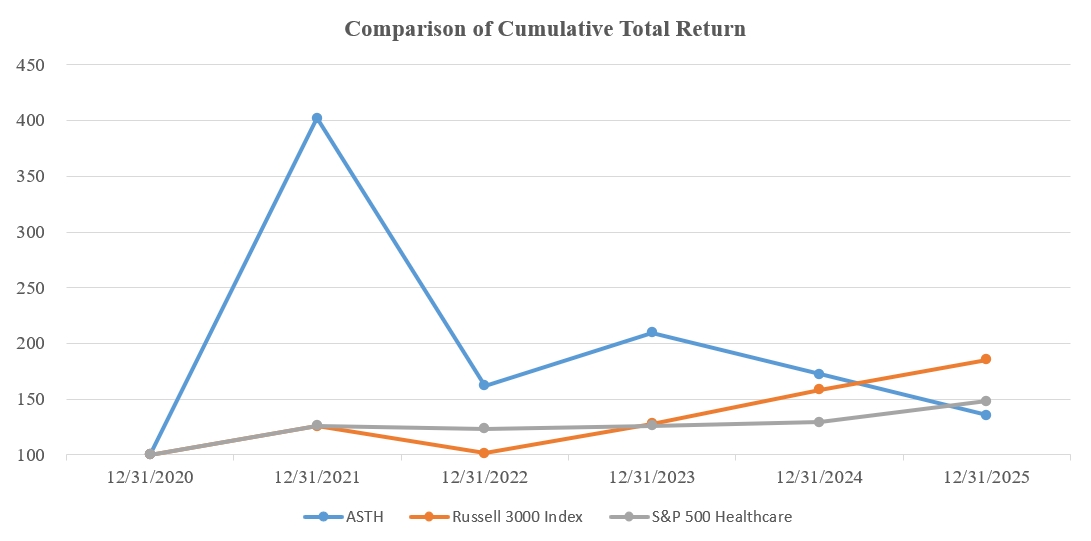
|
|
Indexed Returns for the Years Ended |
|
|||||||||||||||||||||
Company/Index |
|
Base Period |
|
|
12/31/2021 |
|
|
12/31/2022 |
|
|
12/31/2023 |
|
|
12/31/2024 |
|
|
12/31/2025 |
|
||||||
Astrana |
|
$ |
100.00 |
|
|
$ |
402.19 |
|
|
$ |
161.96 |
|
|
$ |
209.63 |
|
|
$ |
172.58 |
|
|
$ |
135.80 |
|
Russell 3000 Index |
|
|
100.00 |
|
|
|
125.66 |
|
|
|
101.53 |
|
|
|
127.88 |
|
|
|
158.32 |
|
|
|
185.47 |
|
S&P 500 Health Care |
|
|
100.00 |
|
|
|
126.13 |
|
|
|
123.67 |
|
|
|
126.21 |
|
|
|
129.46 |
|
|
|
148.36 |
|
Item 6. [Reserved]
68
Item 7. Management’s Discussion and Analysis of Financial Condition and Results of Operations
The following management’s discussion and analysis should be read in conjunction with the audited consolidated financial statements and the notes thereto included in Part II, Item 8, “Financial Statements and Supplementary Data” of this Annual Report on Form 10-K.
In this section, “we,” “our,” “ours,” and “us” refer to Astrana Health, Inc. (“Astrana”) and its consolidated subsidiaries and affiliated entities, as appropriate, including its consolidated variable interest entities (“VIEs”).
Overview
Astrana Health, Inc. is a leading physician-centric, technology-powered, risk-bearing healthcare management company. Leveraging its proprietary population health management and healthcare delivery platform, Astrana operates an integrated, value-based healthcare model, that aims to empower the providers in its network to deliver the highest quality of care to its patients in a cost-effective manner. Together with our affiliated physician groups and consolidated entities, we cost-effectively provide coordinated outcomes-based medical care.
Through our risk-bearing organizations (“RBOs”) with more than 20,000 contracted physicians, we were responsible for coordinating the care for approximately 1.6 million patients, primarily in California, as of December 31, 2025. These covered patients are managed care members whose health coverage is provided either through their employers, directly from a health plan, or as a result of their eligibility for Medicaid or Medicare benefits. Our managed patients benefit from an integrated approach that places physicians at the center of patient care and utilizes sophisticated risk management techniques and clinical protocols to deliver high-quality, cost-effective care.
Industry Trends
The One Big Beautiful Bill Act (the “OBBBA”), signed on July 4, 2025, introduces Medicaid work-requirement pilots and tighter provider tax rules beginning in 2026. We expect to see tax impacts from the following changes, including the restoration of 100% bonus depreciation, allowing the current year deduction of research and development expenses, and changing the 163j interest limitation from earnings before tax to EBITDA. We anticipate the OBBBA will not have a material impact on tax expense and did not identify a material impact in 2025. While we are still evaluating the full downstream effects, we believe Astrana is well-positioned to navigate these changes and view these headwinds as manageable. Our diversified footprint, strong track record of Medicaid performance, and investment in care-enablement infrastructure provide meaningful insulation. We remain focused on maintaining continuity of care and supporting our state partners through this policy transition.
On January 26, 2026, the Centers for Medicare & Medicaid Services (“CMS”) issued an advance notice detailing proposed 2027 Medicare Advantage payment rates (the “2027 Advance Notice”). CMS accepted comments on the 2027 Advance Notice until February 25, 2026 and intends to publish the final 2027 rate announcement no later than April 6, 2026. If the proposed rates are finalized, we anticipate impact to the Medicare line of business. We expect the impact of the proposed risk adjustment model changes to be materially less significant for Astrana than for the broader Medicare Advantage market. While we are still evaluating the full downstream effects, we believe Astrana is well-positioned to navigate these changes and view these headwinds as manageable.
69
2025 Highlights
Acquired Businesses and Assets
Certain businesses and assets of Prospect Medical Holdings, Inc. (collectively, “Prospect”) (such acquisition, the “Prospect Acquisition”)
On July 1, 2025, we completed our previously announced acquisition of Prospect, including its California-licensed health plan (Prospect Health Plan), its medical groups in multiple states (Prospect Medical Groups), its management service organization (Prospect Medical Systems), its pharmacy (RightRx), and Foothill Regional Medical Center (“FRMC”). Prospect is a physician-centric, risk-bearing healthcare company that operates an integrated healthcare delivery platform, enabling a network of over 11,000 providers to participate in value-based care arrangements, and empowering them to deliver accessible, high-quality care to patients in a cost-effective manner. Prospect enables physicians to deliver payer-agnostic, patient-centered care across Medicare Advantage, Medicaid, and Commercial lines of business. The acquisition significantly expanded our provider network and enhanced our ability to offer increased access, quality, and value to our members (see Note 3 — “Business Combinations and Goodwill” to our consolidated financial statements under Item 8 in this Annual Report on Form 10-K).
Second Amended and Restated Credit Agreement
On February 26, 2025, we amended and restated our credit agreement with Truist Bank, in its capacities as administrative agent for the lenders (the “Second Amended and Restated Credit Agreement”). The Second Amended and Restated Credit Agreement provides for (a) a five-year revolving credit facility (“Revolver Loan”) to us of $300.0 million, which includes a letter of credit sub-facility of up to $100.0 million and a swingline loan sub-facility of $25.0 million, (b) a five-year term loan A credit facility (“Term Loan”) to us of $250.0 million, and (c) a five-year delayed draw term loan credit facility (“DDTL A” and, together with the Term Loan, the “Term Loans”) to us of $745.0 million of which $707.3 million was drawn to fund the Prospect Acquisition. The Term Loan and Revolver Loan were used to, among other things, refinance certain existing indebtedness of ours and certain subsidiaries, pay transaction costs and expenses arising in connection with the Second Amended and Restated Credit Agreement, and provide for working capital needs and other general corporate purposes. The DDTL A was used to fund the Prospect Acquisition, and, in addition to the foregoing, the Revolver Loan was used to finance certain future permitted acquisitions and permitted investments and capital expenditures (see Note 10 — “Credit Facility and Bank Loans” to our consolidated financial statements under Item 8 in this Annual Report on Form 10-K).
Partnerships
We partnered with a provider group in Southern California and with Intermountain Health across southern Nevada with the collaboration goal to expand access to coordinated, high-quality care, enhance primary care access, improve patient outcomes, and advance the healthcare infrastructure through shared technology and care management programs.
70
Key Financial Measures and Indicators
Operating Revenues
Our revenue, which is recorded in the period during which services are rendered and earned, generally on a monthly basis, primarily consists of capitation revenue, risk pool settlements and incentives, management fee income, fee-for-services (“FFS”) revenue, and other revenue primarily consisting of revenues earned from maternity care and Hospital Quality Assurance Fee Program (“HQAF”). The form of billing and related collection risk for such services may vary by revenue type and customer.
Operating Expenses
Our largest expenses consist of the cost of: (i) patient care paid to contracted providers; (ii) information technology equipment and software; and (iii) hiring staff to provide management and administrative support services to our affiliated physician groups, as further described in the following sections. These services include claims processing, utilization management, contracting, accounting, credentialing, and administrative oversight.
Adjusted EBITDA and Adjusted EBITDA Margin
Our Adjusted EBITDA and Adjusted EBITDA margin are supplemental performance measures of our operations for financial and operational decision-making, and are used as a supplemental means of evaluating period-to-period comparisons on a consistent basis. Adjusted EBITDA is calculated as earnings before interest expense, interest income, income taxes, depreciation, and amortization, excluding income or loss from equity method investments, non-recurring and non-cash transactions, and stock-based compensation. We define Adjusted EBITDA margin as Adjusted EBITDA over total revenue.
Adjusted Net Income Attributable to Astrana and Adjusted Earnings Per Share (“EPS”) - Diluted
Our adjusted EPS - diluted is a supplemental performance measure of our operations for financial and operational decision-making and is used as a supplemental means of evaluating period-to-period comparisons on a consistent basis. We define adjusted EPS - diluted as adjusted net income attributable to Astrana over weighted average shares of common stock outstanding - diluted. Adjusted net income attributable to Astrana is calculated as net income, excluding income or loss from equity method investments, non-recurring and non-cash transactions, stock-based compensation, amortization of intangibles, certain tax adjustments, and amounts related to non-controlling interest.
Free Cash Flow
Our free cash flow is a supplemental performance measure of our operations for financial and operational decision-making and is used as a supplemental means of evaluating period-to-period comparisons on a consistent basis and reflects the cash flow trends in our business. We define free cash flow as net cash provided by operating activities minus cash used in purchases of property and equipment.
71
Results of Operations
2025 Compared to 2024
Our consolidated operating results for the year ended December 31, 2025, as compared to the year ended December 31, 2024, were as follows:
Astrana Health, Inc.
Consolidated Statements of Income (in thousands)
|
|
Years Ended December 31, |
|
|
|
|
|
|
|
|||||||
|
|
2025 |
|
|
2024 |
|
|
$ Change |
|
|
% Change |
|
||||
Revenue |
|
|
|
|
|
|
|
|
|
|
|
|
||||
Capitation, net |
|
$ |
2,924,265 |
|
|
$ |
1,856,785 |
|
|
$ |
1,067,480 |
|
|
|
57 |
% |
Risk pool settlements and incentives |
|
|
86,199 |
|
|
|
86,224 |
|
|
|
(25 |
) |
|
|
— |
|
Management fee income |
|
|
30,394 |
|
|
|
13,979 |
|
|
|
16,415 |
|
|
|
117 |
% |
Fee-for-service, net |
|
|
112,635 |
|
|
|
62,331 |
|
|
|
50,304 |
|
|
|
81 |
% |
Other revenue |
|
|
28,276 |
|
|
|
15,221 |
|
|
|
13,055 |
|
|
|
86 |
% |
Total revenue |
|
|
3,181,769 |
|
|
|
2,034,540 |
|
|
|
1,147,229 |
|
|
|
56 |
% |
Operating expenses |
|
|
|
|
|
|
|
|
|
|
|
|
||||
Cost of services, excluding depreciation and amortization |
|
|
2,840,239 |
|
|
|
1,763,152 |
|
|
|
1,077,087 |
|
|
|
61 |
% |
General and administrative expenses |
|
|
217,256 |
|
|
|
154,111 |
|
|
|
63,145 |
|
|
|
41 |
% |
Depreciation and amortization |
|
|
45,749 |
|
|
|
27,927 |
|
|
|
17,822 |
|
|
|
64 |
% |
Total expenses |
|
|
3,103,244 |
|
|
|
1,945,190 |
|
|
|
1,158,054 |
|
|
|
60 |
% |
Income from operations |
|
|
78,525 |
|
|
|
89,350 |
|
|
|
(10,825 |
) |
|
|
(12 |
)% |
Other expense |
|
|
|
|
|
|
|
|
|
|
|
|
||||
Income from equity method investments |
|
|
1,708 |
|
|
|
4,451 |
|
|
|
(2,743 |
) |
|
|
(62 |
)% |
Interest expense |
|
|
(49,928 |
) |
|
|
(33,097 |
) |
|
|
(16,831 |
) |
|
|
51 |
% |
Interest income |
|
|
12,157 |
|
|
|
14,508 |
|
|
|
(2,351 |
) |
|
|
(16 |
)% |
Unrealized (loss) gain on investments |
|
|
(68 |
) |
|
|
731 |
|
|
|
(799 |
) |
|
|
(109 |
)% |
Other (loss) income |
|
|
(2,788 |
) |
|
|
4,875 |
|
|
|
(7,663 |
) |
|
|
(157 |
)% |
Total other expense, net |
|
|
(38,919 |
) |
|
|
(8,532 |
) |
|
|
(30,387 |
) |
|
|
356 |
% |
Income before provision for income taxes |
|
|
39,606 |
|
|
|
80,818 |
|
|
|
(41,212 |
) |
|
|
(51 |
)% |
Provision for income taxes |
|
|
15,530 |
|
|
|
30,886 |
|
|
|
(15,356 |
) |
|
|
(50 |
)% |
Net income |
|
$ |
24,076 |
|
|
$ |
49,932 |
|
|
$ |
(25,856 |
) |
|
|
(52 |
)% |
|
|
|
|
|
|
|
|
|
|
|
|
|
||||
Net income attributable to noncontrolling interests |
|
|
1,589 |
|
|
|
6,783 |
|
|
|
(5,194 |
) |
|
|
(77 |
)% |
Net income attributable to Astrana Health, Inc. |
|
$ |
22,487 |
|
|
$ |
43,149 |
|
|
$ |
(20,662 |
) |
|
|
(48 |
)% |
|
|
|
|
|
|
|
|
|
|
|
|
|
||||
Adjusted EBITDA |
|
$ |
205,424 |
|
|
$ |
170,370 |
|
|
$ |
35,054 |
|
|
|
21 |
% |
72
Risk-Bearing Organizations and Patients
As of December 31, 2025 and 2024, we managed a total of 28 and 20 independent risk-bearing organizations, including both affiliated and non-affiliated, respectively, and the total number of patients for whom we managed the delivery of healthcare services was approximately 1.6 million and 1.1 million, respectively.
Revenue
Our total revenue in 2025 was $3,181.8 million, as compared to $2,034.5 million in 2024, an increase of $1,147.2 million or 56%. The increase in total revenue was partially attributable to the acquisition of Prospect, which contributed approximately $616.3 million of revenue from the acquisition date. In addition, capitation revenue increased by $539.0 million primarily as a result of our 2024 acquisitions within our Care Partners segment, along with enrollees transitioning to full risk through our Restricted Knox-Keene plans.
Cost of Services, Excluding Depreciation and Amortization
Expenses related to the cost of services, excluding depreciation and amortization, in 2025 were $2,840.2 million, compared to $1,763.2 million in 2024, an increase of $1,077.1 million or 61%. The overall increase was primarily due to increased participation in a value-based Medicare FFS model and medical costs associated with both professional and institutional risk of our Restricted Knox-Keene licensed health plan as a result of our recent acquisitions, of which Prospect contributed approximately $538.3 million from the date of acquisition.
General and Administrative Expenses
General and administrative expenses in 2025 were $217.3 million, compared to $154.1 million in 2024, an increase of $63.1 million or 41%. This increase was primarily due to approximately $30.9 million from the inclusion of Prospect’s results of operations from the date of acquisition, transaction costs related to our acquisitions that were driven by the Prospect Acquisition in 2025, as well as other general and administrative expenses to support operational growth.
Depreciation and Amortization
Depreciation and amortization expenses were $45.7 million and $27.9 million for the years ended December 31, 2025 and 2024, respectively, an increase of $17.8 million driven by $17.3 million due to the Prospect Acquisition. This amount includes depreciation of property and equipment and the amortization of intangible assets.
Income from Equity Method Investments
Income from equity method investments in 2025 was $1.7 million, compared to $4.5 million in 2024, a decrease of $2.7 million. This amount includes the Company’s portion of the equity method investment’s net earnings or losses. The decrease was primarily due to APC’s equity method investment in LaSalle Medical Associates and reduced income pickup due to the sale of our equity method investment in CAIPA MSO, LLC.
Interest Expense
Interest expense in 2025 was $49.9 million, compared to $33.1 million in 2024, an increase of $16.8 million. The increase in interest expense for the year was primarily due to the increased borrowings under the Second Amended and Restated Credit Facility to finance the Prospect Acquisition, partially offset by a decrease in interest rates on our floating-rate debt, including the interest rate swap agreement entered to manage our interest. Our outstanding borrowings, as of December 31, 2025, increased to $1,052.2 million on the Second Amended and Restated Credit Facility from $428.2 million borrowed under the facility as of December 31, 2024. The interest rate on the Term Loans and $100.0 million of the Revolver Loan was 5.72%, and the interest rate on $22.0 million of the Revolver Loan was 5.77%, as of December 31, 2025. The interest rate swap has a fixed rate of 3.179% and covers $200.0 million of our credit facility. As of December 31, 2024, the interest rates for the Term Loan and Revolver were 6.67% and 6.23%, respectively.
73
Interest Income
Interest income in 2025 was $12.2 million, compared to $14.5 million in 2024, a decrease of $2.4 million. Interest income reflects interest earned on cash held in bank accounts, money market and certificate of deposit accounts, and on our loans receivable. The change in interest income was primarily due to decreases in interest rates related to cash held in interest-bearing bank accounts.
Other (Loss) Income
Other loss in 2025 was $2.8 million, as compared to other income of $4.9 million in 2024, a decrease of $7.7 million. The decrease was primarily due to a $5.3 million reimbursement in 2024 from Allied Pacific Holdings Investment Management, LLC, with no similar transaction occurring in 2025 and $5.0 million of debt issuance costs that were expensed in connection with the Second Amended and Restated Credit Facility in 2025. The decrease was partially offset by a $3.6 million employee retention tax credit related to COVID-19 relief.
Provision for Income Taxes
Provision for income taxes was $15.5 million in 2025, as compared to $30.9 million in 2024, a decrease of $15.4 million. The decrease in provision for income taxes was primarily due to a decrease in pre-tax income.
Net Income Attributable to Noncontrolling Interests
Net income attributable to non-controlling interests was $1.6 million in 2025, as compared to a net income of $6.8 million in 2024, a decrease of $5.2 million. The decrease was primarily driven by a decrease in net income.
Net Income Attributable to Astrana Health, Inc.
Net income attributable to Astrana Health, Inc. was $22.5 million in 2025, as compared to net income of $43.1 million in 2024, a decrease of $20.7 million, driven by a decrease in our operating income and an increase in our interest expense, partially offset by a decrease in our provision for income taxes and a decrease in net income attributable to noncontrolling interests.
Adjusted EBITDA
Adjusted EBITDA was $205.4 million, as compared to $170.4 million in 2024, an increase of $35.1 million. The increase was primarily due to the acquisition of Prospect, partially offset by a decrease in operating income as a result of higher utilization and an increase in general and administrative expenses.
2024 Compared to 2023
See Part II, Item 7. “Management’s Discussion and Analysis of Financial Condition and Results of Operations—Results of Operations” of our Annual Report on Form 10-K for the year ended December 31, 2024 filed with the SEC on March 14, 2025, for a discussion of our results of operations during the year ended December 31, 2024, compared to the year ended December 31, 2023.
Segment Financial Performance
We have three reportable segments: Care Partners, Care Delivery, and Care Enablement. We evaluate the performance of our operating segments based on segment revenue growth and operating income. Management uses revenue growth and total segment operating income as measures of the performance of operating businesses, separate from non-operating factors. We integrated the Prospect Acquisition into our three reportable segments. For more information about our segments, see Note 1 — “Description of Business” and Note 20 — “Segments” to our consolidated financial statements under Item 8 in this Annual Report on Form 10-K for additional information.
74
2025 Segments Compared to 2024 Segments
The following table sets forth our revenue and operating income by segment for the year ended December 31, 2025, as compared to the year ended December 31, 2024:
|
|
Years Ended December 31, |
|
|
|
|
|
|
|
|||||||
Segment Revenue (in thousands) |
|
2025 |
|
|
2024 |
|
|
$ Change |
|
|
% Change |
|
||||
Care Partners |
|
$ |
3,022,602 |
|
|
$ |
1,949,033 |
|
|
$ |
1,073,569 |
|
|
|
55 |
% |
Care Delivery |
|
$ |
250,742 |
|
|
$ |
136,668 |
|
|
$ |
114,074 |
|
|
|
83 |
% |
Care Enablement |
|
$ |
246,660 |
|
|
$ |
155,448 |
|
|
$ |
91,212 |
|
|
|
59 |
% |
|
|
Years Ended December 31, |
|
|
|
|
|
|
|
|||||||
Segment Operating Income (Loss) (in thousands) |
|
2025 |
|
|
2024 |
|
|
$ Change |
|
|
% Change |
|
||||
Care Partners |
|
$ |
154,967 |
|
|
$ |
141,238 |
|
|
$ |
13,729 |
|
|
|
10 |
% |
Care Delivery |
|
$ |
(2,015 |
) |
|
$ |
103 |
|
|
$ |
(2,118 |
) |
|
* |
|
|
Care Enablement |
|
$ |
39,716 |
|
|
$ |
18,267 |
|
|
$ |
21,449 |
|
|
|
117 |
% |
* Percentage change of over 500%
Care Partners Segment
Revenue increased $1,073.6 million and operating income increased $13.7 million for the year ended December 31, 2025, compared to the corresponding period in 2024. The increases in revenue and operating income were primarily due to $542.3 million of revenue from the Prospect Acquisition, other recent acquisitions within our Care Partners segment, and members transitioning to full risk through our Restricted Knox-Keene plans. The increase in operating income was partially offset by recognition of a $13.0 million loss contingency in the third quarter of 2025.
Care Delivery Segment
Revenue increased $114.1 million and operating income decreased $2.1 million for the year ended December 31, 2025, compared to the corresponding period in 2024. The increase in revenue was primarily driven by $105.1 million from the inclusion of Prospect, as well as an increased volume in patient visits at our primary, multi-specialty, and ancillary Care Delivery entities. Operating income decreased $2.1 million due to an increase in expenses incurred to support growth in our Care Delivery segment, including new clinic locations and related lease costs.
Care Enablement Segment
Revenue increased $91.2 million and operating income increased $21.4 million for the year ended December 31, 2025, compared to the corresponding period in 2024. The increase in revenue was primarily due to managing more IPAs in our Care Partners segment, including $83.8 million from Prospect. As of December 31, 2025, and 2024, the total number of affiliated physician groups we managed was 28 groups and 20 groups, respectively. The increase in operating income was primarily due to the acquisition of Prospect, partially offset by higher costs incurred by the Care Enablement segment as a result of an increase in the workforce that provides management and administrative services.
2024 Segments Compared to 2023 Segments
See Part II, Item 7. “Management’s Discussion and Analysis of Financial Condition and Results of Operations—Segment Financial Performance” of our Annual Report on Form 10-K for the year ended December 31, 2024 filed with the SEC on March 14, 2025, for a discussion of our segment financial performance during the year ended December 31, 2024, compared to the year ended December 31, 2023.
75
Reconciliation of Net Income to EBITDA, Adjusted EBITDA, and Adjusted EBITDA Margin
Set forth below are reconciliations of Net Income to EBITDA and Adjusted EBITDA for the years ended December 31, 2025 and 2024.
|
|
Years Ended December 31, |
|
|
|||||
(in thousands) |
|
2025 |
|
|
2024 |
|
|
||
Net income |
|
$ |
24,076 |
|
|
$ |
49,932 |
|
|
Interest expense |
|
|
49,928 |
|
|
|
33,097 |
|
|
Interest income |
|
|
(12,157 |
) |
|
|
(14,508 |
) |
|
Provision for income taxes |
|
|
15,530 |
|
|
|
30,886 |
|
|
Depreciation and amortization |
|
|
45,749 |
|
|
|
27,927 |
|
|
EBITDA |
|
|
123,126 |
|
|
|
127,334 |
|
|
|
|
|
|
|
|
|
|
||
Income from equity method investments |
|
|
(1,708 |
) |
|
|
(4,451 |
) |
|
Other, net |
|
|
45,405 |
|
(1) |
|
12,951 |
|
(2) |
Stock-based compensation |
|
|
38,601 |
|
|
|
34,536 |
|
|
Adjusted EBITDA |
|
$ |
205,424 |
|
|
$ |
170,370 |
|
|
|
|
|
|
|
|
|
|
||
Total Revenue |
|
$ |
3,181,769 |
|
|
$ |
2,034,540 |
|
|
|
|
|
|
|
|
|
|
||
Adjusted EBITDA margin |
|
|
6 |
% |
|
|
8 |
% |
|
76
Reconciliation of Net Income to Adjusted Net Income Attributable to Astrana and Adjusted EPS - Diluted
Set forth below are reconciliations of net income to adjusted net income attributable to Astrana as well as the reconciliation to adjusted EPS - diluted for years ended December 31, 2025 and 2024.
|
|
Years Ended December 31, |
|
|
|||||
(in thousands, except for share and per share data) |
|
2025 |
|
|
2024 |
|
|
||
Net income |
|
$ |
24,076 |
|
|
$ |
49,932 |
|
|
Income from equity method investments |
|
|
(1,708 |
) |
|
|
(4,451 |
) |
|
Other, net (1) |
|
|
45,405 |
|
|
|
12,951 |
|
|
Stock-based compensation |
|
|
38,601 |
|
|
|
34,536 |
|
|
Amortization of intangibles |
|
|
40,747 |
|
|
|
25,608 |
|
|
Tax adjustments |
|
|
(25,337 |
) |
(2) |
|
(13,902 |
) |
(3) |
Adjusted non-controlling interest |
|
|
(13,203 |
) |
(4) |
|
(11,629 |
) |
(5) |
Adjusted net income attributable to Astrana Health, Inc. |
|
$ |
108,581 |
|
|
$ |
93,045 |
|
|
|
|
|
|
|
|
|
|
||
Weighted average shares of common stock outstanding – diluted |
|
|
49,369,685 |
|
|
|
47,974,334 |
|
|
|
|
|
|
|
|
|
|
||
Adjusted earnings per share - diluted |
|
$ |
2.20 |
|
|
$ |
1.94 |
|
|
77
Reconciliation of Net Cash Provided by Operating Activities to Free Cash Flow
The following table provides a reconciliation of net cash provided by operating activities to free cash flow for the years ended December 31, 2025 and 2024 (in thousands):
|
|
December 31, |
|
|||||
|
|
2025 |
|
|
2024 |
|
||
Net cash provided by operating activities |
|
$ |
114,597 |
|
|
$ |
52,198 |
|
Purchases of property and equipment |
|
|
(10,106 |
) |
|
|
(8,031 |
) |
Free cash flow |
|
$ |
104,491 |
|
|
$ |
44,167 |
|
Use of Non-GAAP Financial Measures
This Annual Report on Form 10-K contains the non-GAAP financial measures EBITDA, Adjusted EBITDA, Adjusted EBITDA margin, adjusted net income attributable to Astrana, and adjusted EPS - diluted, of which the most directly comparable financial measure presented in accordance with U.S. generally accepted accounting principles (“GAAP”) is net income. This Annual Report on Form 10-K also contains the non-GAAP financial measure free cash flow, of which the most directly comparable financial measure presented in accordance with U.S. GAAP is net cash provided by operating activities. These measures are not in accordance with, or alternatives to, GAAP, and may be calculated differently from similar non-GAAP financial measures used by other companies. We use Adjusted EBITDA, Adjusted EPS - diluted, and free cash flow as supplemental performance measures of our operations, for financial and operational decision-making, and as supplemental means of evaluating period-to-period comparisons on a consistent basis and, for free cash flow, to reflect the cash flow trends in our business. Adjusted EBITDA is calculated as earnings before interest expense, interest income, income taxes, depreciation, and amortization, excluding income or loss from equity method investments, non-recurring and non-cash transactions, and stock-based compensation. We define Adjusted EBITDA margin as Adjusted EBITDA over total revenue. Adjusted net income attributable to Astrana is calculated as net income, excluding income or loss from equity method investments, non-recurring and non-cash transactions, stock-based compensation, amortization of intangibles, certain tax adjustments, and amounts related to non-controlling interest. We define adjusted EPS - diluted as adjusted net income attributable to Astrana over weighted average shares of common stock outstanding - diluted. We define free cash flow as net cash provided by operating activities minus cash used in purchases of property and equipment.
We believe the presentation of these non-GAAP financial measures provides investors with relevant and useful information, as it allows investors to evaluate the operating performance of the business activities without having to account for differences recognized because of non-core or non-recurring financial information. When GAAP financial measures are viewed in conjunction with non-GAAP financial measures, investors are provided with a more meaningful understanding of our ongoing operating performance. In addition, these non-GAAP financial measures are among those indicators we use as a basis for evaluating operational performance, allocating resources, and planning and forecasting future periods. Non-GAAP financial measures are not intended to be considered in isolation, or as a substitute for, GAAP financial measures. Other companies may calculate EBITDA, Adjusted EBITDA, adjusted net income attributable to Astrana, adjusted EPS - diluted, and free cash flow differently, limiting the usefulness of these measures for comparative purposes. To the extent this Form 10-K contains historical or future non-GAAP financial measures, we have provided corresponding GAAP financial measures for comparative purposes. The reconciliation between certain GAAP and non-GAAP measures is provided above.
Liquidity and Capital Resources
Cash, cash equivalents at December 31, 2025, totaled $429.5 million. Working capital totaled $248.0 million at December 31, 2025, compared to $272.9 million at December 31, 2024, a decrease of $24.9 million.
78
We have historically financed our operations primarily through internally generated funds and borrowings on long-term debt. We generate cash primarily from capitation contracts, risk pool settlements and incentives, fees for medical management services provided to our affiliated physician groups, FFS reimbursements, and other revenues. We generally invest cash in money market accounts, which are classified as cash and cash equivalents. In February 2025, we entered into the Second Amended and Restated Credit Agreement, which amended and restated our prior amended credit agreement and provided for a five-year revolving credit facility of $300.0 million, a term loan of $250.0 million, and a delayed-draw term loan of $745.0 million, which were primarily used to refinance certain existing indebtedness and to fund the costs associated with the Prospect Acquisition. In July 2025, we drew down the delayed-draw term loan for $707.3 million to fund the Prospect Acquisition and terminated the remaining commitment. In addition, we have a current shelf registration statement filed with the SEC under which we may issue common stock, preferred stock, debt securities, and other securities in one or more offerings on terms to be determined at the time of each offering. We believe we have sufficient liquidity to fund our operations through at least the next 12 months and the foreseeable future.
Cash Flow Activities
Our cash flows for the years ended December 31, 2025 and 2024 are summarized as follows (in thousands):
|
|
Years Ended December 31, |
|
|
|
|
|
|
|
|||||||
|
|
2025 |
|
|
2024 |
|
|
$ Change |
|
|
% Change |
|
||||
Net cash provided by operating activities |
|
$ |
114,597 |
|
|
$ |
52,198 |
|
|
$ |
62,399 |
|
|
|
120 |
% |
Net cash used in investing activities |
|
|
(538,999 |
) |
|
|
(192,395 |
) |
|
|
(346,604 |
) |
|
|
180 |
% |
Net cash provided by financing activities |
|
|
569,346 |
|
|
|
135,146 |
|
|
|
434,200 |
|
|
|
321 |
% |
Net increase (decrease) in cash, cash equivalents, and restricted cash |
|
$ |
144,944 |
|
|
$ |
(5,051 |
) |
|
$ |
149,995 |
|
|
* |
|
|
* Percentage change of over 500%
Operating Activities
Cash provided by operating activities during the year ended December 31, 2025, was $114.6 million, as compared to $52.2 million during the year ended December 31, 2024. The increase in cash provided by operating activities was primarily driven by favorable changes in working capital relative to 2024 and higher adjusted net income. The change in working capital for the 2025 and 2024 periods included the timing of claims payments related to our medical liabilities, and a decrease in cash paid for income taxes. For the year ended December 31, 2025, net income, exclusive of depreciation and amortization, amortization of debt issuance costs, share-based compensation, non-cash lease expense, deferred tax, and other was $117.7 million, as compared to $115.8 million for the year ended December 31, 2024.
Investing Activities
Cash used in investing activities during the year ended December 31, 2025, was $539.0 million, primarily due to payments for business and asset acquisitions, net of cash acquired for $548.6 million, purchases of property and equipment for $10.1 million, and issuance of loans for $1.7 million. The cash used in investing activities was partially offset by proceeds from the sale of an equity method investment for $15.1 million and other investing activities of $6.3 million, including proceeds from repayment of loans and sales of marketable securities. Cash used in investing activities during the year ended December 31, 2024, was $192.4 million, primarily due to payments for business and asset acquisitions, net of cash acquired, of $146.3 million, issuance of loans receivable of $26.0 million, purchases of property and equipment of $8.0 million, purchases of investments – equity method of $6.0 million, purchase of a call option issued in conjunction with an equity method investment of $3.9 million, and other investing activities of $2.2 million mainly related to a $2.5 million purchase of a privately held investment.
79
Financing Activities
Cash provided by financing activities during the year ended December 31, 2025, was $569.3 million, primarily due to borrowings of long-term debt of $1,119.3 million, partially offset by repayments of debt of $495.3 million, payment of deferred financing costs of $19.2 million, repurchase of treasury shares of $15.4 million, payment of contingent liabilities for $8.3 million, dividend payments of $7.9 million, and tax payments from net share settlement of restricted stock awards and units of $6.2 million. Cash provided by financing activities during the year ended December 31, 2024, was $135.1 million, primarily attributable to borrowings on long-term debt totaling $171.9 million. This was partially offset by repayments of debt of $18.5 million, payment of a financing obligation of $8.5 million, tax payments from net share settlement of restricted stock awards and units of $4.7 million, and dividend payments of $4.0 million.
Credit Facilities
Our debt balance consisted of the following (in thousands):
|
|
December 31, 2025 |
|
|
Term Loans |
|
$ |
930,243 |
|
Revolver Loan |
|
|
122,000 |
|
Total debt |
|
|
1,052,243 |
|
|
|
|
|
|
Less: Current portion of debt |
|
|
(47,865 |
) |
Less: Unamortized financing costs |
|
|
(13,474 |
) |
Long-term debt |
|
$ |
990,904 |
|
The following are the future commitments of our debt for the years ending December 31 (in thousands):
|
|
Amount |
|
|
2026 |
|
$ |
47,865 |
|
2027 |
|
|
65,814 |
|
2028 |
|
|
71,798 |
|
2029 |
|
|
89,747 |
|
2030 |
|
|
777,019 |
|
Total |
|
$ |
1,052,243 |
|
Second Amended and Restated Credit Agreement
The Second Amended and Restated Credit Agreement provides for (a) Revolver Loan to us of $300.0 million, which includes a letter of credit sub-facility of up to $100.0 million and a swingline loan sub-facility of $25.0 million, (b) Term Loan to the Company of $250.0 million, and (c) DDTL A to us of $745.0 million, of which $707.3 million was drawn down, and the remainder of the commitment terminated, in connection with closing the Prospect Acquisition. As a result, as of December 31, 2025, we had a combined borrowing of $930.2 million on our Term Loans and $122.0 million under the Revolver Loan under the Second Amended and Restated Credit Agreement. The maturity of the Term Loans and the Revolver Loan remains February 26, 2030.
See Note 10 — “Credit Facility and Bank Loans” to our consolidated financial statements under Item 8 in this Annual Report on Form 10-K for additional information on the Second Amended and Restated Credit Agreement.
80
Effective Interest Rate
Our average effective interest rate on our total debt during the years ended December 31, 2025, 2024, and 2023 was 6.18%, 7.05%, and 6.19%, respectively. Interest expense in the consolidated statements of income included amortization of deferred debt issuance costs for the years ended December 31, 2025, 2024, and 2023 of $4.1 million, $1.8 million, and $1.1 million, respectively.
Standby Letters of Credit
We established irrevocable standby letters of credit with Truist Bank under the Second Amended and Restated Credit Agreement, totaling $25.7 million for the benefit of CMS and certain health plans as of December 31, 2025. Unless the institution provides notification that the standby letters of credit will be terminated prior to the expiration date, the letters will be automatically extended without amendment for additional one-year periods from the present or any future expiration date.
Certain affiliated IPAs consolidated by us established irrevocable standby letters of credit for a total of $2.1 million for the benefit of certain health plans as of December 31, 2025. The loan under which the standby letters of credit can be issued had an original loan availability of $4.1 million. The standby letters of credit are automatically extended without amendment for additional one-year periods from the present or any future expiration date, unless notified by the institution in advance of the expiration date that the letter will be terminated.
See Note 14 — “Commitments and Contingencies” to our consolidated financial statements under Item 8 in this Annual Report on Form 10-K for additional information on our standby letters of credit.
Critical Accounting Policies and Estimates
The consolidated financial statements have been prepared in accordance with generally accepted accounting principles in the United States of America (“U.S. GAAP”), which require management to make a number of estimates and assumptions relating to the reported amount of assets and liabilities and the disclosure of contingent assets and liabilities at the date of the consolidated financial statements and to the reported amounts of revenues and expenses during the period. We base our estimates on historical experience and various other assumptions we believe are reasonable under the circumstances. Changes in estimates are recorded if and when better information becomes available. Actual results could differ from those estimates under different assumptions and conditions. We believe that the accounting policies discussed below are the most important to the presentation of its financial condition and results of operations, and that they require our management’s most difficult, subjective, and complex judgments. Our significant accounting policies are described in Note 2 — “Basis of Presentation and Summary of Significant Accounting Policies” to our consolidated financial statements under Item 8 in this Annual Report on Form 10-K.
Principles of Consolidation
The consolidated balance sheets as of December 31, 2025 and 2024 and consolidated statements of income for the years ended December 31, 2025, 2024, and 2023 include Astrana’s wholly owned subsidiaries and consolidated variable interest entities (“VIEs”).
81
Use of Estimates
The preparation of the consolidated financial statements and related disclosures in conformity with U.S. GAAP requires management to make estimates and assumptions that affect the reported amounts of assets and liabilities, and disclosure of contingent assets and liabilities, at the date of the consolidated financial statements, as well as the reported amounts of revenues and expenses during the reporting period. Significant items subject to such estimates, and assumptions include collectability of receivables, recoverability of long-lived and intangible assets, business combination and goodwill valuation and impairment assessment, accrual of medical liabilities (incurred but not reported (“IBNR”) claims), determination of hospital shared-risk and health plan shared-risk revenue and receivables (including estimations of affiliated hospitals’ claims costs which involves assumptions for IBNR, such as utilization of healthcare services, historical payment patterns, cost trends, seasonality, changes in membership, and other factors), income tax-valuation allowance, share-based compensation, right-of-use assets and lease liabilities. Management evaluates its estimates and assumptions on an ongoing basis using historical experience and other factors, including the current economic environment, and makes adjustments when facts and circumstances dictate. As future events and their effects cannot be determined with precision, actual results could differ materially from those estimates and assumptions.
Receivables, Other Receivables, and Loans Receivable
Our receivables are comprised of capitation receivables, fee-for-service receivables, risk pool settlements, incentive receivables, management fee income, and receivables from related parties. The Company’s receivables are recorded and stated as the amount expected to be collected.
Capitation receivables relate to each health plan’s capitation revenue and are usually received by us in the month following the month of service. Capitation receivables also include receivables from CMS related to our participation in the ACO REACH model. Fee-for-service receivable involves our hospital and clinics. Both our hospital and the clinics receive amounts from third-party payers and patients for patient care services, while the clinics additionally receive amounts from hospitals. Risk pool settlements and incentive receivables mainly consist of our hospital shared-risk pool receivable, which is recorded based on reports received from our hospital partners and management’s estimate of our portion of the estimated risk pool surplus for open performance years. Settlement of risk pool surplus or deficits occurs within 6 to 12 months after the risk pool performance year is completed. Other receivables consist of amounts due from the seller associated with acquisitions and stop-loss insurance premium reimbursements. Loans receivable consist of promissory notes that accrue interest per annum and are recorded and stated at amortized cost plus accrued interest. Receivables from related parties primarily consist of hospital-shared risk pool settlements from AHMC Healthcare Inc., of which one of our directors is an officer. These amounts are recorded quarterly based on reports received from our hospital partners and management’s estimate of our portion of the estimated risk pool surplus for open performance years. Final settlement occurs within 18 months after the risk pool performance year is completed.
We maintain reserves for potential credit losses on the receivables. Management reviews the composition of our receivables and analyzes historical bad debts, customer concentrations, customer creditworthiness, current economic trends, and changes in customer payment patterns to evaluate the adequacy of these reserves. We also regularly analyze the ultimate collectability of accounts receivable after certain stages of the collection cycle using a look-back analysis to determine the amount of receivables subsequently collected, and adjustments are recorded when necessary. Reserves are recorded based on historical trends. Any change in such an estimate of reserves is recorded in the period when such a change is identified.
Receivables are recorded when we are able to determine amounts receivable under applicable contracts and agreements based on information provided, and collection is reasonably likely to occur. Regarding the credit loss standard, we continuously monitor our collections of receivables. Our expectation is that the historical credit loss experienced across our receivable portfolio is materially similar to any current expected credit losses that would be estimated under the current expected credit losses (“CECL”) model.
We assess outstanding loans receivable under the CECL model by evaluating the party’s ability to pay, which involves reviewing quarterly interest payment history, annually reviewing financial history, assessing the value of any collateral, and reassessing any identified insolvency risk.
82
Fair Value Measurements
Our financial instruments include cash and cash equivalents, restricted cash, investment in marketable securities, receivables, loans receivable, accounts payable, certain accrued expenses, lines of credit, long-term debt, and certain other liabilities. The carrying values of the financial instruments classified as current in the accompanying consolidated balance sheets are considered to be at their fair values due to the short maturity of these instruments. The carrying amount of the loans receivable, net of current portion, lines of credit, and long-term debt approximates fair value as they bear interest at rates that approximate current market rates for debt with similar maturities and credit quality. The FASB’s Accounting Standards Codification (“ASC”) 820, “Fair Value Measurement” (“ASC 820”), applies to all financial assets and financial liabilities that are measured and reported on a fair value basis and requires disclosure that establishes a framework for measuring fair value and expands disclosure about fair value measurements. ASC 820 establishes a fair value hierarchy for disclosures of the inputs to valuations used to measure fair value.
This hierarchy prioritizes the inputs into three broad levels as follows:
Level 1 — Inputs are unadjusted quoted prices in active markets for identical assets or liabilities that can be accessed at the measurement date.
Level 2 — Inputs include quoted prices for similar assets and liabilities in active markets, quoted prices for identical or similar assets or liabilities in markets that are not active, inputs other than quoted prices that are observable for the asset or liability (i.e., interest rates and yield curves), and inputs that are derived principally from or corroborated by observable market data by correlation or other means (market corroborated inputs).
Level 3 — Unobservable inputs that reflect assumptions about what market participants would use in pricing the asset or liability. These inputs would be based on the best information available, including our own data.
Business Combinations
We use the acquisition method of accounting for all business combinations, which requires assets and liabilities of the acquiree to be recorded at fair value, to measure the fair value of the consideration transferred, including contingent consideration, to be determined on the acquisition date, and to account for acquisition-related costs separately from the business combination, which are expensed as incurred.
Intangible Assets and Long-Lived Assets
Intangible assets with finite lives include network relationships, management contracts, member relationships, patient management platform, tradename/trademarks, and developed technology. The valuations of these intangible assets are based on the multi-period excess earnings method, the cost to recreate method, or the relief from royalty method. Network relationships and management contracts are amortized using an accelerated method based on expected patterns of economic benefit or using the straight-line method. Patient management platform, tradename/trademarks, and developed technology are amortized using the straight-line method. Member relationships are amortized using an accelerated method based on expected patterns of economic benefit. Intangible assets are net of accumulated amortization and impairment losses, if any.
Finite-lived intangibles and long-lived assets are reviewed for impairment whenever events or changes in circumstances indicate that the carrying amount of an asset may not be recoverable. If the expected future cash flows from the use of such assets (undiscounted and without interest charges) are less than the carrying value, a write-down would be recorded to reduce the carrying value of the asset to its estimated fair value. Fair value is determined based on appropriate valuation techniques.
Goodwill and Intangible Assets
Under ASC 350, “Intangibles – Goodwill and Other”, goodwill and indefinite-lived intangible assets are reviewed at least annually for impairment under a two-step process.
83
We may also elect to skip the qualitative testing and proceed directly to quantitative testing. Our five reporting units consist of the following:
An impairment loss is recognized if the carrying value of a reporting unit exceeds its fair value. If this event arises, the impairment loss recorded is equal to the excess of the carrying value of the reporting unit over its fair value.
At least annually, indefinite-lived intangible assets are tested for impairment. Impairment for intangible assets with indefinite lives exists if the carrying value of the intangible asset exceeds its fair value. The fair values of indefinite-lived intangible assets are determined using valuation techniques that rely on estimates, judgments, and assumptions that management believes are appropriate in the circumstances.
Accrual of Medical Liabilities
Our Care Partners segment is responsible for integrated care provided by the associated physicians and contracted hospitals to their enrollees. Our Care Partners segment provides integrated care to HMOs, Medicare, and Medi-Cal enrollees through a network of contracted providers under sub-capitation and direct patient service arrangements. Medical costs for professional and institutional services rendered by contracted providers are recorded as cost of services, excluding depreciation and amortization, in the accompanying consolidated statements of income.
An estimate of amounts due to contracted physicians, hospitals, and other professional providers is included in medical liabilities in the accompanying consolidated balance sheets. Medical liabilities include claims reported as of the balance sheet date and estimated IBNR claims. Such estimates are developed using actuarial methods and are based on numerous variables, including the utilization of healthcare services, historical payment patterns, cost trends, product mix, seasonality, changes in membership, and other factors. The estimation methods and the resulting reserves are periodically reviewed and updated. Many medical contracts are complex and may be subject to differing interpretations of amounts due for the provision of various services. Such differing interpretations may not come to light until a substantial period of time has passed following the contract implementation.
84
Capitation, Net
We participate in the ACO REACH model with CMS. By entering into a contract with CMS, an ACO voluntarily assumes operational, financial, and legal responsibilities and risks that no party, individually or collectively, has under the existing FFS model. For each performance year, CMS will pay a total benchmark amount, determined unilaterally by CMS in advance and subject to prospective adjustments throughout the year, for the totality of care provided to the ACO’s population of aligned beneficiaries during that year. The benchmark is net of a quality withholding applied by CMS. At the end of each performance year, a portion, or all, of the quality withholding can be earned based on the ACO’s performance. ACO REACH capitation revenue is recognized based on the estimated transaction price to transfer the service for a distinct increment of the series (i.e., month) and is recognized net of quality incentives/penalties. We recognize revenue related to the ACO Reach Model within capitation revenue in our consolidated statements of income because of the similar shared characteristics to our other capitation revenue. Revenue is recorded on a gross basis and is comprised of capitated fees for medical services provided, for which we are assigned the responsibility and management.
Risk Pool Settlements and Incentives
Certain IPAs enter into hospital shared-risk capitation arrangements with certain health plans and local hospitals, where the hospital is responsible for providing, arranging, and paying for institutional risk, and the IPA is responsible for providing, arranging, and paying for professional risk. Under a hospital shared-risk pool-sharing agreement, the IPA generally receives a percentage of the net surplus from the affiliated hospital’s risk pools with health plans after deductions for the affiliated hospital’s costs. Advance settlement payments are typically made quarterly in arrears if there is a surplus. Our risk pool settlements under hospital shared-risk capitation arrangements are recognized using the most likely amount methodology, and amounts are included in revenue only to the extent that it is probable that a significant reversal of cumulative revenue will not occur once any uncertainty is resolved. The receivables related to these risk pool arrangements incorporate estimates of the affiliated hospitals’ claims costs, including IBNR claims, which include actuarial methods based on utilization of healthcare services, historical payment patterns, cost trends, seasonality, changes in membership, and other factors.
Under capitated arrangements with certain HMOs, certain IPAs participate in one or more health plan shared-risk arrangements relating to the provision of institutional services to enrollees and thus can earn additional revenue or incur losses based upon the enrollee utilization of institutional services. Health plan shared-risk arrangements are entered into with certain health plans, which are administered by the health plan, where the IPA is responsible for rendering professional services, but the health plan does not enter into a capitation arrangement with a hospital, and therefore, the health plan retains the institutional risk. Health plan shared-risk deficits, if any, are not payable until and unless (and only to the extent) risk-sharing surpluses are generated. At the termination of the HMO contract, any accumulated deficit will be extinguished. Final settlement of health plan shared-risk for prior contract years generally occurs in the third or fourth quarter of the following year. We have limited insight into the amount and timing of the health plans’ shared-risk payments. These amounts are considered to be fully constrained and only recorded when such payments can be reasonably estimated, and to the extent that it is probable that a significant reversal will not occur once such settlement occurs.
We also receive incentives under “pay-for-performance” programs for quality medical care, based on various criteria. As an incentive to promote quality care, certain HMOs have designed quality incentive programs and commercial generic pharmacy incentive programs to compensate us for our efforts to improve the quality of services and efficient and effective use of pharmacy supplemental benefits provided to HMO members. The incentive programs track specific performance measures and calculate payments to us based on the performance measures. Our incentives under “pay-for-performance” programs are recognized using the most likely methodology.
85
Share-Based Compensation
We maintain a stock-based compensation program for employees, non-employee directors, and consultants. From time to time, we issue shares of its common stock to its employees, directors, and consultants, which shares may be subject to our repurchase right (but not obligation), that vest based on time-based and/or performance-based vesting schedules. The value of share-based awards is recognized as compensation expense and adjusted for forfeitures as they occur. Compensation expenses for time-based awards are recognized on a cumulative straight-line basis over the vesting period of the awards. Share-based awards with performance conditions are recognized to the extent that the performance conditions are probable to be achieved. Compensation expenses for performance-based awards are recognized on an accelerated attribution method. The grant date fair value of the restricted stock awards is the grant date’s closing market price of our common stock. The fair value of options granted is determined using the Black-Scholes option pricing model and includes several assumptions, including the expected term, expected volatility, expected dividends, and the risk-free rate. The expected term is presumed to be the midpoint between the vesting date and the end of the contractual term. The expected stock price volatility is determined based on an average of historical volatility. The expected dividend yield is based on our expected dividend payouts. The risk-free interest rate is based on the U.S. Constant Maturity curve over the expected term of the option at the time of grant.
Leases
We determine if an arrangement is a lease at its inception. The expected term of the lease used for computing the lease liability and the right-of-use asset, and for determining the classification of the lease as operating or financing, may include options to extend or terminate the lease when it is reasonably certain that we will exercise those options. We elected practical expedients for ongoing accounting that were provided by the new standard, which is comprised of the following:
The present value of the lease payments is calculated using a rate implicit in the lease, when readily determinable. However, as most of our leases do not provide an implicit rate, we use our incremental borrowing rate to determine the present value of the lease payments for the majority of its leases.
Variable Interest Model
If an entity is determined to be a VIE, we evaluate whether we are the primary beneficiary. The primary beneficiary analysis is a qualitative analysis based on power and economics. We consolidate a VIE if both power and benefits belong to us — that is, we have:
We consolidates VIEs whenever it is determined that we are the primary beneficiary.
86
Investments in Other Entities — Equity Method
We account for certain investments using the equity method of accounting when it is determined that the investment provides us with the ability to exercise significant influence, but not control, over the investee. Significant influence is generally deemed to exist if we have an ownership interest in the voting stock of the investee of between 20% and 50%, although other factors, such as representation on the investee’s Board of Directors, are considered in determining whether the equity method of accounting is appropriate. Under the equity method of accounting, the investment, originally recorded at cost, is adjusted to recognize our share of net earnings or losses of the investee and is recognized in the accompanying consolidated statements of income under “Income from equity method investments” and is also adjusted by contributions to and distributions from the investee. During the year ended December 31, 2025, we recognized no impairment loss.
Non-controlling Interests
We consolidate entities in which we have a controlling financial interest. We consolidate subsidiaries in which we hold, directly or indirectly, more than 50% of the voting rights, and VIEs in which we are the primary beneficiary. Non-controlling interests represent third-party equity ownership interests (including equity ownership interests held by certain VIEs) in our consolidated entities. Net income attributable to non-controlling interests is disclosed in the consolidated statements of income.
Mezzanine Deficit
Pursuant to APC’s shareholder agreements, in the event of a disqualifying event, as defined in the agreements, APC could be required to repurchase its shares from the respective shareholders based on certain triggers outlined in the shareholder agreements. As the redemption feature of the shares is not solely within the control of APC, the equity of APC does not qualify as permanent equity and has been classified as mezzanine or temporary equity. Accordingly, we recognize non-controlling interests in APC as mezzanine deficit in the consolidated financial statements. APC’s shares were not redeemable, and it was not probable that the shares would become redeemable as of December 31, 2025 and 2024.
Income Taxes
Federal and state income taxes are computed at currently enacted tax rates, less tax credits, using the asset and liability method. Deferred taxes are adjusted for both items that do not have tax consequences and for the cumulative effect of any changes in tax rates from those previously used to determine deferred tax assets or liabilities. Tax provisions include amounts that are currently payable, changes in deferred tax assets and liabilities that arise because of temporary differences between the timing of when items of income and expense are recognized for financial reporting and income tax purposes, changes in recognition of tax positions, and any changes in the valuation allowance caused by a change in judgment about the realizability of the related deferred tax assets. A valuation allowance is established when necessary to reduce deferred tax assets to amounts expected to be realized.
We use a recognition threshold of “more-likely-than-not” and a measurement attribute on all tax positions taken, or expected to be taken, in a tax return in order to be recognized in the consolidated financial statements. Once the recognition threshold is met, the tax position is measured to determine the actual amount of benefit to recognize in the consolidated financial statements.
Effect of New Accounting Standards
See “Recent Accounting Pronouncements” under Note 2 — “Basis of Presentation and Summary of Significant Accounting Policies” to our consolidated financial statements under Item 8 in this Annual Report on Form 10-K for additional information.
87
Item 7A. Quantitative and Qualitative Disclosures About Market Risk
Interest Rate Risk
Borrowings under the Term Loans and Revolver Loan provided for under our Second Amended and Restated Credit Agreement, as of December 31, 2025, were $930.2 million and $122.0 million, respectively. The loans under the Second Amended and Restated Credit Agreement bear interest at an annual rate equal to either, at our option, (a) the rate for term SOFR published by the CME Group Benchmark Administration Limited two days prior to the first day of the applicable interest period, plus a spread of 1.25% to 2.50%, as determined on a quarterly basis based on our leverage ratio, or (b) a base rate, plus a spread of 0.25% to 1.50%, as determined on a quarterly basis based on our leverage ratio. We had entered into a collar agreement for our Revolver Loan to effectively convert our floating-rate debt to a fixed-rate basis. The interest rate collar set a cap of 5.00% and a floor of 2.34% for the SOFR portion of the interest rate and expired in December 2025. In August 2025, we entered into a five-year interest swap agreement to effectively convert our floating-rate debt to a fixed-rate basis with a termination date of August 31, 2029, provided that the bank has the right to change the swap to a two-year term. The interest swap agreement sets a fixed rate of 3.179% for the first $200.0 million of our aggregate debt balance. The principal objective of the collar and swap agreement was and is to eliminate or reduce the variability of cash flows associated with our floating-rate debt, thereby reducing the impact of interest rate changes on future interest payment cash flows. Based on our current outstanding borrowings as of December 31, 2025, a hypothetical 1% change in our interest rates for our outstanding borrowings would have increased or decreased our interest expense, on an annual basis, by $8.5 million.
88
Item 8. Financial Statements and Supplementary Data
89
Report of Independent Registered Public Accounting Firm
To the Stockholders and the Board of Directors of Astrana Health, Inc.
Opinion on the Financial Statements
We have audited the accompanying consolidated balance sheets of Astrana Health, Inc. (the Company) as of December 31, 2025 and 2024, the related consolidated statements of income, mezzanine and stockholders' equity (deficit) and cash flows for each of the three years in the period ended December 31, 2025, and the related notes (collectively referred to as the “consolidated financial statements”). In our opinion, the consolidated financial statements present fairly, in all material respects, the financial position of the Company at December 31, 2025 and 2024, and the results of its operations and its cash flows for each of the three years in the period ended December 31, 2025, in conformity with U.S. generally accepted accounting principles.
We also have audited, in accordance with the standards of the Public Company Accounting Oversight Board (United States) (PCAOB), the Company's internal control over financial reporting as of December 31, 2025, based on criteria established in Internal Control—Integrated Framework issued by the Committee of Sponsoring Organizations of the Treadway Commission (2013 framework), and our report dated March 12, 2026 expressed an adverse opinion thereon.
Basis for Opinion
These financial statements are the responsibility of the Company's management. Our responsibility is to express an opinion on the Company’s financial statements based on our audits. We are a public accounting firm registered with the PCAOB and are required to be independent with respect to the Company in accordance with the U.S. federal securities laws and the applicable rules and regulations of the Securities and Exchange Commission and the PCAOB.
We conducted our audits in accordance with the standards of the PCAOB. Those standards require that we plan and perform the audit to obtain reasonable assurance about whether the financial statements are free of material misstatement, whether due to error or fraud. Our audits included performing procedures to assess the risks of material misstatement of the financial statements, whether due to error or fraud, and performing procedures that respond to those risks. Such procedures included examining, on a test basis, evidence regarding the amounts and disclosures in the financial statements. Our audits also included evaluating the accounting principles used and significant estimates made by management, as well as evaluating the overall presentation of the financial statements. We believe that our audits provide a reasonable basis for our opinion.
Critical Audit Matters
The critical audit matters communicated below are matters arising from the current period audit of the financial statements that were communicated or required to be communicated to the audit committee and that: (1) relate to accounts or disclosures that are material to the financial statements and (2) involved our especially challenging, subjective or complex judgments. The communication of critical audit matters does not alter in any way our opinion on the consolidated financial statements, taken as a whole, and we are not, by communicating the critical audit matters below, providing separate opinions on the critical audit matters or on the accounts or disclosures to which they relate.
90
|
Valuation of Incurred but not Reported (IBNR) Claims Liability |
|
|
Description of the Matter |
At December 31, 2025, the Company’s medical liabilities totaled $335.7 million. As discussed in Note 2 of the consolidated financial statements, medical liabilities include reserves for incurred but not reported (“IBNR”) claims. The IBNR liability is an estimate that management developed using actuarial methods and is based on numerous variables, including the utilization of healthcare services, historical payment patterns, cost trends, product mix, seasonality, changes in membership, and other factors, which are utilized in the determination of completion factors and per member per month trend factors. Auditing management’s estimate of the IBNR liability involved a high degree of subjectivity due to the complexity of the models used by management and the nature of the assumptions used in the estimation of the liability. We involved our actuarial specialists to assist with the testing due to the highly judgmental nature of assumptions used in the valuation process, including completion factors and per member per month trend factors. These assumptions have a significant effect on the valuation of the IBNR liability. |
How We Addressed the Matter in Our Audit |
We obtained an understanding, evaluated the design, and tested the operating effectiveness, as applicable, of the Company’s controls over the process for estimating the IBNR liability. This included testing management review controls over completion factors and per member per month trend factors, and management’s review of actuarial methods used to calculate the IBNR liability, including the completeness and accuracy of data inputs and outputs of those models. To test the IBNR liability, our audit procedures included, among others, testing the completeness and accuracy of data used in the Company’s models by testing reconciliations of underlying claims and membership data recorded in source systems to the actuarial reserve models, and comparing claims to source documentation. With the assistance of our actuarial specialists, we compared management’s methods and assumptions used in their analysis with historical experience, consistency with generally accepted actuarial methodologies used within the industry, and observable healthcare trend levels within the markets the Company operates. With the assistance of our actuarial specialists, we used the Company’s underlying claims and membership data to develop an independent range of IBNR estimates and compared management’s recorded IBNR liability to our range. Additionally, we performed a hindsight review of prior period estimates using subsequent claims development, and we evaluated management’s disclosures surrounding IBNR. |
91
|
Valuation of member relationships intangible asset acquired in a business combination |
|
|
Description of the Matter |
As discussed in Note 3 of the consolidated financial statements, on July 1, 2025, the Company and its affiliates, acquired substantially all the assets of certain direct and indirect subsidiaries of PHP Holdings, LLC, and all of the outstanding equity interests of Prospect Health Plan, Inc., and Foothill Regional Medical Center. The acquisition was accounted for as a business combination in accordance with Accounting Standards Codification Topic 805, Business Combinations. The consideration paid in the acquisition was allocated to the acquired assets and liabilities assumed generally based on their fair value with the excess of the purchase price over those fair values allocated to goodwill. Auditing the Company’s accounting for the acquisition was complex primarily due to the significant estimation uncertainty involved in estimating the fair value of the member relationships intangible asset. The total fair value ascribed to the member relationships intangible asset, using the multi-period excess earnings method, was $123.5 million. The significant assumptions used to estimate the fair value of member relationships intangible asset included forecasted external revenue growth, earnings before income taxes, depreciation and amortization (EBITDA) margin, and discount rate. These significant assumptions are subjective and could be affected by future economic and market conditions. |
How We Addressed the Matter in Our Audit |
We obtained an understanding, evaluated the design, and tested the operating effectiveness of internal controls over the Company’s accounting for the recognition and measurement of the member relationships intangible asset and management's judgments and evaluation over the underlying assumptions with regard to the valuation model applied. We also tested management’s internal controls over the completeness and accuracy of the data used in the valuation models. To test the estimated fair value of the member relationships intangible asset, our audit procedures included, among others, assessing the appropriateness of the valuation methodology used, evaluating the significant assumptions discussed above, and evaluating the completeness and accuracy of the underlying data supporting the significant assumptions and estimates. For forecasted external revenue growth and EBITDA margin, we compared the financial projections to current industry and economic trends, the historical financial performance of the acquired businesses, the Company’s history with other acquisitions, and forecasted performance of guideline public companies. We also performed sensitivity analyses to evaluate the changes in the fair value of the member relationships intangible asset that would result from changes in the significant assumptions. We involved our valuation specialists to assist in evaluating the methodologies used to estimate the fair value of the member relationships intangible assets and to test significant assumptions, including the discount rate. |
/s/
We have served as the Company’s auditor since 2020.
March 12, 2026
92
ASTRANA HEALTH, INC.
CONSOLIDATED BALANCE SHEETS
(in thousands, except share and per share data)
|
|
December 31, 2025 |
|
|
December 31, 2024 |
|
||
Assets |
|
|
|
|
|
|
||
|
|
|
|
|
|
|
||
Current assets |
|
|
|
|
|
|
||
Cash and cash equivalents |
|
$ |
|
|
$ |
|
||
Receivables, net (including amounts with related parties) |
|
|
|
|
|
|
||
Income taxes receivable |
|
|
|
|
|
|
||
Other receivables |
|
|
|
|
|
|
||
Prepaid expenses and other current assets |
|
|
|
|
|
|
||
Loans receivable |
|
|
|
|
|
|
||
|
|
|
|
|
|
|
||
Total current assets |
|
|
|
|
|
|
||
|
|
|
|
|
|
|
||
Non-current assets |
|
|
|
|
|
|
||
Property and equipment, net |
|
|
|
|
|
|
||
Intangible assets, net |
|
|
|
|
|
|
||
Goodwill |
|
|
|
|
|
|
||
Income taxes receivable, net of current portion |
|
|
|
|
|
|
||
Loans receivable, net of current portion |
|
|
|
|
|
|
||
Investments in other entities – equity method |
|
|
|
|
|
|
||
Investments in privately held entities |
|
|
|
|
|
|
||
Operating lease right-of-use assets |
|
|
|
|
|
|
||
Other assets |
|
|
|
|
|
|
||
|
|
|
|
|
|
|
||
Total non-current assets |
|
|
|
|
|
|
||
|
|
|
|
|
|
|
||
Total assets (1) |
|
$ |
|
|
$ |
|
||
|
|
|
|
|
|
|
||
Liabilities, Mezzanine Deficit, and Stockholders’ Equity |
|
|
|
|
|
|
||
|
|
|
|
|
|
|
||
Current liabilities |
|
|
|
|
|
|
||
Accounts payable and accrued expenses |
|
$ |
|
|
$ |
|
||
Fiduciary accounts payable |
|
|
|
|
|
|
||
Medical liabilities |
|
|
|
|
|
|
||
Operating lease liabilities |
|
|
|
|
|
|
||
Current portion of long-term debt |
|
|
|
|
|
|
||
Other liabilities |
|
|
|
|
|
|
||
|
|
|
|
|
|
|
||
Total current liabilities |
|
|
|
|
|
|
||
|
|
|
|
|
|
|
||
Non-current liabilities |
|
|
|
|
|
|
||
Deferred tax liability |
|
|
|
|
|
|
||
Operating lease liabilities, net of current portion |
|
|
|
|
|
|
||
Long-term debt, net of current portion and deferred financing costs |
|
|
|
|
|
|
||
Other long-term liabilities |
|
|
|
|
|
|
||
|
|
|
|
|
|
|
||
Total non-current liabilities |
|
|
|
|
|
|
||
|
|
|
|
|
|
|
||
Total liabilities (1) |
|
|
|
|
|
|
||
|
|
|
|
|
|
|
||
|
|
|
|
|
|
|||
|
|
|
|
|
|
|
||
Mezzanine deficit |
|
|
|
|
|
|
||
Non-controlling interest in Allied Physicians of California, a Professional |
|
|
( |
) |
|
|
( |
) |
|
|
|
|
|
|
|
||
Stockholders’ equity |
|
|
|
|
|
|
||
Preferred stock, $ |
|
|
|
|
|
|
||
Common stock, $ |
|
|
|
|
|
|
||
Additional paid-in capital |
|
|
|
|
|
|
||
Retained earnings |
|
|
|
|
|
|
||
Total stockholders’ equity |
|
|
|
|
|
|
||
|
|
|
|
|
|
|
||
Non-controlling interest |
|
|
|
|
|
|
||
|
|
|
|
|
|
|
||
Total equity |
|
|
|
|
|
|
||
|
|
|
|
|
|
|
||
Total liabilities, mezzanine deficit, and stockholders’ equity |
|
$ |
|
|
$ |
|
||
See accompanying notes to consolidated financial statements.
93
ASTRANA HEALTH, INC.
CONSOLIDATED STATEMENTS OF INCOME
(in thousands, except per share data)
|
|
Years ended December 31, |
|
|||||||||
|
|
2025 |
|
|
2024 |
|
|
2023 |
|
|||
Revenue |
|
|
|
|
|
|
|
|
|
|||
Capitation, net |
|
$ |
|
|
$ |
|
|
$ |
|
|||
Risk pool settlements and incentives |
|
|
|
|
|
|
|
|
|
|||
Management fee income |
|
|
|
|
|
|
|
|
|
|||
Fee-for-service, net |
|
|
|
|
|
|
|
|
|
|||
Other revenue |
|
|
|
|
|
|
|
|
|
|||
|
|
|
|
|
|
|
|
|
|
|||
Total revenue |
|
|
|
|
|
|
|
|
|
|||
|
|
|
|
|
|
|
|
|
|
|||
Operating expenses |
|
|
|
|
|
|
|
|
|
|||
Cost of services, excluding depreciation and amortization |
|
|
|
|
|
|
|
|
|
|||
General and administrative expenses |
|
|
|
|
|
|
|
|
|
|||
Depreciation and amortization |
|
|
|
|
|
|
|
|
|
|||
|
|
|
|
|
|
|
|
|
|
|||
Total expenses |
|
|
|
|
|
|
|
|
|
|||
|
|
|
|
|
|
|
|
|
|
|||
Income from operations |
|
|
|
|
|
|
|
|
|
|||
|
|
|
|
|
|
|
|
|
|
|||
Other (expense) income |
|
|
|
|
|
|
|
|
|
|||
Income from equity method investments |
|
|
|
|
|
|
|
|
|
|||
Interest expense |
|
|
( |
) |
|
|
( |
) |
|
|
( |
) |
Interest income |
|
|
|
|
|
|
|
|
|
|||
Unrealized (loss) gain on investments |
|
|
( |
) |
|
|
|
|
|
( |
) |
|
Other (loss) income |
|
|
( |
) |
|
|
|
|
|
|
||
|
|
|
|
|
|
|
|
|
|
|||
Total other (expense) income, net |
|
|
( |
) |
|
|
( |
) |
|
|
|
|
|
|
|
|
|
|
|
|
|
|
|||
Income before provision for income taxes |
|
|
|
|
|
|
|
|
|
|||
|
|
|
|
|
|
|
|
|
|
|||
Provision for income taxes |
|
|
|
|
|
|
|
|
|
|||
|
|
|
|
|
|
|
|
|
|
|||
Net income |
|
|
|
|
|
|
|
|
|
|||
|
|
|
|
|
|
|
|
|
|
|||
Net income (loss) attributable to noncontrolling interests |
|
|
|
|
|
|
|
|
( |
) |
||
|
|
|
|
|
|
|
|
|
|
|||
Net income attributable to Astrana Health, Inc. |
|
$ |
|
|
$ |
|
|
$ |
|
|||
|
|
|
|
|
|
|
|
|
|
|||
Earnings per share – basic |
|
$ |
|
|
$ |
|
|
$ |
|
|||
|
|
|
|
|
|
|
|
|
|
|||
Earnings per share – diluted |
|
$ |
|
|
$ |
|
|
$ |
|
|||
See accompanying notes to consolidated financial statements.
94
ASTRANA HEALTH, INC.
CONSOLIDATED STATEMENTS OF MEZZANINE AND STOCKHOLDERS’ EQUITY (DEFICIT)
(in thousands, except share data)
|
|
Mezzanine |
|
|
Common Stock Outstanding |
|
|
Additional |
|
|
Retained |
|
|
Non-controlling |
|
|
Stockholders’ |
|
||||||||||
|
|
Interest in APC |
|
|
Shares |
|
|
Amount |
|
|
Paid-in Capital |
|
|
Earnings |
|
|
Interest |
|
|
Equity |
|
|||||||
Balance at January 1, 2023 |
|
$ |
|
|
|
|
|
$ |
|
|
$ |
|
|
$ |
|
|
$ |
|
|
$ |
|
|||||||
Net (loss) income |
|
|
( |
) |
|
|
— |
|
|
|
— |
|
|
|
— |
|
|
|
|
|
|
|
|
|
|
|||
Purchase of non-controlling interest |
|
|
— |
|
|
|
— |
|
|
|
— |
|
|
|
— |
|
|
|
— |
|
|
|
( |
) |
|
|
( |
) |
Sale of non-controlling interest |
|
|
— |
|
|
|
— |
|
|
|
— |
|
|
|
— |
|
|
|
— |
|
|
|
|
|
|
|
||
Shares issued for vesting of restricted stock awards |
|
|
— |
|
|
|
|
|
|
— |
|
|
|
( |
) |
|
|
— |
|
|
|
— |
|
|
|
( |
) |
|
Shares issued for cash and exercise of options and warrants |
|
|
— |
|
|
|
|
|
|
— |
|
|
|
|
|
|
— |
|
|
|
— |
|
|
|
|
|||
Purchase of treasury shares |
|
|
( |
) |
|
|
( |
) |
|
|
— |
|
|
|
( |
) |
|
|
— |
|
|
|
— |
|
|
|
( |
) |
Share-based compensation |
|
|
— |
|
|
|
— |
|
|
|
— |
|
|
|
|
|
|
— |
|
|
|
— |
|
|
|
|
||
Issuance of shares for business acquisition |
|
|
— |
|
|
|
|
|
|
— |
|
|
|
|
|
|
— |
|
|
|
— |
|
|
|
|
|||
Dividends |
|
|
( |
) |
|
|
— |
|
|
|
— |
|
|
|
— |
|
|
|
— |
|
|
|
( |
) |
|
|
( |
) |
Transfer of common control entities |
|
|
|
|
|
— |
|
|
|
— |
|
|
|
( |
) |
|
|
— |
|
|
|
— |
|
|
|
( |
) |
|
Tax impact from dividends |
|
|
( |
) |
|
|
— |
|
|
|
— |
|
|
|
— |
|
|
|
— |
|
|
|
— |
|
|
|
— |
|
Tax impact from investments |
|
|
( |
) |
|
|
— |
|
|
|
— |
|
|
|
— |
|
|
|
— |
|
|
|
— |
|
|
|
— |
|
Balance at December 31, 2023 |
|
$ |
( |
) |
|
|
|
|
$ |
|
|
$ |
|
|
$ |
|
|
$ |
|
|
$ |
|
||||||
Net income |
|
|
|
|
|
— |
|
|
|
— |
|
|
|
— |
|
|
|
|
|
|
|
|
|
|
||||
Purchase of non-controlling interest |
|
|
— |
|
|
|
— |
|
|
|
— |
|
|
|
— |
|
|
|
— |
|
|
|
( |
) |
|
|
( |
) |
Sale of non-controlling interest |
|
|
— |
|
|
|
— |
|
|
|
— |
|
|
|
— |
|
|
|
— |
|
|
|
|
|
|
|
||
Shares issued for vesting of restricted stock awards and units |
|
|
— |
|
|
|
|
|
|
— |
|
|
|
( |
) |
|
|
— |
|
|
|
— |
|
|
|
( |
) |
|
Shares issued for cash and exercise of options |
|
|
— |
|
|
|
|
|
|
— |
|
|
|
|
|
|
— |
|
|
|
— |
|
|
|
|
|||
Purchase of treasury shares |
|
|
— |
|
|
|
( |
) |
|
|
— |
|
|
|
( |
) |
|
|
— |
|
|
|
— |
|
|
|
( |
) |
Share-based compensation |
|
|
— |
|
|
|
— |
|
|
|
— |
|
|
|
|
|
|
— |
|
|
|
— |
|
|
|
|
||
Issuance of shares for business acquisition |
|
|
— |
|
|
|
|
|
|
|
|
|
|
|
|
— |
|
|
|
— |
|
|
|
|
||||
Issuance of shares for Employee Stock Purchase Plan (“ESPP”) |
|
|
— |
|
|
|
|
|
|
— |
|
|
|
|
|
|
— |
|
|
|
— |
|
|
|
|
|||
All-American Medical Group (“AAMG”) Stock Contingent Consideration |
|
|
— |
|
|
|
|
|
|
— |
|
|
|
|
|
|
— |
|
|
|
— |
|
|
|
|
|||
Acquisition of non-controlling interest |
|
|
— |
|
|
|
( |
) |
|
|
— |
|
|
|
( |
) |
|
|
— |
|
|
|
|
|
|
( |
) |
|
Dividends |
|
|
— |
|
|
|
— |
|
|
|
— |
|
|
|
— |
|
|
|
— |
|
|
|
( |
) |
|
|
( |
) |
Tax impact from investments |
|
|
|
|
|
— |
|
|
|
— |
|
|
|
— |
|
|
|
— |
|
|
|
— |
|
|
|
— |
|
|
Balance at December 31, 2024 |
|
$ |
( |
) |
|
|
|
|
$ |
|
|
$ |
|
|
$ |
|
|
$ |
|
|
$ |
|
||||||
Net (loss) income |
|
|
( |
) |
|
|
— |
|
|
|
— |
|
|
|
— |
|
|
|
|
|
|
|
|
|
|
|||
Purchase of non-controlling interest |
|
|
— |
|
|
|
— |
|
|
|
— |
|
|
|
— |
|
|
|
— |
|
|
|
( |
) |
|
|
( |
) |
Sale of non-controlling interest |
|
|
— |
|
|
|
— |
|
|
|
— |
|
|
|
— |
|
|
|
— |
|
|
|
|
|
|
|
||
Shares issued for vesting of restricted stock awards and units |
|
|
— |
|
|
|
|
|
|
|
|
|
( |
) |
|
|
— |
|
|
|
— |
|
|
|
( |
) |
||
Shares issued for cash and exercise of options |
|
|
— |
|
|
|
|
|
|
— |
|
|
|
|
|
|
— |
|
|
|
— |
|
|
|
|
|||
Repurchase of subsidiary’s shares |
|
|
( |
) |
|
|
— |
|
|
|
— |
|
|
|
— |
|
|
|
— |
|
|
|
— |
|
|
|
— |
|
Purchase of treasury shares |
|
|
— |
|
|
|
( |
) |
|
|
— |
|
|
|
( |
) |
|
|
— |
|
|
|
— |
|
|
|
( |
) |
Share-based compensation |
|
|
— |
|
|
|
— |
|
|
|
— |
|
|
|
|
|
|
— |
|
|
|
— |
|
|
|
|
||
Issuance of shares for ESPP |
|
|
— |
|
|
|
|
|
|
— |
|
|
|
|
|
|
— |
|
|
|
— |
|
|
|
|
|||
AAMG Stock Contingent Consideration |
|
|
— |
|
|
|
|
|
|
— |
|
|
|
|
|
|
— |
|
|
|
— |
|
|
|
|
|||
Acquisition of non-controlling interest |
|
|
— |
|
|
|
— |
|
|
|
— |
|
|
|
— |
|
|
|
— |
|
|
|
|
|
|
|
||
Dividends |
|
|
( |
) |
|
|
|
|
|
— |
|
|
|
|
|
|
( |
) |
|
|
( |
) |
|
|
|
|||
Balance at December 31, 2025 |
|
$ |
( |
) |
|
|
|
|
$ |
|
|
$ |
|
|
$ |
|
|
$ |
|
|
$ |
|
||||||
See accompanying notes to consolidated financial statements.
95
ASTRANA HEALTH, INC.
CONSOLIDATED STATEMENTS OF CASH FLOWS
(in thousands)
|
|
Years ended December 31, |
|
|||||||||
|
|
2025 |
|
|
2024 |
|
|
2023 |
|
|||
Cash flows from operating activities |
|
|
|
|
|
|
|
|
|
|||
Net income |
|
$ |
|
|
$ |
|
|
$ |
|
|||
Adjustments to reconcile net income to net cash provided by operating activities: |
|
|
|
|
|
|
|
|
|
|||
Depreciation and amortization |
|
|
|
|
|
|
|
|
|
|||
Amortization of debt issuance cost |
|
|
|
|
|
|
|
|
|
|||
Share-based compensation |
|
|
|
|
|
|
|
|
|
|||
Non-cash lease expense |
|
|
|
|
|
|
|
|
|
|||
Deferred tax |
|
|
( |
) |
|
|
( |
) |
|
|
( |
) |
Change in fair value of contingent consideration liabilities |
|
|
|
|
|
|
|
|
— |
|
||
Other |
|
|
( |
) |
|
|
( |
) |
|
|
( |
) |
Changes in operating assets and liabilities, net of business combinations |
|
|
|
|
|
|
|
|
|
|||
Receivables, net |
|
|
( |
) |
|
|
( |
) |
|
|
( |
) |
Other receivables |
|
|
|
|
|
|
|
|
|
|||
Prepaid expenses and other current assets |
|
|
|
|
|
( |
) |
|
|
( |
) |
|
Other assets |
|
|
|
|
|
( |
) |
|
|
|
||
Accounts payable and accrued expenses |
|
|
( |
) |
|
|
( |
) |
|
|
( |
) |
Fiduciary accounts payable |
|
|
( |
) |
|
|
|
|
|
( |
) |
|
Medical liabilities |
|
|
|
|
|
|
|
|
|
|||
Income taxes payable/receivable |
|
|
|
|
|
( |
) |
|
|
( |
) |
|
Operating lease liabilities |
|
|
( |
) |
|
|
( |
) |
|
|
( |
) |
Other liabilities |
|
|
( |
) |
|
|
|
|
|
|
||
Net cash provided by operating activities |
|
|
|
|
|
|
|
|
|
|||
|
|
|
|
|
|
|
|
|
|
|||
Cash flows from investing activities |
|
|
|
|
|
|
|
|
|
|||
Payments for business and asset acquisition, net of cash acquired |
|
|
( |
) |
|
|
( |
) |
|
|
( |
) |
Purchases of investments – equity method |
|
|
|
|
|
( |
) |
|
|
( |
) |
|
Purchase of call option issued in conjunction with equity method investment |
|
|
|
|
|
( |
) |
|
|
|
||
Issuance of loans receivable |
|
|
( |
) |
|
|
( |
) |
|
|
( |
) |
Purchases of property and equipment |
|
|
( |
) |
|
|
( |
) |
|
|
( |
) |
Proceeds from sale of equity method investment |
|
|
|
|
|
|
|
|
|
|||
Other |
|
|
|
|
|
( |
) |
|
|
( |
) |
|
Net cash used in investing activities |
|
|
( |
) |
|
|
( |
) |
|
|
( |
) |
|
|
|
|
|
|
|
|
|
|
|||
Cash flows from financing activities |
|
|
|
|
|
|
|
|
|
|||
Dividends paid |
|
|
( |
) |
|
|
( |
) |
|
|
( |
) |
Repayments on debt |
|
|
( |
) |
|
|
( |
) |
|
|
( |
) |
Borrowings on debt |
|
|
|
|
|
|
|
|
|
|||
Taxes paid from net share settlement of restricted stock |
|
|
( |
) |
|
|
( |
) |
|
|
|
|
Repurchase of treasury shares |
|
|
( |
) |
|
|
( |
) |
|
|
( |
) |
Deferred financing cost |
|
|
( |
) |
|
|
|
|
|
( |
) |
|
Payment of financing obligation |
|
|
|
|
|
( |
) |
|
|
|
||
Payment of contingent consideration liabilities |
|
|
( |
) |
|
|
( |
) |
|
|
( |
) |
Other |
|
|
|
|
|
|
|
|
|
|||
Net cash provided by financing activities |
|
|
|
|
|
|
|
|
|
|||
|
|
|
|
|
|
|
|
|
|
|||
Net increase (decrease) in cash, cash equivalents, and restricted cash |
|
|
|
|
|
( |
) |
|
|
|
||
|
|
|
|
|
|
|
|
|
|
|||
Cash, cash equivalents, and restricted cash, beginning of year |
|
|
|
|
|
|
|
|
|
|||
|
|
|
|
|
|
|
|
|
|
|||
Cash, cash equivalents, and restricted cash, end of year |
|
$ |
|
|
$ |
|
|
$ |
|
|||
|
|
|
|
|
|
|
|
|
|
|||
Supplemental disclosures of cash flow information |
|
|
|
|
|
|
|
|
|
|||
Cash paid for income taxes |
|
(1) |
|
|
$ |
|
|
$ |
|
|||
Cash paid for interest |
|
$ |
|
|
$ |
|
|
$ |
|
|||
|
|
|
|
|
|
|
|
|
|
|||
Supplemental disclosures of non-cash investing and financing |
|
|
|
|
|
|
|
|
|
|||
Right-of-use assets obtained in exchange for operating lease liabilities |
|
$ |
|
|
$ |
|
|
$ |
|
|||
Common stock issued in business combination |
|
$ |
|
|
$ |
|
|
$ |
|
|||
Common stock issued for contingent consideration payment |
|
$ |
|
|
$ |
|
|
$ |
|
|||
Acquisition of business through loan conversion |
|
$ |
|
|
$ |
|
|
$ |
|
|||
Draw on letter of credit through Revolver Loan |
|
$ |
|
|
$ |
|
|
$ |
|
|||
Tax impact from APC dividends to APC Shareholders |
|
$ |
|
|
$ |
|
|
$ |
|
|||
Distribution of real estate investments |
|
$ |
|
|
$ |
|
|
$ |
|
|||
Effective settlement of note payable upon consolidation |
|
$ |
|
|
$ |
|
|
$ |
|
|||
Transfer of investment in privately held to equity method |
|
$ |
|
|
$ |
|
|
$ |
|
|||
Repurchase of treasury shares outstanding payable |
|
$ |
|
|
$ |
|
|
$ |
|
|||
Dividend paid in form of stock |
|
$ |
|
|
$ |
|
|
$ |
|
|||
The following table provides a reconciliation of cash, cash equivalents, and restricted cash reported within the consolidated balance sheets, that sum to the total amounts of cash, cash equivalents, and restricted cash shown in the consolidated statements of cash flows (in thousands).
|
|
December 31, |
|
|||||||||
|
|
2025 |
|
|
2024 |
|
|
2023 |
|
|||
Cash and cash equivalents |
|
$ |
|
|
$ |
|
|
$ |
|
|||
Restricted cash (1) |
|
$ |
|
|
$ |
|
|
$ |
|
|||
Total cash, cash equivalents and restricted cash shown in the statement of cash flows |
|
$ |
|
|
$ |
|
|
$ |
|
|||
See accompanying notes to consolidated financial statements.
96
ASTRANA HEALTH, INC.
NOTES TO CONSOLIDATED FINANCIAL STATEMENTS
Overview
Unless the context dictates otherwise, references in these notes to the financial statements, the “Company,” “we,” “us,” “our,” and similar words are references to Astrana Health, Inc., a Delaware corporation (“Astrana”) and its consolidated subsidiaries and affiliated entities, as appropriate, including its consolidated variable interest entities (“VIEs”).
Headquartered in Alhambra, California, Astrana is a leading physician-centric, technology-powered, risk-bearing healthcare company. Leveraging its proprietary end-to-end technology solutions, Astrana operates an integrated healthcare delivery platform that enables providers to participate in value-based care arrangements, empowering them to deliver accessible, high-quality care to patients cost-effectively. Together with Astrana’s affiliated physician groups and consolidated subsidiaries and VIEs, the Company delivers value-based care to patients, of whom the majority are covered by private or public insurance provided through Medicare, Medicaid, and health maintenance organizations (“HMOs”), with a small portion of its revenue coming from non-insured patients. The Company provides care coordination services to each major constituent of the healthcare delivery system, including patients, families, primary care physicians, specialists, acute care hospitals, alternative sites of inpatient care, physician groups, and health plans. The Company’s physician network consists of primary care physicians, specialist physicians, physician and specialist extenders, and hospitalists.
Segments
The Company’s
Care Partners
The Company’s Care Partners segment is focused on building and managing high-quality and high-performance provider networks by partnering with, empowering, and investing in strong provider partners aligned on a shared vision for coordinated care delivery. By leveraging the Company’s unique Care Enablement platform and ability to recruit, empower, and incentivize physicians to effectively manage total cost of care, the Company is able to organize partnered providers into successful multi-payer, risk-bearing organizations that take on varying levels of risk based on total cost of care across membership in all lines of business, including Medicare Advantage, Medicaid, Commercial, Exchange, and Medicare fee for service (“FFS”). The Company’s healthcare delivery entities in this segment consist of a network of risk-bearing organizations (“RBOs”) that encompass independent practice associations (“IPAs”), accountable care organizations (“ACOs”), and state-specific entities such as Restricted Knox-Keene licensed health plans in California. These entities are tasked with coordinating and providing high-quality care to patients within Astrana's ecosystem. This helps ensure seamless continuity of care among patients across different age groups, life stages, and life circumstances. The Company participates in the Accountable Care Organization Realizing Equity, Access, and Community Health Model (“ACO REACH”), and in the Medicare Shared Savings Program (“MSSP”). The MSSP was created to promote accountability and improve coordination of care for Medicare beneficiaries.
Care Delivery
The Company’s Care Delivery segment is a group of patient-centric, data-driven organizations focused on delivering high-quality, accessible care to all patients. This segment includes the following:
97
Care Enablement
The Company’s Care Enablement segment represents a comprehensive platform that integrates clinical, operational, financial, and administrative information, all powered by the Company’s proprietary technology suite. These tools are leveraged across the Company’s lines of business as well as third-party providers outside of Astrana’s ecosystem. The Company provides solutions to payers and providers, including independent physicians, provider and medical groups, and ACOs. The Company’s platform meets providers and payers wherever they are on the spectrum of total cost of care, offering solutions for fee-for-service entities and providers open to taking upside and downside risks on professional and institutional spending and across all patient types, including Medicare, Medicaid, Commercial, and Exchange-insured patients. This segment includes the Company’s wholly owned subsidiaries that operate as management services organizations (“MSOs”), which enter into long-term management and/or administrative services agreements with RBOs and other providers. By leveraging our Care Enablement platform, providers and payers can improve their ability to deliver high-quality care to their patients and achieve better patient, clinical, and financial outcomes.
Basis of Presentation
The accompanying consolidated financial statements have been prepared by management in accordance with generally accepted accounting principles in the United States of America (“U.S. GAAP”).
Principles of Consolidation
The consolidated balance sheets as of December 31, 2025 and 2024 and consolidated statements of income for the years ended December 31, 2025, 2024, and 2023 include Astrana’s wholly owned subsidiaries and consolidated VIEs. All intercompany transactions and balances have been eliminated in consolidation.
Reclassifications
Certain amounts disclosed in prior period financial statements have been reclassified to conform to the current period presentation. These reclassifications were made to reclass receivables, net – related parties within receivables, net, investments in marketable securities within prepaid expenses and other current assets, restricted cash within other assets, dividend payable and finance lease liabilities within other liabilities, and finance lease, net of current portion within other long-term liabilities on the accompanying consolidated balance sheet as of December 31, 2024. The reclassifications were also made to reclass receivable, net – related parties within receivables, net within changes in operating assets and liabilities, net of business combinations, change in fair value of contingent consideration liabilities, gain on debt extinguishment, unrealized (gain) loss on investment, income from equity method investments, unrealized gain on interest rate swaps, gain on sale or distribution of investments to other within net cash provided by operating activities; proceeds from repayment of promissory notes, including those with related parties, purchase of marketable securities, proceeds from sale of marketable securities, purchase of investment – privately held, purchase of call options issued in conjunction with equity method investments, and contribution to investment – equity method to other within net cash used in investing activities: and payment of finance lease obligations, proceeds from the exercise of stock options, proceeds from ESPP purchases, purchase of non-controlling interest, and proceeds from sale of non-controlling interest to other within net cash provided by financing activities for the years ended 2024 and 2023. The reclassification had no effect on net income, earnings per share, retained earnings, cash flows provided by (used in) operating, investing, or financing activities, or total assets.
98
Use of Estimates
The preparation of the consolidated financial statements and related disclosures in conformity with U.S. GAAP requires management to make estimates and assumptions that affect the reported amounts of assets and liabilities and disclosure of contingent assets and liabilities at the date of the consolidated financial statements, as well as the reported amounts of revenues and expenses during the reporting period. Significant items subject to such estimates and assumptions include collectability of receivables, recoverability of long-lived and intangible assets, business combination and goodwill valuation and impairment assessment, accrual of medical liabilities (incurred but not reported (“IBNR”) claims), determination of hospital shared-risk and health plan shared-risk revenue and receivables (including estimations of affiliated hospitals’ claims costs which involves assumptions for IBNR, such as utilization of healthcare services, historical payment patterns, cost trends, seasonality, changes in membership, and other factors), income tax valuation allowance, share-based compensation, and right-of-use assets and lease liabilities. Management evaluates its estimates and assumptions on an ongoing basis using historical experience and other factors, including the current economic environment, and makes adjustments when facts and circumstances dictate. As future events and their effects cannot be determined with precision, actual results could differ materially from those estimates and assumptions.
Variable Interest Entities
On an ongoing basis, as circumstances indicate the need for reconsideration, the Company evaluates each legal entity that is not wholly owned by the Company in accordance with the consolidation guidance. The evaluation considers all of the Company’s variable interests, including equity ownership, as well as management services agreements. To fall within the scope of the consolidation guidance, an entity must meet both of the following criteria:
If an entity does not meet both criteria above, the Company applies other accounting guidance (see “Investments in Other Entities — Equity Method” within Note 2 — “Basis of Presentation and Summary of Significant Accounting Policies”). The Company evaluates such entity for consolidation under either the variable interest model if the legal entity meets any of the following characteristics to qualify as a VIE, or under the voting model for all other legal entities that are not VIEs.
A legal entity is determined to be a VIE if it has any of the following three characteristics:
99
If the Company determines that any of the three characteristics of a VIE are met, the Company will conclude that the entity is a VIE and evaluate it for consolidation under the variable interest model.
Variable interest model
If an entity is determined to be a VIE, the Company evaluates whether the Company is the primary beneficiary. The primary beneficiary analysis is a qualitative analysis based on power and economics. The Company consolidates a VIE if both power and benefits belong to the Company — that is, the Company has:
The Company consolidates VIEs whenever it is determined that the Company is the primary beneficiary. See Note 18 — “Variable Interest Entities (VIEs)” to the consolidated financial statements for information on the Company’s consolidated VIEs. If there are variable interests in a VIE but the Company is not the primary beneficiary, such variable interests are accounted for under accounting standards as deemed appropriate, see Note 6 — “Investments in Other Entities” for entities that qualify as VIEs but the Company is not the primary beneficiary.
Business Combinations
The Company uses the acquisition method of accounting for all business combinations, which requires assets and liabilities of the acquiree to be recorded at fair value, to measure the fair value of the consideration transferred, including contingent consideration, to be determined on the acquisition date, and to account for acquisition-related costs separately from the business combination, which are expensed as incurred.
Reportable Segments
The Company operates as
See Note 1 — “Description of Business” and Note 20 — “Segments” to the consolidated financial statements for information on the Company’s segments.
Cash and Cash Equivalents
The Company’s cash and cash equivalents primarily consist of money market funds and certificates of deposit. The Company considers all highly liquid investments that are readily convertible into known amounts of cash and have original maturities of 90 days or less from their date of purchase to be cash equivalents.
The Company maintains its cash in deposit accounts with several banks, which at times may exceed the insured limits of the Federal Deposit Insurance Corporation (“FDIC”). The Company believes it is not exposed to any significant credit risk with respect to its cash and cash equivalents and restricted cash. As of December 31, 2025 and 2024, the Company’s deposit accounts with banks exceeded the FDIC’s insured limit by approximately $
100
Restricted Cash
Restricted cash consists of cash held as collateral in the event of default as required by certain health plan contracts.
Receivables, Other Receivables, and Loans Receivable
The Company’s receivables are comprised of capitation receivables, fee-for-service receivables, risk pool settlements, incentive receivables, management fee income, and receivables from related parties. The Company’s receivables are recorded and stated at the amount expected to be collected.
Capitation receivables relate to each health plan’s capitation revenue and are usually received by the Company in the month following the month of service. Capitation receivables also include receivables from Centers for Medicare and Medicaid Services (“CMS”) related to the Company’s participation in the ACO REACH model. Settlements for the current performance year are settled within the following fiscal year. Fee-for-service receivables involve our clinics and hospital. Both our hospital and the clinics receive amounts from third-party payers and patients for patient care services, while the clinics additionally receive amounts from hospitals. Risk pool settlements and incentive receivables mainly consist of the Company’s hospital shared-risk pool receivable, which is recorded based on reports received from the Company’s hospital partners and management’s estimate of the Company’s portion of the estimated risk pool surplus for open performance years. Final settlement of risk pool surplus or deficit occurs within
The Company’s receivables from related parties consist of hospital-shared risk pool settlements with AHMC Healthcare Inc. (“AHMC”), for which one of our directors is an officer, management fee income from equity method investments, and other receivables. Hospital-shared risk pool settlement receivables from related parties are recorded quarterly based on reports received from the Company’s hospital partners and management’s estimate of the Company’s portion of the estimated risk pool surplus for open performance years. Final settlement of risk pool surplus or deficits occurs within
Other receivables consist of amounts due from the seller(s) associated with acquisitions and stop-loss insurance premium reimbursements.
The Company’s loans receivable consists of promissory notes that accrue interest per annum and are recorded and stated at amortized cost plus accrued interest. Interest income is accrued based on the outstanding principal amounts. As of December 31, 2025 and 2024, the balance of the Company’s aggregate loans receivable was $
The Company maintains reserves for potential credit losses on the receivables. Management reviews the composition of the Company's receivables and analyzes historical bad debts, customer concentrations, customer creditworthiness, current economic trends, and changes in customer payment patterns to evaluate the adequacy of these reserves. The Company also regularly analyzes the ultimate collectability of accounts receivable after certain stages of the collection cycle using a look-back analysis to determine the amount of receivables subsequently collected, and adjustments are recorded when necessary. Reserves are recorded based on historical trends. Any change in such estimate of reserves are recorded in the period when such change is identified.
Receivables are recorded when the Company is able to determine amounts receivable under applicable contracts and agreements based on information provided, and collection is reasonably likely to occur. The Company continuously monitors its receivable collections, and expects that the historical credit loss experienced across its receivable portfolio is materially similar to any current expected credit losses that would be estimated under the current expected credit losses (“CECL”) model.
101
The Company assesses outstanding loans receivable under the CECL model by evaluating the party’s ability to pay, which involves reviewing quarterly interest payment history, annually reviewing financial history, assessing the value of any collateral, and reassessing any identified insolvency risk. As of December 31, 2025, the promissory notes are expected to be collected without default.
Concentrations of Credit Risks
The Company disaggregates revenue from contracts by service type and payer type. This level of detail provides useful information on how the Company generates revenue by significant revenue stream and by type of direct contracts, as used by our chief operating decision maker (“CODM”). The consolidated statements of income present disaggregated revenue by service type.
|
|
Years Ended December 31, |
|
|||||||||
|
|
2025 |
|
|
2024 |
|
|
2023 |
|
|||
Commercial |
|
$ |
|
|
$ |
|
|
$ |
|
|||
Medicare |
|
|
|
|
|
|
|
|
|
|||
Medicaid |
|
|
|
|
|
|
|
|
|
|||
Other third parties |
|
|
|
|
|
|
|
|
|
|||
Revenue |
|
$ |
|
|
$ |
|
|
$ |
|
|||
The Company had major payers that contributed the following percentages of total consolidated net revenue. These payers are primarily within the Care Partners segment.
|
|
Years Ended December 31, |
|
|||||||||
|
|
2025 |
|
|
2024 |
|
|
2023 |
|
|||
Payer A |
|
|
% |
|
|
% |
|
|
% |
|||
Payer B |
|
|
% |
|
|
% |
|
|
% |
|||
The Company had major payers that contributed to the following percentages of receivables, net, and other receivables:
|
|
As of December 31, |
|
|||||
|
|
2025 |
|
|
2024 |
|
||
Payer A |
|
|
% |
|
|
% |
||
Payer C |
|
|
% |
|
|
% |
||
Payer D |
|
* |
|
|
|
% |
||
*Less than 10% of total receivables, net and other receivables
Property and Equipment, Net
Property and equipment, including leasehold improvements, are carried at cost less accumulated depreciation and amortization. Depreciation is provided principally on the straight-line method over the estimated useful lives of the assets, ranging from to
Maintenance and repairs are charged to expenses as incurred. Upon sale or retirement, the asset cost and related accumulated depreciation and amortization are removed from the accounts, and any related gain or loss is included in the determination of consolidated net income.
102
Fair Value Measurements of Financial Instruments
The Company’s financial instruments consist of cash and cash equivalents, restricted cash, investment in marketable securities, receivables, loans receivable, accounts payable, certain accrued expenses, lines of credits, long-term debt, and certain other liabilities. The carrying values of the financial instruments classified as current in the accompanying consolidated balance sheets are considered to be at their fair values, due to the short maturity of these instruments. The carrying amounts of loans receivable, net of current portion, and long-term debt approximate fair value as they bear interest at rates that approximate current market rates for debt with similar maturities and credit quality.
Financial Accounting Standards Board (“FASB”) Accounting Standards Codification (“ASC”) 820, “Fair Value Measurement” (“ASC 820”), applies to all financial assets and financial liabilities that are measured and reported on a fair value basis and requires disclosure that establishes a framework for measuring fair value and expands disclosure about fair value measurements. ASC 820 establishes a fair value hierarchy for disclosure of the inputs to valuations used to measure fair value.
This hierarchy prioritizes the inputs into three broad levels as follows:
Level 1 — Inputs are unadjusted quoted prices in active markets for identical assets or liabilities that can be accessed at the measurement date.
Level 2 — Inputs include quoted prices for similar assets and liabilities in active markets, quoted prices for identical or similar assets or liabilities in markets that are not active, inputs other than quoted prices that are observable for the asset or liability (i.e., interest rates and yield curves), and inputs that are derived principally from or corroborated by observable market data by correlation or other means (market corroborated inputs).
Level 3 — Unobservable inputs that reflect assumptions about what market participants would use in pricing the asset or liability. These inputs would be based on the best information available, including the Company’s own data.
There have been no changes in Level 1, Level 2, or Level 3 classification and no changes in valuation techniques for these assets and liabilities for the years ended December 31, 2025 and 2024.
Intangible Assets and Long-Lived Assets
Intangible assets with finite lives include network relationships, management contracts, member relationships, patient management platform, tradename/trademarks, and developed technology. The valuations of these intangible assets are based on the multi-period excess earnings method, the cost to recreate method, or the relief from royalty method. Network relationships and management contracts are amortized using an accelerated method based on expected patterns of economic benefit or using the straight-line method. Patient management platform, tradename/trademarks, and developed technology are amortized using the straight-line method. Member relationships are amortized using an accelerated method based on expected patterns of economic benefit. Intangible assets are net of accumulated amortization and impairment losses, if any.
Finite-lived intangibles and other long-lived assets are reviewed for impairment whenever events or changes in circumstances indicate that the carrying amount of an asset may not be recoverable. If the expected future cash flows from the use of such assets (undiscounted and without interest charges) are less than the carrying value, a write-down would be recorded to reduce the carrying value of the asset to its estimated fair value. Fair value is determined based on appropriate valuation techniques.
Goodwill and Indefinite-Lived Intangible Assets
Under ASC 350, “Intangibles — Goodwill and Other”, goodwill and indefinite-lived intangible assets are reviewed at least annually for impairment under a two-step process.
103
The Company may also elect to skip the qualitative testing and proceed directly to quantitative testing. The Company’s
An impairment loss is recognized if the carrying value of a reporting unit exceeds its fair value. If this event arises, the impairment loss recorded is equal to the excess of the carrying value of the reporting unit over its fair value.
At least annually, indefinite-lived intangible assets are tested for impairment. Impairment for intangible assets with indefinite lives exists if the carrying value of the intangible asset exceeds its fair value. The fair values of indefinite-lived intangible assets are determined using valuation techniques based on estimates, judgments, and assumptions management believes are appropriate in the circumstances.
The Company had
Investments in Other Entities—Equity Method
The Company accounts for certain investments using the equity method of accounting when it is determined that the investment provides the Company with the ability to exercise significant influence, but not control, over the investee. Significant influence is generally deemed to exist if the Company has an ownership interest in the voting stock of the investee of between
Medical Liabilities
The Company’s Care Partners segment is responsible for integrated care that the associated physicians and contracted hospitals provide to their enrollees. The Company’s Care Partners segment provides integrated care to HMOs, Medicare, and Medi-Cal enrollees through a network of contracted providers under sub-capitation and direct patient service arrangements. Medical costs for professional and institutional services rendered by contracted providers are recorded as cost of services, excluding depreciation and amortization, in the accompanying consolidated statements of income.
104
An estimate of amounts due to contracted physicians, hospitals, and other professional providers is included in medical liabilities in the accompanying consolidated balance sheets. Medical liabilities include claims reported as of the balance sheet date and estimated IBNR claims. Such estimates are developed using actuarial methods and are based on numerous variables, including the utilization of healthcare services, historical payment patterns, cost trends, product mix, seasonality, changes in membership, and other factors. The estimation methods and the resulting reserves are periodically reviewed and updated. Many of the medical contracts are complex in nature and may be subject to differing interpretations regarding amounts due for the provision of various services. Such differing interpretations may not come to light until a substantial period of time has passed following the contract implementation.
Fiduciary Cash and Payable
The Company’s Care Partner segment collects cash from health plans on behalf of their sub-IPAs and providers and passes it through to them. The fiduciary cash balance of $
Revenue Recognition
The Company receives payments from the following sources for services rendered:
Revenue primarily consists of the following:
Revenue is recorded in the period in which services are rendered, or the period, generally on a monthly basis, in which the Company is obligated to provide services. The billing form and related collection risk for such services may vary by revenue type and customer.
105
Capitation, Net
Capitated revenues of the Company consist primarily of capitated fees for medical services provided by the Company under capitated arrangements made directly with various managed care providers, including HMOs. Capitation revenue is typically prepaid monthly to the Company based on the number of enrollees selecting the Company as their healthcare provider. Capitation revenue is recognized in the month in which the Company is obligated to provide services to plan enrollees under contracts with various health plans. Minor ongoing adjustments to prior months’ capitation, primarily arising from contracted HMOs finalizing their monthly patient eligibility data for additions or subtractions of enrollees, are recognized in the month they are communicated to the Company. Additionally, Medicare pays capitation using a “Risk Adjustment” model, which compensates managed care organizations and providers based on the health status (acuity) of each individual enrollee. Health plans and providers with higher acuity enrollees will receive more, and those with lower acuity enrollees will receive less. Under the Risk Adjustment model, capitation is determined based on health severity, which is measured using patient encounter data. Capitation is paid on a monthly basis based on data submitted for the enrollee for the preceding year and is adjusted in subsequent periods after the final data is compiled. Positive or negative capitation adjustments are made for Medicare enrollees with conditions that require more or fewer healthcare services than were assumed in the interim payments. These changes in capitation amounts as a result of Risk Adjustment are recognized as revenue to the extent that it is probable that a significant reversal of cumulative revenue will not occur once any uncertainty is resolved.
Per-member-per-month (“PMPM”) managed care contracts generally have a term of
Under the ACO REACH model, CMS contracts with ACOs, which are composed of healthcare providers operating under a common legal structure and accepting financial accountability for the overall quality and cost of medical care furnished to Medicare FFS beneficiaries aligned to the entity. The combination of the FFS model and the ACO REACH model changes the distribution of responsibilities, risks, costs, and rewards among CMS, ACOs, and providers. By entering into a contract with CMS, an ACO voluntarily assumes operational, financial, and legal responsibilities and risks that no party, individually or collectively, has under the existing FFS model. Each ACO bears the economic costs, and reaps the economic rewards, of fulfilling its responsibilities and managing its risks as an ACO.
For each performance year, CMS will pay a total benchmark amount, determined unilaterally by CMS in advance but subject to prospective adjustments throughout the year, for the totality of care provided to the ACOs’ population of aligned beneficiaries over the course of that year. The benchmark is net of a quality withholding applied by CMS. At the end of each performance year, a portion, or all, of the quality withholding can be earned based on the ACOs’ performance. ACO REACH capitation revenue is recognized based on the estimated transaction price to transfer the service for a distinct increment of the series (i.e., month) and is recognized net of quality incentives/penalties. We recognize revenue related to the ACO Reach Model within capitation revenue in our consolidated statements of income because of the similar shared characteristics to our other capitation revenue. Revenue is recorded on a gross basis and is comprised of capitated fees for medical services provided, for which the Company is assigned the responsibility and management.
106
Risk Pool Settlements and Incentives
Certain IPAs enter into hospital shared-risk capitation arrangements with certain health plans and local hospitals, where the hospital is responsible for providing, arranging, and paying for institutional risk, and the IPA is responsible for providing, arranging, and paying for professional risk. Under a hospital shared-risk pool-sharing agreement, the IPA generally receives a percentage of the net surplus from the affiliated hospital’s risk pools with health plans after deductions for the affiliated hospital’s costs. Advance settlement payments are typically made quarterly in arrears if there is a surplus. The Company’s risk pool settlements under hospital shared risk capitation arrangements, which include arrangements with related parties (see Note 15 — “Related-Party Transactions”), are recognized using the most likely amount methodology, and amounts are only included in revenue to the extent that it is probable that a significant reversal of cumulative revenue will not occur once any uncertainty is resolved. The receivables related to these risk pool arrangements incorporate estimates of the affiliated hospital’s claims costs, including IBNR claims, which include actuarial methods based on utilization of healthcare services, historical payment patterns, cost trends, seasonality, changes in membership, and other factors.
Under capitated arrangements with certain HMOs, certain IPAs participate in one or more health plan shared-risk arrangements relating to the provision of institutional services to enrollees. They can earn additional revenue or incur losses based on enrollee utilization of institutional services. Health plan shared-risk arrangements are entered into with certain health plans, which are administered by the health plan, where the IPA is responsible for rendering professional services, but the health plan does not enter into a capitation arrangement with a hospital, and therefore, the health plan retains the institutional risk. Health plan shared-risk deficits, if any, are not payable until and unless (and only to the extent) risk-sharing surpluses are generated. At the termination of the HMO contract, any accumulated deficit will be extinguished. Final settlement of health plan shared-risk pools for prior contract years generally occurs in the third or fourth quarter of the following year. The Company has limited insight from the health plans on the amount and timing of the health plan shared-risk payments. These amounts are considered to be fully constrained and only recorded when such payments can be reasonably estimated, and to the extent that it is probable that a significant reversal will not occur once such settlement occurs.
The Company also receives incentives under “pay-for-performance” programs for quality medical care, based on various criteria. As an incentive to promote quality care, certain HMOs have designed quality incentive programs and commercial generic pharmacy incentive programs to compensate the Company for its efforts to improve the quality of services and to promote the efficient and effective use of pharmacy supplemental benefits provided to HMO members. The incentive programs track specific performance measures and calculate payments to the Company based on the performance measures. The Company’s incentives under “pay-for-performance” programs are recognized using the most likely amount method.
CMS sponsors the Medicare Shared Savings Program. The MSSP allows ACOs to receive a share of the cost savings they generate in connection with the managing of costs and quality of medical services rendered to Medicare beneficiaries. Payments to ACO participants, if any, are calculated annually and paid once a year by CMS on cost savings generated by the ACO participant relative to the ACO participants’ CMS benchmark. Under the MSSP, an ACO must meet certain qualifications to receive the full amount of its allocable cost savings, or it either receives nothing or is responsible for shared losses. The MSSP rules require CMS to develop a benchmark for savings to be achieved by each ACO if the ACO is to receive shared savings. An ACO that meets the MSSP’s quality performance standards will be eligible to receive a share of the savings to the extent its assigned beneficiary medical expenditures are below the medical expenditure benchmark provided by CMS. A Minimum Savings Rate (“MSR”) must be achieved before the ACO can receive a share of the savings. Once the MSR is surpassed, all the savings below the benchmark provided by CMS will be shared at a certain percentage with the ACO. The MSR varies depending on the number of beneficiaries assigned to the ACO.
107
The Company participates in the MSSP through our ACOs. The MSSP has multiple risk tracks, and Astrana is currently participating in the ENHANCED risk track. Under the MSSP Model, Astrana recruits a group of Participant and Preferred (in-network) Providers. Based on the Participant Providers that join our ACO, CMS grants the Company a pool of Traditional Medicare patients (beneficiaries) to manage (the “MSSP Aligned Beneficiaries”). The Company’s MSSP Aligned Beneficiaries will receive services from physicians and other medical service providers that are both in-network and out-of-network. CMS continues to pay participants and preferred providers on a fee-for-service basis for Medicare-covered services provided to MSSP Aligned Beneficiaries. The Company continues to bear risk on all Medicare expenditures (both in-network and out-of-network), excluding drug expenditures covered by Medicare Part D, based on a budgetary benchmark established with CMS. Astrana’s shared savings or losses in managing the Company’s beneficiaries are generally determined on an annual basis after reconciliation with CMS. Pursuant to Astrana’s risk-share agreement with CMS, the Company is eligible to receive the surplus (“shared savings”) or is liable for the deficit (“shared losses”) according to the budgetary benchmark established by CMS based on Astrana’s efficiency, or lack thereof, in managing the expenditures associated with the Company’s MSSP Aligned Beneficiaries. The Company estimates shared service revenue by analyzing activities during the relevant time period. taking into account the agreed-upon benchmarks, metrics, performance criteria, and attribution criteria, as well as any other contractually defined factors. Revenue is not recorded and is constrained until the shared service revenue can be reasonably estimated by the Company and to the extent that it is probable that a significant reversal will not occur once any uncertainty associated with the variable consideration is subsequently resolved. Due to its similar shared characteristics, the Company recognizes MSSP revenue within risk pool settlements and incentives revenue in its consolidated statements of income.
Management Fee Income
Management fee income encompasses fees paid for management, provider access, physician advisory, healthcare staffing, enrollment outreach, administrative, and other non-medical services provided by the Company to IPAs, ACOs, hospitals, health plans, and other healthcare providers. Such fees may be in the form of billings at agreed-upon hourly rates, percentages of gross revenue or fee collections, amounts fixed on a monthly, quarterly, or annual basis, as a fixed payment amount per enrollee, or as cost recovery assessments based on the specific or allocated expenditures related to the managed entities. The revenue may include variable arrangements measuring factors, such as hours staffed, patient visits, or collections per visit, against benchmarks, and, in certain cases, may be subject to achieving quality metrics or fee collection targets. The Company recognizes such variable supplemental revenues in the period when such amounts are determined to be fixed and therefore contractually obligated as payable by the customer under the terms of the applicable agreement.
The Company provides a significant service of integrating the services selected by the Company’s clients into one overall output for which the client has contracted. Therefore, such management contracts generally contain a single performance obligation. The nature of the Company’s performance obligation is to provide services over the contractual period, representing a series of distinct periods of time. The Company’s performance obligation is satisfied as the Company completes each period’s obligations.
Consideration from management contracts is variable in nature because the majority of the fees are generally based on revenue or collections or the costs of services that are provided under the contract, which can vary from period to period. The Company generally has control over pricing. Contractual fees are invoiced to the Company’s clients generally monthly, and payment terms are typically due within 30 to 60 days. The variable consideration in the Company’s management contracts meets the criteria to be allocated to the distinct period of time to which it relates because (i) it is due to the activities performed to satisfy the performance obligation during that period, and (ii) it represents the consideration to which the Company expects to be entitled. The Company’s management contracts generally have terms ranging from
to108
Fee-for-Service Revenue
FFS revenue represents revenue earned under contracts in which the Company bills and collects for medical services rendered by the Company’s affiliated hospital, contracted physicians, and employed physicians. Both the Company’s clinics and hospital bill and collect from third-party payers and patients for patient care services provided, while the clinics additionally collect from hospitals. FFS revenue related to patient care services is reported net of contractual allowances and implicit price concessions. It is recognized in the period in which the services are rendered to specific patients. The Company periodically assesses the estimates of contractual adjustments and discounts by analyzing actual results, including cash collections, against estimates. Changes in these estimates are charged or credited to the consolidated statements of income in the period that the assessment is made.
Other Revenue
Income Taxes
Federal and state income taxes are computed at currently enacted tax rates, less tax credits, using the asset and liability method. Deferred taxes are adjusted for both items that do not have tax consequences and for the cumulative effect of any changes in tax rates from those previously used to determine deferred tax assets or liabilities. Tax provisions include amounts that are currently payable, changes in deferred tax assets and liabilities that arise because of temporary differences between the timing of when items of income and expense are recognized for financial reporting and income tax purposes, changes in recognition of tax positions, and any changes in the valuation allowance caused by a change in judgment about the realizability of the related deferred tax assets. A valuation allowance is established when necessary to reduce deferred tax assets to amounts expected to be realized.
The Company uses a recognition threshold of “more-likely-than-not” and a measurement attribute on all tax positions taken, or expected to be taken, in a tax return in order to be recognized in the consolidated financial statements. Once the recognition threshold is met, the tax position is measured to determine the actual amount of benefit to recognize in the consolidated financial statements.
Stock-Based Compensation
The Company maintains a stock-based compensation program for employees, non-employees, directors, and consultants. From time to time, the Company issues shares of its common stock to its employees, directors, and consultants, which shares may be subject to the Company’s repurchase right (but not obligation), that vests based on time-based and/or performance-based vesting schedules. The value of share-based awards is recognized as compensation expense and adjusted for forfeitures as they occur. Compensation expenses for time-based awards are recognized on a cumulative straight-line basis over the award’s vesting period. Share-based awards with performance conditions are recognized to the extent that the performance conditions are probable of being achieved. Compensation expenses for performance-based awards are recognized on an accelerated attribution method. The grant date fair value of the restricted stock awards and units is the grant date’s closing market price of the Company’s common stock. The fair value of options granted is determined using the Black-Scholes option pricing model and includes several assumptions, including the expected term, expected volatility, expected dividends, and the risk-free rate. The expected term is estimated using the simplified method, through which the expected term is presumed to be the midpoint between the vesting date and the end of the contractual term, because the Company is generally unable to rely on its limited historical exercise data or alternative information as a reasonable basis upon which to estimate the expected term of such options. The expected stock price volatility is determined based on an average of historical volatility. The expected dividend yield is based on the Company’s expected dividend payouts. The risk-free interest rate is based on the U.S. Constant Maturity curve over the expected term of the option at the time of grant.
109
Basic and Diluted Earnings Per Share
Basic earnings per share (“EPS”) is computed by dividing net income attributable to holders of the Company’s common stock by the weighted average number of shares of common stock outstanding during the periods presented. Diluted earnings per share are computed using the weighted average number of shares of common stock outstanding, plus the effect of dilutive securities outstanding during the periods presented, using the treasury stock method. See Note 17 — “Earnings Per Share” for a discussion of shares treated as treasury shares for accounting purposes.
Non-controlling Interests
The Company consolidates entities in which the Company has a controlling financial interest. The Company consolidates subsidiaries in which it holds, directly or indirectly, more than
Mezzanine Deficit
Pursuant to APC’s shareholder agreements, in the event of a disqualifying event, as defined in the agreements, APC could be required to repurchase its shares from the respective shareholders based on certain triggers outlined in the shareholder agreements. As the redemption feature of the shares is not solely within the control of APC, the equity of APC does not qualify as permanent equity and has been classified as mezzanine or temporary equity. Accordingly, the Company recognizes non-controlling interests in APC as mezzanine deficit in the consolidated financial statements. APC is a consolidated VIE of the Company. As of December 31, 2025 and 2024, APC’s shares were not redeemable, nor was it probable that the shares would become redeemable.
Leases
The Company determines if an arrangement is a lease at its inception. The expected term of the lease used for computing the lease liability and the right-of-use asset, and for determining the classification of the lease as operating or financing, may include options to extend or terminate the lease when it is reasonably certain that the Company will exercise those options.
The Company elected practical expedients for ongoing accounting that are provided by the standard, comprised of the following:
The present value of the lease payments is calculated using a rate implicit in the lease when readily determinable. However, as most of the Company’s leases do not provide an implicit rate, the Company uses its incremental borrowing rate to determine the present value of the lease payments for the majority of its leases.
Recently Adopted Accounting Pronouncements
In December 2023, the FASB issued Accounting Standards Update (“ASU”) 2023-09 “Income Taxes (Topics 740): Improvements to Income Tax Disclosures” to expand the disclosure requirements for income taxes, specifically related to the rate reconciliation and income taxes paid. ASU 2023-09 is effective for the Company’s annual periods beginning
Other than the new standard discussed above, there have been no other recently adopted accounting pronouncements that have significance, or potential significance, to the Company’s financial position, results of operations, and cash flows.
110
Recent Accounting Pronouncements Not Yet Adopted
In November 2024, the FASB issued ASU 2024-03 “Income Statement — Reporting Comprehensive Income — Expense Disaggregation Disclosures (Subtopic 220-40)” to provide disaggregated information about certain income statement costs and expenses. ASU 2024-03 is effective for the Company’s annual periods beginning January 1, 2027, with early adoption permitted. The Company is currently evaluating the potential impact of the updated standard on its financial statement disclosures.
On May 12, 2025, the FASB issued ASU 2025-03 “Business Combinations (Topic 805) and Consolidation (Topic 810) — Determining the Accounting Acquirer in the Acquisition of a Variable Interest Entity,” to revise the guidance in ASC 805 on identifying the accounting acquirer in a business combination in which the legal acquiree is a VIE. The ASU is intended to improve comparability between business combinations that involve VIEs and those that do not. ASU 2025-03 is effective for the Company’s annual periods beginning January 1, 2027, with early adoption permitted. The Company is currently evaluating the potential impact of the updated standard on its financial statement disclosures.
Other than the new standards discussed above, there have been no other recent accounting pronouncements not yet adopted that are expected to have significance, or potential significance, to the Company’s financial position, results of operations, and cash flows.
Certain businesses and assets of Prospect Medical Holdings, Inc. (“Prospect”)
On July 1, 2025, the Company, and its affiliates, acquired substantially all the assets of certain direct and indirect subsidiaries of PHP Holdings, LLC, such as Prospect Medical Group and Prospect Medical Systems, and all of the outstanding equity interests of Prospect Health Plan, Inc., and FRMC, pursuant to the Asset and Equity Purchase Agreement, dated November 8, 2024 (such assets and equity collectively, “Prospect”). Prospect is a physician-centric, risk-bearing healthcare company that operates an integrated healthcare delivery platform, enabling a network of over
As of December 31, 2025, the Company incurred $
The Company is currently finalizing its valuation of the acquired assets and liabilities. Preliminary amounts have been recorded and are subject to change, primarily for accounts that include the use of estimates, such as medical liabilities, collectability of receivables, accrued expenses, and tax liabilities. The final purchase price allocation may result in adjustments to the amounts presented.
111
The following table summarizes the purchase price allocation of the fair value of assets acquired and liabilities assumed at the acquisition date (in thousands):
|
|
Prospect |
|
|
Purchase consideration: |
|
$ |
|
|
|
|
|
|
|
Assets: |
|
|
|
|
Cash and cash equivalents |
|
$ |
|
|
Receivables |
|
|
|
|
Other receivables |
|
|
|
|
Prepaid expenses and other current assets |
|
|
|
|
Loan receivable |
|
|
|
|
Property and equipment |
|
|
|
|
Intangible assets |
|
|
|
|
Goodwill |
|
|
|
|
Loans receivable, non-current |
|
|
|
|
Operating lease right-of-use assets |
|
|
|
|
Other assets |
|
|
|
|
Total assets acquired |
|
$ |
|
|
|
|
|
|
|
Liabilities: |
|
|
|
|
Accounts payable and accrued expenses |
|
$ |
|
|
Medical liabilities |
|
|
|
|
Operating lease liabilities |
|
|
|
|
Other liabilities |
|
|
|
|
Deferred tax liability |
|
|
|
|
Operating lease liabilities, net of current portion |
|
|
|
|
Other long-term liabilities |
|
|
|
|
Total liabilities assumed |
|
$ |
|
|
|
|
|
|
|
Total net assets acquired |
|
$ |
|
|
112
The table below represents intangible assets acquired for the Prospect Acquisition (in thousands):
|
|
Fair Value |
|
|
Useful Life |
|
License |
|
$ |
|
|
Indefinite |
|
Member relationships |
|
|
|
|
||
Network relationships |
|
|
|
|
||
Other (1) |
|
|
|
|
||
|
|
|
|
|
|
|
Total intangible assets acquired |
|
$ |
|
|
|
|
I Health, Inc (“I Health”)
On March 31, 2024, a wholly owned subsidiary of the Company acquired a
Goodwill
The acquisitions were accounted for under the acquisition method of accounting. The fair value of the consideration for the acquired companies was allocated to acquired tangible and intangible assets and liabilities based on their fair values. The excess of the purchase consideration over the fair value of the net tangible and identifiable intangible assets acquired was recorded as goodwill. The goodwill is primarily attributable to the scale, skill sets, operations, and synergies from the acquisitions, which can be leveraged to expand our network and enhance the value and quality of care the Company provides to our members. Of the total goodwill recognized from the acquisitions that closed in 2025, $
At the time of acquisition, the Company estimates the amount of assets, including identifiable intangible assets, and liabilities based on a valuation and the facts and circumstances available at the time. The Company determines the final values of assets, including identifiable intangible assets, and liabilities as soon as information is available, but no later than one year from the date of acquisition.
The total amount of goodwill that is expected to be deductible for tax purposes is $
113
The change in the carrying value of goodwill for the years ended December 31, 2025 and 2024, was as follows (in thousands):
|
|
Amount |
|
|
Balance at January 1, 2024 |
|
$ |
|
|
Acquisitions |
|
|
|
|
Adjustments |
|
|
|
|
Balance at December 31, 2024 |
|
|
|
|
Acquisitions |
|
|
|
|
Adjustments |
|
|
( |
) |
Balance at December 31, 2025 |
|
$ |
|
|
2024 Acquisitions
Measurement period adjustments for the year ended December 31, 2025, impacted receivables, net; other receivables; accounts payable and accrued expenses; and medical liabilities for Advanced Health Management Systems, L.P. (“AHMS”) and Collaborative Health Systems, LLC, Golden Triangle Physician Alliance, and Heritage Physician Networks (collectively, “CHS”). As of December 31, 2025, the Company has finalized the purchase price allocations for all 2024 acquisitions.
DWGAS, Inc. (“DWGAS”)
On December 31, 2024, the Company converted its loan receivable with DWGAS to acquire certain assets of a subsidiary of DWGAS, which was accounted for as a business combination. The loan receivable balance was $
CHS
On October 4, 2024, the Company and its affiliated professional entity acquired all of the outstanding membership interests relating to CHS. CHS partners with independent providers in caring for over
Airline Complete Healthcare of Texas, Ltd. (“Airline Complete”)
On July 1, 2024, the Company, through its consolidated VIE, purchased
AHMS
On March 31, 2024, the Company, through its wholly owned subsidiary, purchased all of the outstanding general and limited partnership interests of AHMS. AHMS’s wholly owned subsidiary operates a Restricted Knox-Keene licensed health plan in Los Angeles, California. Total consideration for the acquisition was $
114
Prime Community Care of Central Valley, Inc. (“PCCCV”)
On March 29, 2024, the Company, through its consolidated VIE, acquired certain assets of PCCCV, a professional medical corporation operating in Central California. Total consideration for the acquisition was approximately $
Community Family Care Medical Group IPA, Inc. (“CFC”)
On January 31, 2024, the Company, through its consolidated VIE, acquired certain assets of CFC. CFC is an RBO that manages the healthcare of members in the Los Angeles, California, area and serves patients across Medicare, Medicaid, and Commercial payers. Total consideration was $
Advanced Diagnostic and Surgical Center, Inc. (“ADSC”)
On January 1, 2024, the Company acquired
The following table summarizes the finalized purchase price allocation of the fair value of assets acquired and liabilities assumed related to acquisitions that closed in 2024 (in thousands):
|
|
CHS |
|
|
AHMS |
|
|
CFC |
|
|
Others (1) |
|
|
Net Total |
|
|||||
|
|
|
|
|
|
|
|
|
|
|
|
|
|
|
|
|||||
Total purchase consideration: |
|
|
|
|
|
|
|
|
|
|
|
|
|
|
|
|||||
Cash paid |
|
$ |
|
|
$ |
|
|
$ |
|
|
$ |
|
|
$ |
|
|||||
Purchase price due to (from) seller |
|
|
|
|
|
( |
) |
|
|
|
|
|
|
|
|
|
||||
Contingent consideration |
|
|
|
|
|
|
|
|
|
|
|
|
|
|
|
|||||
Common stock issued and replacement awards |
|
|
|
|
|
|
|
|
|
|
|
|
|
|
|
|||||
Conversion of promissory note |
|
|
— |
|
|
|
|
|
|
|
|
|
|
|
|
|
||||
|
|
$ |
|
|
$ |
|
|
$ |
|
|
$ |
|
|
$ |
|
|||||
115
|
|
CHS |
|
|
AHMS |
|
|
CFC |
|
|
Others (1) |
|
|
Net Total |
|
|||||
|
|
|
|
|
|
|
|
|
|
|
|
|
|
|
|
|||||
Assets: |
|
|
|
|
|
|
|
|
|
|
|
|
|
|
|
|||||
Cash and cash equivalents |
|
$ |
|
|
$ |
|
|
$ |
|
|
$ |
|
|
$ |
|
|||||
Investment in marketable securities (2) |
|
|
|
|
|
|
|
|
|
|
|
|
|
|
|
|||||
Receivables |
|
|
|
|
|
|
|
|
|
|
|
|
|
|
|
|||||
Other receivables |
|
|
|
|
|
|
|
|
|
|
|
|
|
|
|
|||||
Prepaid expenses and other current assets |
|
|
|
|
|
|
|
|
|
|
|
|
|
|
|
|||||
Property and equipment |
|
|
|
|
|
|
|
|
|
|
|
|
|
|
|
|||||
Intangible assets |
|
|
|
|
|
|
|
|
|
|
|
|
|
|
|
|||||
Goodwill |
|
|
|
|
|
|
|
|
|
|
|
|
|
|
|
|||||
Income tax receivable |
|
|
|
|
|
|
|
|
|
|
|
|
|
|
|
|||||
Investments in other entities – equity method |
|
|
|
|
|
|
|
|
|
|
|
|
|
|
|
|||||
Restricted cash |
|
|
|
|
|
|
|
|
|
|
|
|
|
|
|
|||||
Total assets acquired |
|
$ |
|
|
$ |
|
|
$ |
|
|
$ |
|
|
$ |
|
|||||
|
|
|
|
|
|
|
|
|
|
|
|
|
|
|
|
|||||
Liabilities: |
|
|
|
|
|
|
|
|
|
|
|
|
|
|
|
|||||
Accounts payable and accrued expenses |
|
$ |
|
|
$ |
|
|
$ |
|
|
$ |
|
|
$ |
|
|||||
Medical liabilities |
|
|
|
|
|
|
|
|
|
|
|
|
|
|
|
|||||
Income taxes payable |
|
|
|
|
|
|
|
|
|
|
|
|
|
|
|
|||||
Deferred tax liability |
|
|
|
|
|
|
|
|
|
|
|
|
|
|
|
|||||
Non-controlling interest |
|
|
( |
) |
|
|
|
|
|
|
|
|
|
|
|
|
||||
Total liabilities assumed |
|
$ |
|
|
$ |
|
|
$ |
|
|
$ |
|
|
$ |
|
|||||
|
|
|
|
|
|
|
|
|
|
|
|
|
|
|
|
|||||
Total net assets acquired |
|
$ |
|
|
$ |
|
|
$ |
|
|
$ |
|
|
$ |
|
|||||
116
Unaudited Pro Forma Financial Information
Operating results of the acquired businesses have been included in the consolidated financial statements. For acquisitions that closed in 2025, the total revenue and net income included in the accompanying consolidated statements of income, in aggregate, were $
The pro forma financial information in the table below presents the combined results of the Company and the acquisitions that occurred in 2025 and 2024, as if the acquisitions had occurred on January 1, 2024. The pro forma financial information presented has been adjusted to exclude Prospect’s historical interest expense, as all outstanding debt obligations were settled at closing and not assumed by the Company. The pro forma financial information presented has been adjusted to include the Company’s incremental interest expense, as if the borrowing from the delayed draw term loan credit facility had occurred on January 1, 2024, to finance the purchase of Prospect. The pro forma financial information presented is shown for illustrative purposes only and is not necessarily indicative of future results of operations of the Company, or results of operations of the Company that would have actually occurred had the transactions been in effect for the periods presented.
|
|
For the Years Ended December 31, |
|
|||||
(in thousands, except per share amounts) |
|
2025 |
|
|
2024 |
|
||
Total revenue |
|
$ |
|
|
$ |
|
||
Net income attributable to Astrana Health, Inc. |
|
$ |
|
|
$ |
|
||
|
|
|
|
|
|
|
||
Earnings per share – basic |
|
$ |
|
|
$ |
|
||
Earnings per share – diluted |
|
$ |
|
|
$ |
|
||
Property and equipment, net consisted of (in thousands):
|
|
Useful Life (Years) |
|
December 31, 2025 |
|
|
December 31, 2024 |
|
||
Land |
|
N/A |
|
$ |
|
|
$ |
— |
|
|
Building and improvements |
|
|
|
|
|
|
— |
|
||
Computer software |
|
|
|
|
|
|
|
|||
Furniture and equipment |
|
|
|
|
|
|
|
|||
Construction in progress |
|
N/A |
|
|
|
|
|
|
||
Leasehold improvements |
|
|
|
|
|
|
|
|||
|
|
|
|
|
|
|
|
|
||
Less accumulated depreciation and amortization |
|
|
|
|
( |
) |
|
|
( |
) |
Property and equipment, net |
|
|
|
$ |
|
|
$ |
|
||
Depreciation expense was $
117
At December 31, 2025, intangible assets, net consisted of the following (in thousands):
|
|
Useful |
|
Gross |
|
|
Additions |
|
|
Impairment/ |
|
|
Gross |
|
|
Accumulated |
|
|
Net |
|
||||||
Indefinite lived assets: |
|
|
|
|
|
|
|
|
|
|
|
|
|
|
|
|
|
|
|
|
||||||
Trademarks and licenses |
|
N/A |
|
$ |
|
|
$ |
|
|
$ |
— |
|
|
$ |
|
|
$ |
— |
|
|
$ |
|
||||
Amortized intangible assets: |
|
|
|
|
|
|
|
|
|
|
|
|
|
|
|
|
|
|
|
|
||||||
Network relationships |
|
|
|
|
|
|
|
|
|
— |
|
|
|
|
|
|
( |
) |
|
|
|
|||||
Member relationships |
|
|
|
|
|
|
|
|
|
— |
|
|
|
|
|
|
( |
) |
|
|
|
|||||
Other (1) |
|
|
|
|
|
|
|
|
|
— |
|
|
|
|
|
|
( |
) |
|
|
|
|||||
|
|
|
|
$ |
|
|
$ |
|
|
$ |
— |
|
|
$ |
|
|
$ |
( |
) |
|
$ |
|
||||
At December 31, 2024, intangible assets, net consisted of the following (in thousands):
|
|
Useful |
|
Gross |
|
|
Additions |
|
|
Impairment/ |
|
|
Gross |
|
|
Accumulated |
|
|
Net |
|
||||||
Indefinite lived assets: |
|
|
|
|
|
|
|
|
|
|
|
|
|
|
|
|
|
|
|
|
||||||
Trademarks and licenses |
|
N/A |
|
$ |
|
|
$ |
|
|
$ |
— |
|
|
$ |
|
|
$ |
— |
|
|
$ |
|
||||
Amortized intangible assets: |
|
|
|
|
|
|
|
|
|
|
|
|
|
|
|
|
|
|
|
|
||||||
Network relationships |
|
|
|
|
|
|
|
|
|
— |
|
|
|
|
|
|
( |
) |
|
|
|
|||||
Member relationships |
|
|
|
|
|
|
|
|
|
— |
|
|
|
|
|
|
( |
) |
|
|
|
|||||
Other (1) |
|
|
|
|
|
|
— |
|
|
|
— |
|
|
|
|
|
|
( |
) |
|
|
|
||||
|
|
|
|
$ |
|
|
$ |
|
|
$ |
— |
|
|
$ |
|
|
$ |
( |
) |
|
$ |
|
||||
As of December 31, 2025, network relationships, management contracts, member relationships, tradename/trademarks, and developed technology had weighted-average remaining useful lives of
There was
118
Future amortization expense is estimated to be as follows for the years ending December 31 (in thousands):
|
|
Amount |
|
|
2026 |
|
$ |
|
|
2027 |
|
|
|
|
2028 |
|
|
|
|
2029 |
|
|
|
|
2030 |
|
|
|
|
Thereafter |
|
|
|
|
|
|
$ |
|
|
For the years ended December 31, 2025 and 2024, the Company’s equity method investment balance consisted of the following (in thousands):
|
|
% of Ownership |
|
December 31, 2025 |
|
|
December 31, 2024 |
|
|
||
LaSalle Medical Associates – IPA Line of Business |
|
|
$ |
|
|
$ |
|
|
|||
CAIPA MSO, LLC |
|
|
$ |
|
|
$ |
|
|
|||
I Health, Inc. |
|
|
$ |
|
|
$ |
|
|
|||
Third Way Health |
|
|
$ |
|
|
$ |
|
|
|||
Other (1) |
|
|
$ |
|
|
$ |
|
|
|||
|
|
|
|
$ |
|
|
$ |
|
|
||
Third Way Health, Inc.
In August 2022, the Company had entered into a Simple Agreement for Future Equity (“SAFE”) with Third Way Health, Inc. (“Third Way Health”). The SAFE included a right to acquire Third Way Health’s shares, as triggered by an equity financing event where preferred stock is issued and sold for proceeds of at least $
CAIPA MSO, LLC
On July 31, 2025, a wholly owned subsidiary of the Company sold its
119
I Health, Inc.
On July 1, 2025, the Company paid cash to acquire an additional
Other - Certain Entities of CHS
On October 4, 2024, the Company acquired
Equity method investments are subject to impairment evaluation. There was
IntraCare
In July 2023, the Company entered into a
BASS Medical Group
On January 29, 2024, the Company provided BASS Medical Group (“BASS”) with a $
120
The Company’s accounts payable and accrued expenses consisted of the following (in thousands):
|
|
December 31, 2025 |
|
|
December 31, 2024 |
|
||
Accounts payable and other accruals |
|
$ |
|
|
$ |
|
||
Capitation payable |
|
|
|
|
|
|
||
HQAF payable |
|
|
|
|
|
|
||
Professional fees |
|
|
|
|
|
|
||
Contract liabilities |
|
|
|
|
|
|
||
Due to related parties |
|
|
|
|
|
|
||
Accrued compensation |
|
|
|
|
|
|
||
Provider payables including incentives |
|
|
|
|
|
|
||
Total accounts payable and accrued expenses |
|
$ |
|
|
$ |
|
||
The Company’s medical liabilities consisted of the following (in thousands):
|
|
December 31, 2025 |
|
|
December 31, 2024 |
|
||
Medical liabilities, beginning of year |
|
$ |
|
|
$ |
|
||
Acquired |
|
|
|
|
|
|
||
Components of medical care costs related to claims incurred: |
|
|
|
|
|
|
||
Current period |
|
|
|
|
|
|
||
Prior periods |
|
|
( |
) |
|
|
|
|
Total medical care costs |
|
|
|
|
|
|
||
Payments for medical care costs related to claims incurred: |
|
|
|
|
|
|
||
Current period |
|
|
( |
) |
|
|
( |
) |
Prior periods |
|
|
( |
) |
|
|
( |
) |
Claims paid for acquired balance |
|
|
( |
) |
|
|
( |
) |
Total paid |
|
|
( |
) |
|
|
( |
) |
Medical liabilities, end of year |
|
$ |
|
|
$ |
|
||
121
Credit Facility
The Company’s debt balance consisted of the following (in thousands):
|
|
December 31, 2025 |
|
|
December 31, 2024 |
|
||
Term Loans |
|
$ |
|
|
$ |
|
||
Revolver Loan |
|
|
|
|
|
|
||
Promissory Note Payable |
|
|
|
|
|
|
||
Total debt |
|
|
|
|
|
|
||
Less: Current portion of debt |
|
|
( |
) |
|
|
( |
) |
Less: Unamortized financing costs |
|
|
( |
) |
|
|
( |
) |
Long-term debt |
|
$ |
|
|
$ |
|
||
The estimated fair value of the Company’s long-term debt was determined using Level 2 inputs primarily related to comparable market prices. As of December 31, 2025 and 2024, the carrying value was not materially different from fair value, as the interest rates on the Company’s debt approximated rates currently available to the Company.
The following are the future commitments, as of December 31, 2025, of the Company’s debt for the years ending December 31 (in thousands):
|
|
Amount |
|
|
2026 |
|
$ |
|
|
2027 |
|
|
|
|
2028 |
|
|
|
|
2029 |
|
|
|
|
2030 |
|
|
|
|
Total |
|
$ |
|
|
Credit Facility
Second Amended and Restated Credit Agreement
On February 26, 2025, the Company entered into the Second Amended and Restated Credit Agreement (the “Second Amended and Restated Credit Agreement,” and the credit facility thereunder, the “Second Amended and Restated Credit Facility”) with Truist Bank, in its capacities as administrative agent for the lenders, issuing bank, swingline lender and a lender, and the banks and other financial institutions from time to time party thereto, to, among other things, amend and restate that certain amended credit agreement, dated June 16, 2021, by and among the Company, Truist Bank, and certain lenders thereto, in its entirety. The Second Amended and Restated Credit Agreement provides for (a) a
122
$
Amounts borrowed under the Second Amended and Restated Credit Agreement bear interest at an annual rate equal to either, at the Company’s option, (a) the rate for term Secured Overnight Financing Rate (“SOFR”) published by the CME Group Benchmark Administration Limited two days prior to the first day of the applicable interest period, plus a spread of
The Second Amended and Restated Credit Agreement requires the Company to pay a commitment fee of
The Second Amended and Restated Credit Agreement requires the Company and its subsidiaries to comply with, and to use commercially reasonable efforts to the extent permitted by law to cause certain material associated practices of the Company to comply with, restrictions on liens, indebtedness, and investments (including restrictions on acquisitions by the Company), subject to specified exceptions. The Second Amended and Restated Credit Agreement also contains certain negative covenants binding the Company and its subsidiaries, including restrictions on fundamental changes, dividends and distributions, dispositions, sales and leasebacks, transactions with affiliates, restrictive agreements, use of proceeds, amendments of organizational documents, accounting changes and prepayments, and modifications of subordinated debt.
The Company and its subsidiary, Astrana Health Management, Inc. (“AHM”), have granted the lenders a security interest in all of their assets, including stock and other equity issued by their subsidiaries, pursuant to the Amended and Restated Guaranty and Security Agreement, dated as of February 26, 2025, by and among the Company, as borrower, and AHM, as guarantor, in favor of Truist Bank, which amends and restates that certain guaranty and security agreement dated as of September 11, 2019, in its entirety. The Second Amended and Restated Credit Agreement contains certain customary events of default. If any event of default occurs and continues under the Second Amended and Restated Credit Agreement, the lenders may terminate their commitments and may require the Company and its guarantors to repay outstanding debt and/or provide a cash deposit as additional security for outstanding letters of credit. In addition, the agent, on behalf of the lenders, may pursue other remedies, including, without limitation, transferring pledged securities of the Company’s subsidiaries in the name of the agent and exercising all rights with respect thereto (including the right to vote and to receive dividends), collect on pledged accounts, instruments and other receivables, and other rights provided by law.
123
Deferred Financing Costs
The Company paid debt financing costs of $
As of December 31, 2025, unamortized deferred financing costs for the Revolver Loan and Term Loans were $
Promissory Notes Payable
I Health. Promissory Note Payable – Related Party
The Company entered into a promissory note agreement with I Health in April 2024, which was scheduled to mature on March 31, 2027. As of December 31, 2024, the Company held a principal amount of $
Effective Interest Rate
The Company’s average effective interest rate on its total debt during the years ended December 31, 2025, 2024 and 2023, was
Provision for income taxes consisted of the following (in thousands):
|
|
Years ended December 31, |
|
|||||||||
|
|
2025 |
|
|
2024 |
|
|
2023 |
|
|||
Current |
|
|
|
|
|
|
|
|
|
|||
Federal |
|
$ |
|
|
$ |
|
|
$ |
|
|||
State |
|
|
|
|
|
|
|
|
|
|||
|
|
|
|
|
|
|
|
|
|
|||
Deferred |
|
|
|
|
|
|
|
|
|
|||
Federal |
|
|
( |
) |
|
|
( |
) |
|
|
( |
) |
State |
|
|
( |
) |
|
|
( |
) |
|
|
( |
) |
|
|
|
( |
) |
|
|
( |
) |
|
|
( |
) |
Total provision for income taxes |
|
$ |
|
|
$ |
|
|
$ |
|
|||
124
The table below provides the updated requirements of ASU 2023-09 for 2025. The provision for income taxes differs from the amount computed by applying the federal statutory income tax rate as follows (in thousands):
|
|
Year ended December 31, 2025 |
|
|||||
|
|
Amount |
|
|
Percentage |
|
||
Provision for income taxes at U.S. federal statutory rate |
|
$ |
|
|
|
% |
||
State and local income taxes, net of federal benefit |
|
|
|
|
|
|
||
Tax credits: |
|
|
|
|
|
|
||
Research and development ("R&D") credits |
|
|
( |
) |
|
|
( |
) |
Changes in valuation allowance |
|
|
|
|
|
|
||
Non-taxable or non-deductible items: |
|
|
|
|
|
|
||
Nondeductible officer's compensation |
|
|
|
|
|
|
||
Equity compensation |
|
|
|
|
|
|
||
Transaction cost |
|
|
|
|
|
|
||
Other |
|
|
|
|
|
|
||
Changes in unrecognized tax benefits |
|
|
|
|
|
|
||
Other adjustments: |
|
|
|
|
|
|
||
Variable interest entities |
|
|
( |
) |
|
|
( |
) |
Return to provision |
|
|
( |
) |
|
|
( |
) |
Allowance for doubtful account |
|
|
( |
) |
|
|
( |
) |
Other |
|
|
( |
) |
|
|
( |
) |
Total tax provision and effective tax rate |
|
$ |
|
|
|
% |
||
The following table represents cash paid for income taxes, net of refunds received, by jurisdiction (in thousands):
|
|
Year ended December 31, 2025 |
|
|||||
|
|
Amount |
|
|
Percentage |
|
||
United States |
|
|
|
|
|
|
||
Federal |
|
$ |
|
|
|
% |
||
State |
|
|
( |
) |
|
|
( |
)% |
Total |
|
$ |
|
|
|
% |
||
|
|
Year ended December 31, 2025 |
|
|||||
|
|
Amount |
|
|
Percentage |
|
||
State |
|
|
|
|
|
|
||
California |
|
$ |
( |
) |
|
|
% |
|
Connecticut |
|
|
|
|
|
( |
)% |
|
Texas |
|
|
|
|
|
( |
)% |
|
Other states |
|
|
|
|
|
( |
)% |
|
Total |
|
$ |
( |
) |
|
|
% |
|
125
As previously disclosed for the years ended December 31, 2024 and 2023, prior to the adoption of ASU 2023-09, the effective income tax rate differs from the statutory federal income tax rate as follows:
|
|
Years ended December 31, |
|
|||||
|
|
2024 |
|
|
2023 |
|
||
Tax provision at U.S. federal statutory rates |
|
|
% |
|
|
% |
||
State income taxes net of federal benefit |
|
|
|
|
|
|
||
Non-deductible permanent items |
|
|
|
|
|
|
||
Variable interest entities |
|
|
|
|
|
( |
) |
|
Stock-based compensation |
|
|
|
|
|
|
||
Change in valuation allowance |
|
|
( |
) |
|
|
( |
) |
Gain on sale of investment |
|
|
|
|
|
|
||
Tax credits |
|
|
( |
) |
|
|
|
|
NOL adjustment |
|
|
( |
) |
|
|
|
|
Undistributed dividend |
|
|
|
|
|
( |
) |
|
Spin-off transaction |
|
|
|
|
|
|
||
Uncertain tax position |
|
|
|
|
|
|
||
Tax rate change |
|
|
( |
) |
|
|
|
|
Return-to-provision |
|
|
( |
) |
|
|
|
|
Accrual to cash true-up |
|
|
|
|
|
|
||
Other |
|
|
|
|
|
( |
) |
|
Effective income tax rate |
|
|
% |
|
|
% |
||
The Company’s effective tax rate differs from the Federal statutory rate of
126
Significant components of the Company’s deferred tax assets (liabilities) are shown below (in thousands):
|
|
December 31, |
|
|||||
|
|
2025 |
|
|
2024 |
|
||
Deferred tax assets |
|
|
|
|
|
|
||
State taxes |
|
$ |
|
|
$ |
|
||
Accrued expenses |
|
|
|
|
|
|
||
Allowance for bad debts |
|
|
|
|
|
|
||
Net operating loss carryforward |
|
|
|
|
|
|
||
Lease liability |
|
|
|
|
|
|
||
Unrealized gain |
|
|
|
|
|
|
||
Stock options |
|
|
|
|
|
|
||
Transaction costs |
|
|
|
|
|
|
||
Other |
|
|
|
|
|
|
||
Deferred tax assets before valuation allowance |
|
|
|
|
|
|
||
Valuation allowance |
|
|
( |
) |
|
|
( |
) |
Net deferred tax assets |
|
|
|
|
|
|
||
|
|
|
|
|
|
|
||
Deferred tax liabilities |
|
|
|
|
|
|
||
Property and equipment |
|
|
( |
) |
|
|
( |
) |
Acquired intangible assets |
|
|
( |
) |
|
|
( |
) |
Right-of-use assets |
|
|
( |
) |
|
|
( |
) |
Debt issuance cost |
|
|
|
|
|
( |
) |
|
Investment in other entities |
|
|
( |
) |
|
|
( |
) |
Other |
|
|
|
|
|
( |
) |
|
Deferred tax liabilities |
|
|
( |
) |
|
|
( |
) |
Net deferred tax liabilities |
|
$ |
( |
) |
|
$ |
( |
) |
Activity related to the Company’s valuation allowance consisted of the following (in thousands):
|
|
Years Ended December 31, |
|
|||||||||
|
|
2025 |
|
|
2024 |
|
|
2023 |
|
|||
Balance, beginning of year |
|
$ |
|
|
$ |
|
|
$ |
|
|||
Allowance taken or written off |
|
|
( |
) |
|
|
( |
) |
|
|
( |
) |
Balance, end of year |
|
$ |
|
|
$ |
|
|
$ |
|
|||
As of December 31, 2025, the Company had federal and California tax net operating loss carryforwards of approximately $
127
The Company determines its uncertain tax positions based on a determination of whether and how much of a tax benefit taken by the Company in its tax filings is more likely than not to be sustained upon examination by the relevant income tax authorities.
|
|
2025 |
|
|
2024 |
|
||
Gross unrecognized tax benefits at January 1, |
|
$ |
|
|
$ |
|
||
Increases for tax positions taken in the current year |
|
|
|
|
|
|
||
Increases for tax positions taken in the prior year |
|
|
|
|
|
|
||
Gross unrecognized tax benefits at December 31, |
|
$ |
|
|
$ |
|
||
If recognized, $
The Company is subject to U.S. federal income tax, as well as income tax in several states. The Company and its subsidiaries’ state and federal income tax returns are open to audit under the statute of limitations for the years ended December 31, 2021 through December 31, 2024, and for the years ended December 31, 2022 through December 31, 2024, respectively. The Company is currently under audit by the California Franchise Tax Board for tax years ended December 31, 2019 through December 31, 2022.
Recent Tax Legislation
On July 4, 2025, the reconciliation bill, commonly referred to as the One Big Beautiful Bill Act (“OBBBA”), was signed into law in the U.S., which includes a broad range of tax reform provisions. Beginning in 2025, the OBBBA provides an elective deduction for domestic research and development expenses, a reinstatement of elective 100% first-year bonus depreciation and repeal of non-U.S. corporations' fiscal year end. The impact of this legislation was not material to the Company's consolidated financial position and results of operation for the year ended December 31, 2025.
Mezzanine Deficit
APC
As the redemption feature (see Note 2 — “Basis of Presentation and Summary of Significant Accounting Policies”) of APC’s shares of common stock is not solely within the control of APC, the equity of APC, a consolidated affiliate of the Company, does not qualify as permanent equity and has been classified as non-controlling interest in mezzanine or temporary equity. APC’s shares were not redeemable, and it was not probable that the shares would become redeemable as of December 31, 2025, 2024, and 2023.
Stockholders’ Equity
Common Stock
Subject to the rights of preferred stockholders, if any, holders of the Company’s common stock are entitled to receive such dividends, if any, as may be declared from time to time by the Company’s Board of Directors, at its discretion, from legally available funds. In the event of a liquidation, dissolution, or winding up, the holders of common stock will be entitled to share ratably in the net assets legally available for distribution to stockholders after the payment of all of the Company’s known debts and other liabilities and the satisfaction of any liquidation preference granted to the holders of any then-outstanding shares of preferred stock.
128
As of December 31, 2025,
Dividends
During the years ended December 31, 2025, 2024, and 2023, APC declared dividends of $
During the year ended December 31, 2025, APC distributed
During the years ended December 31, 2025, 2024, and 2023, certain consolidated subsidiaries of the Company, excluding APC, paid distributions of $
Treasury Stock
As of December 31, 2025 and 2024, APC owned
During the year ended December 31, 2025, the Company had repurchased
As of December 31, 2025 and 2024, the total treasury stock, including the Company’s stock held by APC, was
Equity Incentive Plans
On November 15, 2023, the Company adopted the Employment Inducement Award Plan (the “Inducement Plan”), pursuant to which the Company may, from time to time, grant equity-based awards to new employees as a material inducement to their employment. Awards granted under the Inducement Plan may be in the form of non-qualified stock options, stock appreciation rights, restricted stock awards, restricted stock units, and other stock-based awards. A total of
129
On February 28, 2024, the Board of the Company unanimously adopted the Astrana Health, Inc. 2024 Equity Incentive Plan (as amended and restated, the “2024 Plan”), which was then approved by our stockholders on June 12, 2024, at the 2024 Annual Meeting. The 2024 Plan replaced the 2015 Equity Incentive Plan as of the approval date, rendering the 2015 Plan effectively terminated. On March 26, 2025, the Board of the Company unanimously approved the amendment and restatement of the 2024 Plan, which was then approved by our stockholders on June 11, 2025 at the 2025 Annual Meeting. Under the 2024 Plan, the Company is authorized to issue up to
The Company recognizes stock-based compensation expense associated with the issuance of restricted stock awards and units, stock options, and shares under the ESPP within cost of service and general and administrative expenses in the accompanying condensed consolidated statements of income.
During the year ended December 31, 2025, 2024, and 2023, the Company recognized $
Unrecognized compensation expense related to total share-based payments outstanding as of December 31, 2025, was $
Options
The Company’s outstanding stock options consisted of the following:
|
|
Shares |
|
|
Weighted- |
|
|
Weighted- |
|
|
Aggregate |
|
||||
Options outstanding at January 1, 2025 |
|
|
|
|
$ |
|
|
|
|
|
$ |
|
||||
Options granted |
|
|
|
|
|
|
|
|
— |
|
|
|
— |
|
||
Options exercised |
|
|
( |
) |
|
|
|
|
|
— |
|
|
|
|
||
Options canceled, forfeited or expired |
|
|
( |
) |
|
|
|
|
|
— |
|
|
|
— |
|
|
|
|
|
|
|
|
|
|
|
|
|
|
|
||||
Options outstanding at December 31, 2025 |
|
|
|
|
$ |
|
|
|
|
|
$ |
|
||||
|
|
|
|
|
|
|
|
|
|
|
` |
|
||||
Options exercisable at December 31, 2025 |
|
|
|
|
$ |
|
|
|
|
|
$ |
|
||||
During the years ended December 31, 2025, 2024, and 2023,
The exercise prices ranged from $
During the years ended December 31, 2025, 2024 and 2023,
130
Restricted Stock Awards and Units
The Company’s unvested restricted stock awards and units activity for the year ended December 31, 2025, consisted of the following:
|
|
Restricted Stock Awards and Units |
|
|
Performance-Based |
|
||||||||||
|
|
Number |
|
|
Weighted |
|
|
Number |
|
|
Weighted |
|
||||
Unvested as of January 1, 2025 |
|
|
|
|
$ |
|
|
|
|
|
$ |
|
||||
Granted |
|
|
|
|
|
|
|
|
|
|
|
|
||||
Vested |
|
|
( |
) |
|
|
|
|
|
( |
) |
|
|
|
||
Forfeited |
|
|
( |
) |
|
|
|
|
|
( |
) |
|
|
|
||
|
|
|
|
|
|
|
|
|
|
|
|
|
||||
Unvested as of December 31, 2025 |
|
|
|
|
$ |
|
|
|
|
|
$ |
|
||||
The Company grants restricted stock awards and units to officers and employees, which are earned based on service and/or performance conditions. The awards will vest over a period of
Employee Stock Purchase Plan (“ESPP”)
The Company’s ESPP is a shareholder-approved plan that allows eligible employees to contribute a portion of their eligible earnings toward the semi-annual purchase of the Company’s common stock at a discounted price equal to
Regulatory Matters
Laws and regulations governing the Medicare program and healthcare generally are complex and subject to interpretation. While the Company believes it complies with applicable laws and regulations, compliance with such laws and regulations can be subject to future government review and interpretation, as well as significant regulatory action. Failure to comply with such laws and regulations may result in fines, penalties, and/or exclusion from the Medicare and Medi-Cal programs.
131
The Company’s affiliated risk-bearing organizations are required to follow the regulations of the Department of Managed Health Care (“DMHC”). They must comply with a minimum working capital requirement, a tangible net equity (“TNE”) requirement, a cash-to-claims ratio, and claims payment requirements prescribed by the DMHC. TNE is defined as total assets minus total liabilities, reduced by the value of intangible assets and unsecured obligations of officers, directors, owners, or affiliates outside of the normal course of business, plus subordinated obligations. At December 31, 2025 and 2024, the consolidated IPAs were in compliance with these regulations.
Many of the Company’s payer and provider contracts are complex in nature and may be subject to differing interpretations regarding amounts due for the provision of medical services. Such differing interpretations may not come to light until a substantial period of time has passed following contract implementation. Liabilities for claims disputes are recorded when the loss is probable and can be estimated. Any adjustments to reserves are reflected in current operations.
Standby Letters of Credit and Surety Bonds
The Company established irrevocable standby letters of credit with Truist Bank under the Second Amended and Restated Credit Agreement for a total of $
Certain affiliated IPAs consolidated by the Company established irrevocable standby letters of credit for a total of $
The Company currently has several surety bonds as required by CMS and other agencies. The bonds total approximately $
Litigation
From time to time, the Company is involved in various legal proceedings and other matters arising in the normal course of its business. The Company assesses its liabilities and contingencies in connection with outstanding legal proceedings utilizing the latest information available. Where it is probable that the Company will incur a loss and the amount of the loss can be reasonably estimated, the Company records a liability in its consolidated financial statements. These legal accruals may be increased or decreased to reflect any relevant developments on a quarterly basis. Where a loss is not probable, or the amount of the loss is not estimable, the Company does not record an accrual, consistent with applicable accounting guidance. In the opinion of management, while the outcome of such claims and disputes cannot be predicted with certainty, the Company’s ultimate liability in connection with these matters is not expected to have a material adverse effect on the Company’s results of operations, financial position, or cash flows, and, except for the matter set forth below, the amounts accrued for any individual matter are not material. However, legal proceedings are inherently uncertain. As a result, the outcome of a particular matter or a combination of matters may be material to the Company’s results of operations for a particular period, depending upon the size of the loss or our income for that particular period.
132
CFC Health Plan, Inc. – Arbitration Proceeding
Prior to the acquisition of AHMS, CFC Health Plan, Inc. (“CFC HP”), now a wholly owned subsidiary of the Company, was engaged in arbitration with a provider associated with CFC HP (“CFC HP Provider”). Specifically, on or about October 23, 2023, the CFC HP Provider initiated arbitration proceedings by filing a Demand for Arbitration, alleging breach of contract and fraud related to CFC HP’s purported failure to pay for services in accordance with the terms of a hospital services agreement. On or about August 8, 2025, the CFC HP Provider filed a First Amended Demand for Arbitration, further alleging that CFC HP never intended to comply with the payment terms of the contract. The proceedings continued following the acquisition and remained ongoing until the action was resolved by settlement and dismissed in February 2026. As of December 31, 2025, per the terms of the settlement agreement, the Company paid $
As part of the acquisition of AHMS, given the ongoing arbitration proceedings between the CFC HP Provider and CFC HP (the “CFC HP Arbitration”), the Company and the sellers of CFC HP entered into a side letter to the purchase agreement that required $
Liability Insurance
The Company believes that its insurance coverage is appropriate based upon the Company’s claims experience and the nature and risks of the Company’s business. In addition to the known incidents that have resulted in the assertion of claims, the Company cannot be certain that its insurance coverage will be adequate to cover liabilities arising out of claims asserted against the Company, the Company’s affiliated professional organizations or the Company’s affiliated hospitalists in the future, where the outcomes of such claims are unfavorable. The Company believes that the ultimate resolution of all pending claims — including potential liabilities in excess of the Company’s insurance coverage — will not have a material adverse effect on the Company’s financial position, results of operations, or cash flows; however, there can be no assurance that future claims will not have such a material adverse effect on the Company’s business. Contracted physicians are required to obtain their own insurance coverage.
The Company’s contracted physicians are required to carry first-dollar coverage with limits of liability of not less than $
Although the Company currently maintains liability insurance policies on a claims-made basis, intended to cover malpractice liability and certain other claims, the coverage must be renewed annually and may not continue to be available to the Company in future years at acceptable costs and on favorable terms.
Equity Method Investments
During the years ended December 31, 2025, 2024, and 2023, the Company paid approximately $
133
Astrana Board Members and Officers
During the years ended December 31, 2025, 2024, and 2023, the Company incurred rent expense of approximately $
During the year ended December 31, 2024, Allied Pacific Holdings Investment Management, LLC paid APC $
During the years ended December 31, 2025, 2024, and 2023, the Company incurred approximately $
During the years ended December 31, 2025, 2024, and 2023, Astrana paid approximately $
The Company has an agreement with AHMC for services provided to the Company, involving payment for hospital and other inpatient-related services, at rates similar to other hospitals with which the Company contracts. Revenue with AHMC consists of capitation, risk pool, and miscellaneous fees. Expenses involved with AHMC includes primarily claims expenses. One of the Company’s directors is an officer of AHMC.
The following table sets forth revenue recognized and fees incurred related to AHMC for the years ended December 31, 2025, 2024, and 2023 (in thousands):
|
|
Years Ended December 31, |
|
|||||||||
|
|
2025 |
|
|
2024 |
|
|
2023 |
|
|||
Revenue |
|
$ |
|
|
$ |
|
|
$ |
|
|||
Expenses |
|
|
|
|
|
|
|
|
|
|||
Net |
|
$ |
( |
) |
|
$ |
|
|
$ |
|
||
The Company and AHMC have a risk-sharing agreement with certain AHMC hospitals to share the surplus and deficits of each of the hospital pools. Under this agreement, during the years ended December 31, 2025, 2024, and 2023, the Company had recognized risk pool revenue of $
APC Board Members
During the years ended December 31, 2025, 2024, and 2023, the Company paid an aggregate of approximately $
In addition, affiliates wholly owned by the Company’s key personnel are reported in the accompanying consolidated statements of income on a consolidated basis, together with the Company’s subsidiaries, and therefore, the Company does not separately disclose transactions between such affiliates and the Company’s subsidiaries as related-party transactions.
134
Intercompany Transactions
Because of corporate practice of medicine laws, the Company uses designated shareholder professional corporations, of which the sole shareholder is a member of the Company’s key personnel, to engage in certain transactions and make intercompany loans from time to time.
AHM has a qualified 401(k) plan that covers substantially all employees who have completed at least
Basic earnings per share is calculated using the weighted average number of shares of the Company’s common stock issued and outstanding during a certain period, and is calculated by dividing net income attributable to Astrana by the weighted average number of shares of the Company’s common stock issued and outstanding during such period. Diluted earnings per share is calculated using the weighted average number of shares of common stock and potentially dilutive shares of common stock outstanding during the period, using the as-if converted method for secured convertible notes, preferred stock, and the treasury stock method for options and common stock warrants. The non-controlling interests in APC are allocated their share of Astrana’s income from APC’s ownership of Astrana common stock, and this is included in the net income (loss) attributable to non-controlling interests on the consolidated statements of income. Therefore, none of the shares of Astrana held by APC are considered outstanding for the purposes of basic or diluted earnings per share computation.
As of December 31, 2025, 2024, and 2023, APC held
The following potentially dilutive outstanding securities were excluded from the computation of diluted weighted average common shares outstanding because the assumed proceeds, as calculated under the treasury stock method, resulted in these awards and units being antidilutive or the conditions to issue such shares were not achieved as of December 31, 2025, 2024, and 2023, respectively:
|
|
Years ended December 31, |
|
|||||||||
|
|
2025 |
|
|
2024 |
|
|
2023 |
|
|||
Stock options |
|
|
|
|
|
|
|
|
|
|||
Restricted stock awards and units |
|
|
|
|
|
|
|
|
|
|||
Contingently issuable shares |
|
|
|
|
|
|
|
|
|
|||
Total potentially dilutive securities |
|
|
|
|
|
|
|
|
|
|||
Below is a summary of the earnings per share computations:
|
|
Years ended December 31, |
|
|||||||||
|
|
2025 |
|
|
2024 |
|
|
2023 |
|
|||
Earnings per share – basic |
|
$ |
|
|
$ |
|
|
$ |
|
|||
Earnings per share – diluted |
|
$ |
|
|
$ |
|
|
$ |
|
|||
Weighted-average shares of common stock outstanding – basic |
|
|
|
|
|
|
|
|
|
|||
Weighted-average shares of common stock outstanding – diluted |
|
|
|
|
|
|
|
|
|
|||
135
Below is a summary of the shares included in the diluted earnings per share computations:
|
|
Years ended December 31, |
|
|||||||||
|
|
2025 |
|
|
2024 |
|
|
2023 |
|
|||
Weighted-average shares of common stock outstanding – basic |
|
|
|
|
|
|
|
|
|
|||
Stock options and ESPP shares |
|
|
|
|
|
|
|
|
|
|||
Restricted stock awards and units |
|
|
|
|
|
|
|
|
|
|||
Contingently issuable shares |
|
|
|
|
|
|
|
|
|
|||
Weighted-average shares of common stock outstanding – diluted |
|
|
|
|
|
|
|
|
|
|||
Consolidated Variable Interest Entities
The Company’s consolidated financial statements include its subsidiaries and consolidated VIEs. A VIE is defined as a legal entity whose equity owners do not have sufficient equity at risk, or, as a group, the holders of the equity investment at risk lack any of the following three characteristics: decision-making rights, the obligation to absorb losses, or the right to receive the expected residual returns of the entity. The primary beneficiary is identified as the variable interest holder that has both the power to direct the activities of the VIE that most significantly affect the entity’s economic performance and the obligation to absorb expected losses or the right to receive benefits from the entity that could potentially be significant to the VIE.
Some states have laws that prohibit business entities with non-physician owners — such as Astrana and its subsidiaries — from practicing medicine, employing physicians to practice medicine, or exercising control over medical decisions by physicians. These laws are generally referred to as corporate practice of medicine laws. States with corporate practice of medicine laws permit only physicians to practice medicine, exercise control over medical decisions, or engage in certain arrangements with physicians, such as fee-splitting.
Due to these laws, the Company operates by maintaining long-term MSAs with its affiliated IPAs and medical groups, each of which is owned and operated by physicians only, and employs or contracts with additional physicians to provide medical services. AHM, a wholly owned subsidiary of the Company, has entered into MSAs with several affiliated IPAs, including APC. APC arranges for the delivery of healthcare services by contracting with physicians or professional medical corporations for primary care and specialty care services. The physicians in the IPA are exclusively in control of, and responsible for, all aspects of the practice of medicine for enrolled patients. In accordance with relevant accounting guidance, APC has been determined to be a VIE of AHM, as AHM is its primary beneficiary with the ability, through majority representation on the APC Joint Planning Board and otherwise, to direct the activities (excluding clinical decisions) that most significantly affect APC’s economic performance. Therefore, APC and its wholly owned subsidiaries and VIEs are consolidated in the accompanying financial statements.
Certain state laws prohibit a professional corporation that has more than one shareholder from being a shareholder in another professional corporation. As a result, the Company cannot directly own shares in another professional corporation. However, an exception to this regulation permits a professional corporation that has only one shareholder to own shares in another professional corporation. In reliance on this exception, the Company designated certain key personnel as the nominee shareholder of professional corporations that hold controlling and non-controlling ownership interests in several medical corporations. Via a Physician Shareholder Agreement with the nominee shareholder, the Company has the ability to designate another person to be the equity holder of the professional corporation. In addition, these entities are managed by the Company’s wholly owned MSOs via MSAs. In accordance with relevant accounting guidance, the professional corporations, and their consolidated medical corporations, are consolidated by the Company in the accompanying financial statements.
136
Astrana Medical and Astrana Care Partners Medical were formed as designated shareholder professional corporations in May 2019 and July 2021, respectively. The Company’s Vice Chairman is the sole shareholder of Astrana Medical and Astrana Care Partners Medical. Via a Physician Shareholder Agreement, Astrana makes all the decisions on behalf of Astrana Medical and Astrana Care Partners Medical. Astrana has the obligation to absorb losses of, or the right to receive benefits from, Astrana Medical and Astrana Care Partners Medical. Therefore, Astrana Medical and Astrana Care Partners Medical are controlled by and consolidated by Astrana, which serves as the primary beneficiary of the VIEs.
During the year ended December 31, 2025, as part of the Prospect Acquisition, the Company acquired a hospital that was recognized as a VIE.
The following table includes assets that can only be used to settle the liabilities of the Company’s VIEs, and to which the creditors of Astrana have no recourse, and liabilities to which the creditors of the Company’s VIEs have no recourse to the general credit of Astrana, as the primary beneficiary of the VIEs. The assets and liabilities of VIEs acquired in the Prospect Acquisition are included in the accompanying consolidated balance sheet as of December 31, 2025. These assets and liabilities of the Company’s VIEs, with the exception of investments in affiliates and amounts due to, or from, affiliates which are eliminated upon consolidation, are included in the accompanying consolidated balance sheets (in thousands).
|
|
December 31, |
|
|||||
|
|
2025 |
|
|
2024 |
|
||
Assets |
|
|
|
|
|
|
||
|
|
|
|
|
|
|
||
Current assets |
|
|
|
|
|
|
||
Cash and cash equivalents |
|
$ |
|
|
$ |
|
||
Receivables, net (including amounts with related parties) |
|
|
|
|
|
|
||
Other receivables |
|
|
|
|
|
|
||
Prepaid expenses and other current assets |
|
|
|
|
|
|
||
Loans receivable |
|
|
|
|
|
|
||
Amount due from affiliates (1) |
|
|
|
|
|
|
||
|
|
|
|
|
|
|
||
Total current assets |
|
|
|
|
|
|
||
|
|
|
|
|
|
|
||
137
|
|
December 31, |
|
|||||
|
|
2025 |
|
|
2024 |
|
||
Non-current assets |
|
|
|
|
|
|
||
Property and equipment, net |
|
|
|
|
|
|
||
Intangible assets, net |
|
|
|
|
|
|
||
Goodwill |
|
|
|
|
|
|
||
Income taxes receivable, net of current portion |
|
|
|
|
|
|
||
Loans receivable, net of current portion |
|
|
|
|
|
|
||
Investments in other entities – equity method |
|
|
|
|
|
|
||
Investment in a privately held entity |
|
|
|
|
|
|
||
Investment in affiliates (1) |
|
|
|
|
|
|
||
Operating lease right-of-use assets |
|
|
|
|
|
|
||
Other assets |
|
|
|
|
|
|
||
|
|
|
|
|
|
|
||
Total non-current assets |
|
|
|
|
|
|
||
|
|
|
|
|
|
|
||
Total assets |
|
$ |
|
|
$ |
|
||
|
|
|
|
|
|
|
||
Current liabilities |
|
|
|
|
|
|
||
Accounts payable and accrued expenses |
|
$ |
|
|
$ |
|
||
Fiduciary accounts payable |
|
|
|
|
|
|
||
Medical liabilities |
|
|
|
|
|
|
||
Income taxes payable |
|
|
|
|
|
|
||
Operating lease liabilities |
|
|
|
|
|
|
||
Other liabilities |
|
|
|
|
|
|
||
Amount due to affiliates (1) |
|
|
|
|
|
|
||
|
|
|
|
|
|
|
||
Total current liabilities |
|
|
|
|
|
|
||
|
|
|
|
|
|
|
||
Non-current liabilities |
|
|
|
|
|
|
||
Deferred tax liability |
|
|
|
|
|
|
||
Operating lease liabilities, net of current portion |
|
|
|
|
|
|
||
Other long-term liabilities |
|
|
|
|
|
|
||
|
|
|
|
|
|
|
||
Total non-current liabilities |
|
|
|
|
|
|
||
|
|
|
|
|
|
|
||
Total liabilities |
|
$ |
|
|
$ |
|
||
138
The Company has operating leases for corporate and medical offices. These leases have remaining lease terms ranging from
Leases with an initial term of 12 months or less are not recorded on the consolidated balance sheets.
During the years ended December 31, 2025, 2024 and 2023, operating lease costs were $
|
|
Years Ended December 31 , |
|
|||||||||
|
|
2025 |
|
|
2024 |
|
|
2023 |
|
|||
Supplemental Cash Flows Information |
|
|
|
|
|
|
|
|
|
|||
|
|
|
|
|
|
|
|
|
|
|||
Cash paid for amounts included in the measurement of lease liabilities: |
|
|
|
|
|
|
|
|
|
|||
Operating cash flows from operating leases |
|
$ |
|
|
$ |
|
|
$ |
|
|||
|
|
|
|
|
|
|
|
|
|
|||
Right-of-use assets obtained in exchange for lease liabilities: |
|
|
|
|
|
|
|
|
|
|||
Operating leases |
|
|
|
|
|
|
|
|
|
|||
|
|
December 31, 2025 |
|
|
December 31, 2024 |
|
||
|
|
|
|
|
|
|
||
Weighted-Average Remaining Lease Term |
|
|
|
|
||||
|
|
|
|
|
|
|
||
Weighted-Average Discount Rate |
|
|
% |
|
|
% |
||
Future minimum lease payments under non-cancellable leases as of December 31, 2025 were as follows (in thousands):
Years ending December 31, |
|
Operating |
|
|
2026 |
|
$ |
|
|
2027 |
|
|
|
|
2028 |
|
|
|
|
2029 |
|
|
|
|
2030 |
|
|
|
|
Thereafter |
|
|
|
|
|
|
|
|
|
Total future minimum lease payments |
|
|
|
|
Less: imputed interest |
|
|
|
|
Total lease obligations |
|
|
|
|
Less: current portion |
|
|
|
|
Long-term lease obligations |
|
$ |
|
|
139
The Company determined its operating segments in accordance with ASC 280, “Segment Reporting” (“ASC 280”). Factors used in determining the reportable business segments include the nature of operating activities and the type of information presented to the Company's chief operating decision maker (“CODM”) to evaluate all results of operations and allocate resources. The Company currently has
The Company’s Care Partners segment is focused on building and managing high-quality and high-performance provider networks by partnering with, empowering, and investing in strong provider partners with a shared vision for coordinated care delivery. Revenue for this segment is primarily comprised of capitation and risk pool settlements and incentives. The cost of service for this segment is primarily capitation and claims expenses.
The Company’s Care Delivery segment is a patient-centric, data-driven care delivery organization focused on providing high-quality, accessible care to all patients. Revenue for this segment is primarily earned based on fee-for-service reimbursements, capitation, and performance-based incentives. The cost of service for this segment is primarily medical supply costs and salary expenses for medical staff and clinic employees.
The Company’s Care Enablement segment is an integrated, end-to-end clinical and administrative platform powered by the Company’s proprietary technology suite, which provides operational, clinical, financial, technology, management, and strategic services to enable success in the delivery of high-quality, value-based care for providers and payers. Revenue for this segment is primarily comprised of management and software fees, charged as a percentage of gross revenue or on a per-member-per-month basis. The cost of service for this segment is primarily MSO salary expenses.
In the normal course of business, the Company’s reportable segments enter into transactions with each other. While intersegment transactions are treated like third-party transactions to determine segment performance, the revenues recognized by a segment and expenses incurred by the counterparty are eliminated in consolidation and do not affect consolidated results.
Corporate costs are unallocated and primarily include corporate initiatives, corporate infrastructure costs, and corporate shared costs such as finance, human resources, legal, and executives.
Certain amounts disclosed in prior periods have been recast to conform to the current period presentation. Specifically, depreciation and amortization expense is disclosed separately from general and administrative expenses in the accompanying segment table for the years ended December 31, 2024 and 2023.
Additionally, for the prior periods, certain amounts are presented in a column for Other to represent other affiliates of the Company that primarily consisted of real estate operations, which were spun-off on December 26, 2023, and do not represent a reportable segment. On December 26, 2023, APC completed a restructuring transaction to spin-off its real estate investments, a component of Excluded Assets that was solely for the benefit of the APC shareholders. To effect the restructuring, APC contributed its real estate investments to a wholly owned subsidiary in exchange for
140
The following table presents information about our segments (in thousands):
|
|
Year Ended December 31, 2025 |
|
|||||||||||||||||||||||||
|
|
Care |
|
|
Care |
|
|
Care |
|
|
Other |
|
|
Intersegment |
|
|
Corporate |
|
|
Consolidated |
|
|||||||
Revenue |
|
|
|
|
|
|
|
|
|
|
|
|
|
|
|
|
|
|
|
|
|
|||||||
Third Party |
|
$ |
|
|
$ |
|
|
$ |
|
|
$ |
— |
|
|
$ |
— |
|
|
$ |
— |
|
|
$ |
|
||||
Intersegment |
|
|
|
|
|
|
|
|
|
|
|
— |
|
|
|
( |
) |
|
|
— |
|
|
|
— |
|
|||
Total revenues |
|
|
|
|
|
|
|
|
|
|
|
— |
|
|
|
( |
) |
|
|
— |
|
|
|
|
||||
|
|
|
|
|
|
|
|
|
|
|
|
|
|
|
|
|
|
|
|
|
|
|||||||
Cost of services |
|
|
|
|
|
|
|
|
|
|
|
— |
|
|
|
( |
) |
|
|
— |
|
|
|
|
||||
General and administrative |
|
|
|
|
|
|
|
|
|
|
|
— |
|
|
|
( |
) |
|
|
|
|
|
|
|||||
Depreciation and amortization |
|
|
|
|
|
|
|
|
|
|
|
— |
|
|
|
— |
|
|
|
|
|
|
|
|||||
Total expenses |
|
|
|
|
|
|
|
|
|
|
|
— |
|
|
|
( |
) |
|
|
|
|
|
|
|||||
|
|
|
|
|
|
|
|
|
|
|
|
|
|
|
|
|
|
|
|
|
|
|||||||
Income (loss) from operations |
|
$ |
|
|
$ |
( |
) |
|
$ |
|
|
$ |
— |
|
|
$ |
|
(1) |
$ |
( |
) |
|
$ |
|
||||
|
|
Year Ended December 31, 2024 |
|
|||||||||||||||||||||||||
|
|
Care |
|
|
Care |
|
|
Care |
|
|
Other |
|
|
Intersegment |
|
|
Corporate |
|
|
Consolidated |
|
|||||||
Revenue |
|
|
|
|
|
|
|
|
|
|
|
|
|
|
|
|
|
|
|
|
|
|||||||
Third Party |
|
$ |
|
|
$ |
|
|
$ |
|
|
$ |
— |
|
|
$ |
— |
|
|
$ |
— |
|
|
$ |
|
||||
Intersegment |
|
|
— |
|
|
|
|
|
|
|
|
|
— |
|
|
|
( |
) |
|
|
— |
|
|
|
— |
|
||
Total revenues |
|
|
|
|
|
|
|
|
|
|
|
— |
|
|
|
( |
) |
|
|
— |
|
|
|
|
||||
|
|
|
|
|
|
|
|
|
|
|
|
|
|
|
|
|
|
|
|
|
|
|||||||
Cost of services |
|
|
|
|
|
|
|
|
|
|
|
— |
|
|
|
( |
) |
|
|
— |
|
|
|
|
||||
General and administrative |
|
|
|
|
|
|
|
|
|
|
|
— |
|
|
|
( |
) |
|
|
|
|
|
|
|||||
Depreciation and amortization |
|
|
|
|
|
|
|
|
|
|
|
— |
|
|
|
— |
|
|
|
— |
|
|
|
|
||||
Total expenses |
|
|
|
|
|
|
|
|
|
|
|
— |
|
|
|
( |
) |
|
|
|
|
|
|
|||||
|
|
|
|
|
|
|
|
|
|
|
|
|
|
|
|
|
|
|
|
|
|
|||||||
Income (loss) from operations |
|
$ |
|
|
$ |
|
|
$ |
|
|
$ |
— |
|
|
$ |
|
(1) |
$ |
( |
) |
|
$ |
|
|||||
141
|
|
Year Ended December 31, 2023 |
|
|||||||||||||||||||||||||
|
|
Care |
|
|
Care |
|
|
Care |
|
|
Other |
|
|
Intersegment |
|
|
Corporate |
|
|
Consolidated |
|
|||||||
Revenue |
|
|
|
|
|
|
|
|
|
|
|
|
|
|
|
|
|
|
|
|
|
|||||||
Third Party |
|
$ |
|
|
$ |
|
|
$ |
|
|
$ |
|
|
$ |
— |
|
|
$ |
— |
|
|
$ |
|
|||||
Intersegment |
|
|
— |
|
|
|
|
|
|
|
|
|
|
|
|
( |
) |
|
|
— |
|
|
|
— |
|
|||
Total revenues |
|
|
|
|
|
|
|
|
|
|
|
|
|
|
( |
) |
|
|
— |
|
|
|
|
|||||
|
|
|
|
|
|
|
|
|
|
|
|
|
|
|
|
|
|
|
|
|
|
|||||||
Cost of services |
|
|
|
|
|
|
|
|
|
|
|
|
|
|
( |
) |
|
|
— |
|
|
|
|
|||||
General and administrative |
|
|
|
|
|
|
|
|
|
|
|
|
|
|
( |
) |
|
|
|
|
|
|
||||||
Depreciation and amortization |
|
|
|
|
|
|
|
|
|
|
|
|
|
|
— |
|
|
|
— |
|
|
|
|
|||||
Total expenses |
|
|
|
|
|
|
|
|
|
|
|
|
|
|
( |
) |
|
|
|
|
|
|
||||||
|
|
|
|
|
|
|
|
|
|
|
|
|
|
|
|
|
|
|
|
|
|
|||||||
Income (loss) from operations |
|
$ |
|
|
$ |
|
|
$ |
|
|
$ |
( |
) |
|
$ |
|
(1) |
$ |
( |
) |
|
$ |
|
|||||
The carrying amounts and fair values of the Company’s financial instruments as of December 31, 2025 are presented below (in thousands):
|
|
Fair Value Measurements |
|
|
|
|
||||||||||
|
|
Level 1 |
|
|
Level 2 |
|
|
Level 3 |
|
|
Total |
|
||||
Assets |
|
|
|
|
|
|
|
|
|
|
|
|
||||
Money market accounts (1) |
|
$ |
|
|
$ |
|
|
$ |
|
|
$ |
|
||||
Marketable securities (2) |
|
|
|
|
|
|
|
|
|
|
|
|
||||
|
|
$ |
|
|
$ |
|
|
$ |
|
|
$ |
|
||||
Liabilities |
|
|
|
|
|
|
|
|
|
|
|
|
||||
Sun Clinical Laboratories, a California corporation (“Sun Labs”) remaining equity interest purchase |
|
$ |
|
|
$ |
|
|
$ |
|
|
$ |
|
||||
CFC contingent consideration |
|
|
|
|
|
|
|
|
|
|
|
|
||||
CHS contingent consideration |
|
|
|
|
|
|
|
|
|
|
|
|
||||
Other (3) |
|
|
|
|
|
|
|
|
|
|
|
|
||||
Total liabilities |
|
$ |
|
|
$ |
|
|
$ |
|
|
$ |
|
||||
142
The carrying amounts and fair values of the Company’s financial instruments as of December 31, 2024 are presented below (in thousands):
|
|
Fair Value Measurements |
|
|
|
|
||||||||||
|
|
Level 1 |
|
|
Level 2 |
|
|
Level 3 |
|
|
Total |
|
||||
Assets |
|
|
|
|
|
|
|
|
|
|
|
|
||||
Money market accounts (1) |
|
$ |
|
|
$ |
|
|
$ |
|
|
$ |
|
||||
Marketable securities (2) |
|
|
|
|
|
|
|
|
|
|
|
|
||||
I Health call option |
|
|
|
|
|
|
|
|
|
|
|
|
||||
Interest rate collar |
|
|
|
|
|
|
|
|
|
|
|
|
||||
Total assets |
|
$ |
|
|
$ |
|
|
$ |
|
|
$ |
|
||||
Liabilities |
|
|
|
|
|
|
|
|
|
|
|
|
||||
Sun Labs remaining equity interest purchase |
|
$ |
|
|
$ |
|
|
$ |
|
|
$ |
|
||||
ADSC contingent consideration |
|
|
|
|
|
|
|
|
|
|
|
|
||||
CFC contingent consideration |
|
|
|
|
|
|
|
|
|
|
|
|
||||
CHS contingent consideration |
|
|
|
|
|
|
|
|
|
|
|
|
||||
Other (3) |
|
|
|
|
|
|
|
|
|
|
|
|
||||
Total liabilities |
|
$ |
|
|
$ |
|
|
$ |
|
|
$ |
|
||||
The change in the fair value of Level 3 liabilities is in the accompanying consolidated statements of income. As of December 31, 2025, the reconciliation of our Level 3 liabilities was as follows (in thousands):
|
|
Amount |
|
|
Balance at January 1, 2025 |
|
$ |
|
|
Additions |
|
|
|
|
Change in fair value of Level 3 liabilities |
|
|
|
|
Settlements |
|
|
( |
) |
Balance at December 31, 2025 |
|
$ |
|
|
143
Derivative Financial Instruments
Interest Rate Swap Agreement
On August 7, 2025, the Company entered into an interest rate swap agreement to effectively convert its floating-rate debt to a fixed-rate basis with the principal objective of eliminating or reducing the variability of cash flows in interest payments associated with the Company’s floating-rate debt. The swap involves a notional amount of $
Interest Rate Collar Agreements
The Company’s collar agreement was designed to limit interest rate risk associated with the Company’s Revolver Loan. The principal objective of the collar agreement was to eliminate or reduce the variability of the cash flows in interest payments associated with the Company’s floating-rate debt, thus reducing the impact of interest rate changes on future interest payment cash flows. See Note 10 — “Credit Facility and Bank Loans” for further information on the Company’s debt. Under the terms of the agreement, the ceiling was
I Health Call Option
In March 2024, the Company acquired a
Remaining equity interest purchase
In 2021, the Company entered into a financing obligation to purchase the remaining equity interest in Sun Labs. The purchase of the remaining Sun Labs equity value is considered a financing obligation with a carrying value of $
Contingent consideration
All-American Medical Group (“AAMG”)
Upon acquiring
144
In August 2025, the 2024 target and growth metrics were met, and the Company issued
ADSC
Upon acquiring
As of December 31, 2024, the ADSC 2023 Metric and the ADSC 2024 Metric were valued at $
CFC
Upon acquiring certain assets of CFC in 2024, the total consideration of the acquisition included contingent consideration. The contingent consideration will be settled in cash contingent upon CFC maintaining or exceeding the target member month amount for the first, second, and third measurement period (“CFC contingent consideration”). The first measurement period commences on the first day of the month immediately following the close of AHMS and ending on the one-year anniversary thereof. The second measurement period is for one year after the first measurement period, and the third measurement period is for one year after the second measurement period. The contingent liability will be paid after achieving the metric in each measurement period. The Company will pay $
145
CHS
Upon acquiring
146
Item 9. Changes in and Disagreements with Accountants on Accounting and Financial Disclosure
None.
Item 9A. Controls and Procedures
Evaluation of Disclosure Controls and Procedures
The Company maintains “disclosure controls and procedures,” as defined in Rule 13a-15(e) under the Exchange Act, designed to ensure that information required to be disclosed by a company in the reports filed or submitted under the Exchange Act is recorded, processed, summarized and reported within the time periods specified in the SEC’s rules and forms. Disclosure controls and procedures include, without limitation, controls and procedures designed to ensure that information required to be disclosed by a company in the reports that it files or submits under the Exchange Act is accumulated and communicated to the company’s management, including its principal executive and principal financial officers, as appropriate to allow timely decisions regarding required disclosure. Management recognizes that any controls and procedures, no matter how well designed and operated, can provide only reasonable assurance of achieving their objectives.
As of December 31, 2025, we carried out an evaluation, under the supervision and with the participation of our management, including our Chief Executive Officer and Chief Financial and Operating Officer, of the effectiveness of the design and operation of our disclosure controls and procedures.
Based on that evaluation, our management, including our Chief Executive Officer and Chief Financial and Operating Officer, concluded that our disclosure controls and procedures were not effective as of December 31, 2025, because of the material weakness in internal control over financial reporting disclosed below in Management’s Report on Internal Control Over Financial Reporting.
Management’s Report on Internal Control Over Financial Reporting
Management is responsible for establishing and maintaining adequate “internal control over financial reporting,” as such term is defined in Exchange Act Rule 13a-15(f). A company’s internal control over financial reporting is a process designed by, or under the supervision of, its principal executive officer and principal financial officer, and effected by such company’s Board of Directors, management, and other personnel to provide reasonable assurance regarding the reliability of financial reporting and the preparation of financial statements for external purposes in accordance with generally accepted accounting principles and includes those policies and procedures that:
Because of its inherent limitations, internal control over financial reporting may not prevent or detect misstatements. Also, projections of any evaluation of effectiveness to future periods are subject to the risk that controls may become inadequate because of changes in conditions, or that the degree of compliance with the policies or procedures may deteriorate.
147
Our management, with the participation of our Chief Executive Officer and Chief Financial and Operating Officer, assessed the effectiveness of our internal control over financial reporting as of December 31, 2025, the end of our fiscal year. Our management based its assessment on criteria established in the Internal Control—Integrated Framework (2013) issued by the Committee of Sponsoring Organizations of the Treadway Commission. Our management’s assessment included evaluation and testing of the design and operating effectiveness of key financial reporting controls, process documentation, accounting policies, and our overall control environment.
Based on our management’s assessment, our management has concluded that our internal control over financial reporting was not effective as of December 31, 2025, due to the material weakness described below.
Such material weakness resulted in an elevated risk that a material misstatement of our annual or interim financial statements would not be prevented or detected by other compensating controls. Notwithstanding the material weakness in internal control over financial reporting, our management, including our Chief Executive Officer and Chief Financial and Operating Officer, believe that our consolidated financial statements included in this Form 10-K present fairly, in all material respects, our financial position, results of our operations and our cash flows for the periods presented in this Form 10-K, in conformity with U.S. GAAP.
Management has excluded Prospect, which we acquired on July 1, 2025, from its assessment of internal control over financial reporting as of December 31, 2025. Total assets, net assets, and revenue of Prospect excluded from our assessment of internal control over financial reporting were approximately 13.3% of total assets, 13.7% of net assets, and 19.4% of revenues, respectively, as of and for the year ended December 31, 2025.
Attestation Report of the Independent Registered Public Accounting Firm
Our independent registered public accounting firm, Ernst & Young LLP, audited our consolidated financial statements for the fiscal year ended December 31, 2025, included in this Annual Report on Form 10-K, and has issued an adverse report with respect to the effectiveness of the Company’s internal control over financial reporting, a copy of which is included below in this Annual Report on Form 10-K.
Material Weakness in Internal Control Over Financial Reporting
A material weakness is a deficiency, or a combination of deficiencies, in internal control over financial reporting, such that there is a reasonable possibility that a material misstatement of the Company’s annual or interim financial statements will not be prevented or detected on a timely basis. The Company identified the following material weakness as of December 31, 2025.
We identified a material weakness in the design of our internal control over financial reporting related to accounting for business combinations. Specifically, we did not design and implement effective controls to ensure the completeness and accuracy of the determination of net working capital acquired, including the identification and valuation of current assets and current liabilities as of the acquisition date. As a result, management did not have sufficient precision in its review controls to prevent or detect material misstatements in the purchase price allocation.
Remediation Plan
Management, with the oversight from the Audit Committee of the Board of Directors, has begun the process of executing remediation plans that address the material weakness in our internal controls over financial reporting. We are using both internal and external resources to assist in undertaking the following actions:
148
Changes in Internal Control over Financial Reporting
There were no changes in internal control over financial reporting (as defined by Rule 13a-15(f) under the Exchange Act) during the quarter ended December 31, 2025 that have materially affected, or are reasonably likely to materially affect, our internal control over financial reporting. We commenced activities related to our remediation plan following the end of the quarter.
Inherent Limitations on Effectiveness of Controls
Our management, including our Chief Executive Officer and Chief Financial and Operating Officer, intends that our disclosure controls and procedures and internal control over financial reporting are designed to provide reasonable assurance of achieving their objectives. However, our management does not expect that our disclosure controls and procedures or our internal control over financial reporting will prevent all errors and all fraud. A control system, no matter how well conceived and operated, can provide only reasonable, not absolute, assurance that the objectives of the control system are met. Further, the design of a control system must reflect the fact that there are resource constraints, and the benefits of controls must be considered relative to their costs. Because of the inherent limitations in all control systems, no evaluation of controls can provide absolute assurance that all control issues and instances of fraud, if any, have been detected. These inherent limitations include the realities that judgments in decision-making can be faulty, and that breakdowns can occur because of a simple error or mistake. Additionally, controls can be circumvented by the individual acts of some persons, by collusion of two or more people or by management override of the controls. The design of any system of controls also is based in part upon certain assumptions about the likelihood of future events, and there can be no assurance that any design will succeed in achieving its stated goals under all potential future conditions; over time, controls may become inadequate because of changes in conditions, or the degree of compliance with policies or procedures may deteriorate. Because of the inherent limitations in a cost effective control system, misstatements due to error or fraud may occur and not be detected.
149
Report of Independent Registered Public Accounting Firm
To the Stockholders and the Board of Directors of Astrana Health, Inc.
Opinion on Internal Control Over Financial Reporting
We have audited Astrana Health, Inc.’s internal control over financial reporting as of December 31, 2025, based on criteria established in Internal Control—Integrated Framework issued by the Committee of Sponsoring Organizations of the Treadway Commission (2013 framework) (the COSO criteria). In our opinion, because of the effect of the material weakness described below on the achievement of the objectives of the control criteria, Astrana Health, Inc. (the Company) has not maintained effective internal control over financial reporting as of December 31, 2025, based on the COSO criteria.
A material weakness is a deficiency, or combination of deficiencies, in internal control over financial reporting, such that there is a reasonable possibility that a material misstatement of the company’s annual or interim financial statements will not be prevented or detected on a timely basis. The following material weakness has been identified and included in management’s assessment. Management has identified a material weakness in the design of the Company’s internal control over financial reporting related to accounting for business combinations. Specifically, the Company did not design and implement effective controls to ensure the completeness and accuracy of the determination of net working capital acquired, including the identification and valuation of current assets and current liabilities as of the acquisition date. As a result, management did not have sufficient precision in its review controls to prevent or detect material misstatements in the purchase price allocation.
As indicated in the accompanying Management’s Report on Internal Control Over Financial Reporting, management’s assessment of and conclusion on the effectiveness of internal control over financial reporting did not include the internal controls of all the assets of certain direct and indirect subsidiaries of PHP Holdings, LLC, and all of the outstanding equity interests of Prospect Health Plan, Inc., and Foothill Regional Medical Center (such assets and equity collectively, “Prospect”), which is included in the 2025 consolidated financial statements of the Company and constituted 13.3% and 13.7% of total and net assets, respectively, as of December 31, 2025 and 19.4% of revenues for the year then ended. Our audit of internal control over financial reporting of the Company also did not include an evaluation of the internal control over financial reporting of Prospect.
We also have audited, in accordance with the standards of the Public Company Accounting Oversight Board (United States) (PCAOB), the consolidated balance sheets of the Company as of December 31, 2025 and 2024, the related consolidated statements of income, mezzanine and stockholders' equity (deficit) and cash flows for each of the three years in the period ended December 31, 2025, and the related notes. This material weakness was considered in determining the nature, timing and extent of audit tests applied in our audit of the 2025 consolidated financial statements, and this report does not affect our report dated March 12, 2026, which expressed an unqualified opinion thereon.
Basis for Opinion
The Company’s management is responsible for maintaining effective internal control over financial reporting and for its assessment of the effectiveness of internal control over financial reporting included in the accompanying Management’s Report on Internal Control Over Financial Reporting. Our responsibility is to express an opinion on the Company’s internal control over financial reporting based on our audit. We are a public accounting firm registered with the PCAOB and are required to be independent with respect to the Company in accordance with the U.S. federal securities laws and the applicable rules and regulations of the Securities and Exchange Commission and the PCAOB.
We conducted our audit in accordance with the standards of the PCAOB. Those standards require that we plan and perform the audit to obtain reasonable assurance about whether effective internal control over financial reporting was maintained in all material respects.
150
Our audit included obtaining an understanding of internal control over financial reporting, assessing the risk that a material weakness exists, testing and evaluating the design and operating effectiveness of internal control based on the assessed risk, and performing such other procedures as we considered necessary in the circumstances. We believe that our audit provides a reasonable basis for our opinion.
Definition and Limitations of Internal Control Over Financial Reporting
A company’s internal control over financial reporting is a process designed to provide reasonable assurance regarding the reliability of financial reporting and the preparation of financial statements for external purposes in accordance with generally accepted accounting principles. A company’s internal control over financial reporting includes those policies and procedures that (1) pertain to the maintenance of records that, in reasonable detail, accurately and fairly reflect the transactions and dispositions of the assets of the company; (2) provide reasonable assurance that transactions are recorded as necessary to permit preparation of financial statements in accordance with generally accepted accounting principles, and that receipts and expenditures of the company are being made only in accordance with authorizations of management and directors of the company; and (3) provide reasonable assurance regarding prevention or timely detection of unauthorized acquisition, use, or disposition of the company’s assets that could have a material effect on the financial statements.
Because of its inherent limitations, internal control over financial reporting may not prevent or detect misstatements. Also, projections of any evaluation of effectiveness to future periods are subject to the risk that controls may become inadequate because of changes in conditions, or that the degree of compliance with the policies or procedures may deteriorate
/s/ Ernst & Young LLP
Los Angeles, California
March 12, 2026
151
Item 9B. Other Information
Rule 10b5-1 Trading Plans
During the three months ended December 31, 2025, none of the Company’s directors or executive officers
Item 9C. Disclosure Regarding Foreign Jurisdictions that Prevent Inspections
Not applicable.
PART III
Item 10. Directors, Executive Officers, and Corporate Governance
The information required by this Item will be contained in the Company’s Proxy Statement for the 2026 Annual Meeting to be filed with the SEC not later than 120 days following the end of the Company’s fiscal year ended December 31, 2025, which information is incorporated herein by reference.
The Company has adopted a Code of Ethics that applies to all of its officers, directors and employees. The Code of Ethics is available on the “Investors” section of its website, www.astranahealth.com, under the “Governance — Governance Documents” heading. The Company intends to satisfy the disclosure requirement under Item 5.05 of Form 8-K regarding an amendment to, or waiver from, a provision of its Code of Ethics by posting such information on its website at the web address and location specified above within four business days following the date of the amendment or waiver.
Item 11. Executive Compensation
The information required by this Item will be contained in the Company’s Proxy Statement for the 2026 Annual Meeting to be filed with the SEC not later than 120 days following the end of the Company’s fiscal year ended December 31, 2025, which information is incorporated herein by reference.
Item 12. Security Ownership of Certain Beneficial Owners and Management and Related Stockholder Matters
The information required by this Item will be contained in the Company’s Proxy Statement for the 2026 Annual Meeting to be filed with the SEC not later than 120 days following the end of the Company’s fiscal year ended December 31, 2025, which information is incorporated herein by reference.
Item 13. Certain Relationships and Related Transactions, and Director Independence
The information required by this Item will be contained in the Company’s Proxy Statement for the 2026 Annual Meeting to be filed with the SEC not later than 120 days following the end of the Company’s fiscal year ended December 31, 2025, which information is incorporated herein by reference.
Item 14. Principal Accounting Fees and Services
The information required by this Item will be contained in the Company’s Proxy Statement for the 2026 Annual Meeting to be filed with the SEC not later than 120 days following the end of the Company’s fiscal year ended December 31, 2025, which information is incorporated herein by reference.
152
PART IV
Item 15. Exhibits and Financial Statement Schedules
The consolidated financial statements and notes thereto contained herein are as listed on the “Index to Consolidated Financial Statements” in Part II, Item 8 of this Annual Report on Form 10-K.
All financial statement schedules have been omitted since the required information is not applicable or is not present in sufficient amounts to require submission of the schedule, or because the information required is included in the consolidated financial statements and notes thereto included in this Annual Report on Form 10-K.
Exhibit No. |
|
Description |
|
|
|
2.1† |
|
|
|
|
|
2.2 |
|
|
|
|
|
2.3 |
|
|
|
|
|
2.4† |
|
|
|
|
|
3.1 |
|
|
|
|
|
3.2 |
|
153
Exhibit No. |
|
Description |
|
|
|
3.3 |
|
|
|
|
|
3.4 |
|
|
|
|
|
3.5 |
|
|
|
|
|
3.6 |
|
|
|
|
|
3.7 |
|
|
|
|
|
4.1 |
|
|
|
|
|
10.1+ |
|
|
|
|
|
10.2+ |
|
|
|
|
|
10.3+ |
|
|
|
|
|
10.4+ |
|
|
|
|
|
10.5+ |
|
|
|
|
|
10.6+ |
|
|
|
|
|
10.7+ |
|
|
|
|
|
10.8+ |
|
|
|
|
|
10.9+ |
|
154
Exhibit No. |
|
Description |
|
|
|
10.10+ |
|
|
|
|
|
10.11+ |
|
|
|
|
|
10.12+ |
|
|
|
|
|
10.13+ |
|
|
|
|
|
10.14+ |
|
|
|
|
|
10.15+ |
|
|
|
|
|
10.16+ |
|
|
|
|
|
10.17+ |
|
|
|
|
|
10.18 |
|
|
|
|
|
10.19 |
|
|
|
|
|
10.20 |
|
|
|
|
|
10.21 |
|
155
Exhibit No. |
|
Description |
|
|
|
10.22 |
|
|
|
|
|
10.23 |
|
|
|
|
|
10.24 |
|
|
|
|
|
10.25 |
|
|
|
|
|
10.26† |
|
|
|
|
|
10.27+ |
|
|
|
|
|
10.28+ |
|
|
|
|
|
10.29 |
|
|
|
|
|
10.30 |
|
|
|
|
|
10.31 |
|
|
|
|
|
10.32 |
|
156
Exhibit No. |
|
Description |
|
|
|
10.33 |
|
|
|
|
|
10.34 |
|
|
|
|
|
10.35 |
|
|
|
|
|
10.36 |
|
|
|
|
|
10.37 |
|
|
|
|
|
10.38 |
|
|
|
|
|
10.39 |
|
|
|
|
|
10.40 |
|
157
Exhibit No. |
|
Description |
|
|
|
10.41 |
|
|
|
|
|
10.42 |
|
|
|
|
|
10.43 |
|
|
|
|
|
10.44 |
|
|
|
|
|
10.45+ |
|
|
|
|
|
10.46+ |
|
|
|
|
|
10.47+ |
|
|
|
|
|
10.48+† |
|
|
|
|
|
10.49+ |
|
|
|
|
|
10.50+ |
|
|
|
|
|
10.51+ |
|
|
|
|
|
10.52+ |
|
158
Exhibit No. |
|
Description |
|
|
|
10.53† |
|
|
|
|
|
10.54† |
|
|
|
|
|
10.55† |
|
|
|
|
|
10.56 |
|
|
|
|
|
10.57† |
|
|
|
|
|
10.58† |
|
|
|
|
|
10.59 |
|
|
|
|
|
10.60+ |
|
159
Exhibit No. |
|
Description |
|
|
|
10.61+ |
|
|
|
|
|
10.62+ |
|
|
|
|
|
10.63+ |
|
|
|
|
|
10.64+ |
|
|
|
|
|
10.65+ |
|
|
|
|
|
10.66 |
|
|
|
|
|
10.67 |
|
|
|
|
|
10.68+ |
|
|
|
|
|
10.69 |
|
|
|
|
|
10.70† |
|
|
|
|
|
10.71† |
|
160
Exhibit No. |
|
Description |
|
|
|
10.72†
|
|
|
|
|
|
19.1 |
|
|
|
|
|
21.1* |
|
|
|
|
|
23.1* |
|
Consent of Ernst & Young LLP, Independent Registered Public Accounting Firm. |
|
|
|
24.1* |
|
Power of Attorney (included on the signatures page of this Annual Report on Form 10-K). |
|
|
|
31.1* |
|
|
|
|
|
31.2* |
|
|
|
|
|
32** |
|
|
|
|
|
97.1 |
|
|
|
|
|
101.INS* |
|
Inline XBRL Instance Document. |
|
|
|
101.SCH* |
|
Inline XBRL Taxonomy Extension Schema Document. |
|
|
|
104* |
|
Cover Page Interactive Data File (the cover page XBRL tags are embedded within the inline XBRL document). |
* Filed herewith
** Furnished herewith
+ Management contract or compensatory plan, contract or arrangement
† Certain of the exhibits and schedules to this exhibit have been omitted in accordance with Regulation S-K Item 601(a)(5). The Company agrees to furnish a copy of all omitted exhibits and schedules to the SEC upon its request.
Item 16. Form 10-K Summary
None.
161
SIGNATURE
Pursuant to the requirements of Section 13 or 15(d) of the Securities Exchange Act of 1934, the registrant has duly caused this report to be signed on its behalf by the undersigned, thereunto duly authorized.
|
ASTRANA HEALTH, INC. |
|
|
|
|
Date: March 12, 2026 |
By: |
/s/ Brandon K. Sim, M.S. |
|
|
Brandon K. Sim, M.S. |
|
|
Chief Executive Officer and President |
|
|
(Principal Executive Officer) |
162
POWER OF ATTORNEY
KNOW ALL PERSONS BY THESE PRESENTS, that each person whose signature appears below constitutes and appoints, jointly and severally, Brandon K. Sim, M.S., Chandan Basho, M.B.A., and Glenn Sobotka, as their true and lawful attorneys-in-fact and agents, with full power of substitution and resubstitution, for him or her and in his or her name, place, and stead, in any and all capacities, to sign any and all amendments to this Annual Report on Form 10-K, and to file the same, with all exhibits thereto, and other documents in connection therewith, with the Securities and Exchange Commission, granting unto said attorneys-in-fact and agents, and each of them, full power and authority to do and perform each and every act and thing requisite and necessary to be done in connection therewith, as fully to all intents and purposes as they might or could do in person, hereby ratifying and confirming all that said attorneys-in-fact and agents, or any of them, or their or his substitute or substitutes, may lawfully do or cause to be done by virtue hereof.
Pursuant to the requirements of the Securities Exchange Act of 1934, this report has been signed below by the following persons on behalf of the registrant and in the capacities and on the dates indicated.
|
SIGNATURE |
|
TITLE |
|
DATE |
|
|
|
|
|
|
By: |
/s/ Brandon K. Sim, M.S. |
|
Chief Executive Officer and President |
|
March 12, 2026 |
|
Brandon K. Sim, M.S. |
|
(Principal Executive Officer) |
|
|
|
|
|
|
|
|
By: |
/s/ Chandan Basho |
|
Chief Financial and Operating Officer |
|
March 12, 2026 |
|
Chandan Basho, M.B.A. |
|
(Principal Financial Officer) |
|
|
|
|
|
|
|
|
By: |
/s/ Glenn Sobotka |
|
Chief Accounting Officer |
|
March 12, 2026 |
|
Glenn Sobotka |
|
(Principal Accounting Officer) |
|
|
|
|
|
|
|
|
By: |
/s/ Kenneth Sim |
|
Executive Chairman, Director |
|
March 12, 2026 |
|
Kenneth Sim, M.D. |
|
|
|
|
|
|
|
|
|
|
By: |
/s/ Thomas Lam |
|
Vice Chairman, Director |
|
March 12, 2026 |
|
Thomas Lam, M.D., M.P.H. |
|
|
|
|
|
|
|
|
|
|
By: |
/s/ John Chiang |
|
Director |
|
March 12, 2026 |
|
John Chiang |
|
|
|
|
|
|
|
|
|
|
By: |
/s/ Weili Dai |
|
Director |
|
March 12, 2026 |
|
Weili Dai |
|
|
|
|
|
|
|
|
|
|
By: |
/s/ Linda Dong |
|
Director |
|
March 12, 2026 |
|
Linda Dong |
|
|
|
|
|
|
|
|
|
|
By: |
/s/ J. Lorraine Estradas |
|
Director |
|
March 12, 2026 |
|
J. Lorraine Estradas |
|
|
|
|
|
|
|
|
|
|
By: |
/s/ Mitchell W. Kitayama |
|
Director |
|
March 12, 2026 |
|
Mitchell W. Kitayama |
|
|
|
|
|
|
|
|
|
|
By: |
/s/ Matthew Mazdyasni |
|
Director |
|
March 12, 2026 |
|
Matthew Mazdyasni |
|
|
|
|
|
|
|
|
|
|
By: |
/s/ David G. Schmidt |
|
Director |
|
March 12, 2026 |
|
David G. Schmidt |
|
|
|
|
163